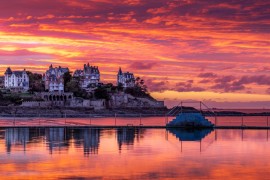
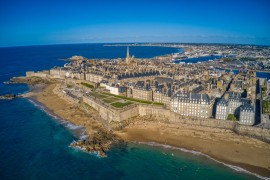
What is Saint-Malo famous for? Known as the "Privateer City" (Cité Corsaire), Saint-Malo is famous for its massive granit walls, its independent spirit, and the explorer Jacques Cartier who discovered Canada. Once a 4-year independent republic, it was rebuilt stone-by-stone after 1944.
Planning a trip to Saint-Malo? Discover the best-located hotels in Saint-Malo, compare available accommodation options in Saint-Malo, and find your ideal rental with vacation rentals in Saint-Malo.
This article may contain affiliate links. This doesn’t change the price for you, but helps support the Monsieur de France website.
1. Why does Saint-Malo have such a distinctive appearance?
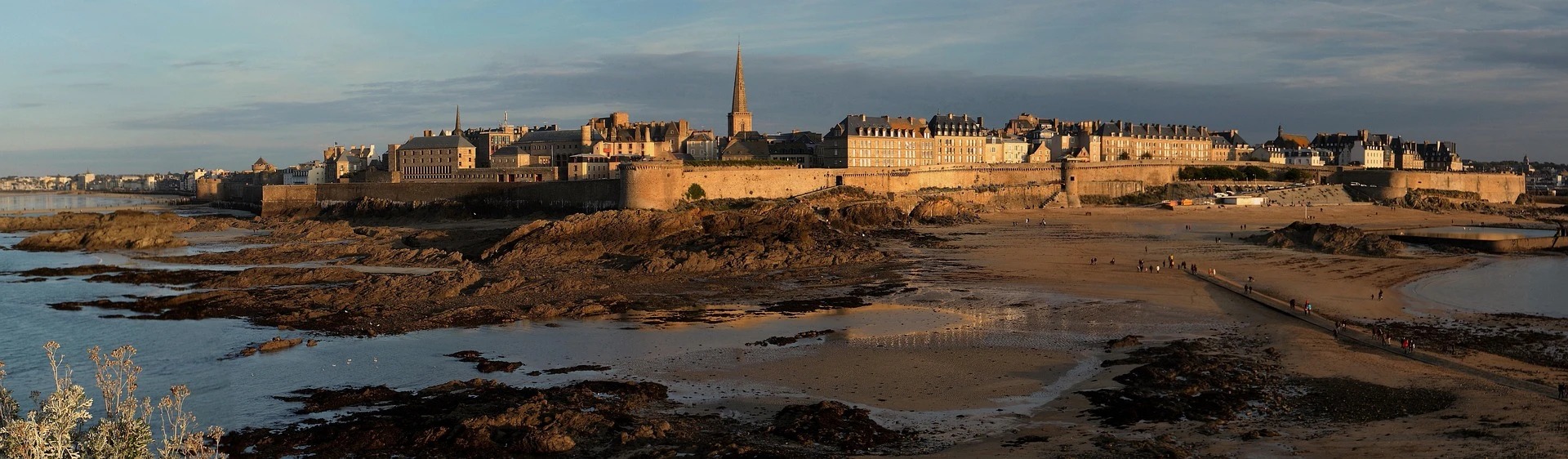
Saint Malo / Image selected by Monsieur de France: by Jean-Michel SACHOT from Pixabay
The "original" town of Saint Malo is the city of Alet. It had its back to the sea, located at the mouth of the Rance River and was an important commercial site for the Gauls of the Coriosolites tribe. Further out to sea, there were several islets and rocks, including the rock on which the city of Saint Malo would be built. It was at the end of the 9th century that the inhabitants began to abandon Alet, and we can understand why! The city was regularly raided by the Vikings and pillaged. As a result, the inhabitants began to settle on the large rock located further away. It must be said that it offered many advantages. Surrounded by "rocks," including underwater ones, which prevented boats from getting too close if they did not know the channels, connected to the land by a narrow strip of sand (the furrow) covered by the sea at high tide twice a day, the rock offered great protection by being fairly isolated and difficult to attack from both sea and land. From the 11th century onwards, this vast rock connected to the mainland took over from Alet, which was too exposed to attack. It was on this original rock that the "INTRA MUROS" (within the walls in Latin) was built, a town surrounded by ramparts, and it was here that the great and exciting adventure of "the pirate city" began.
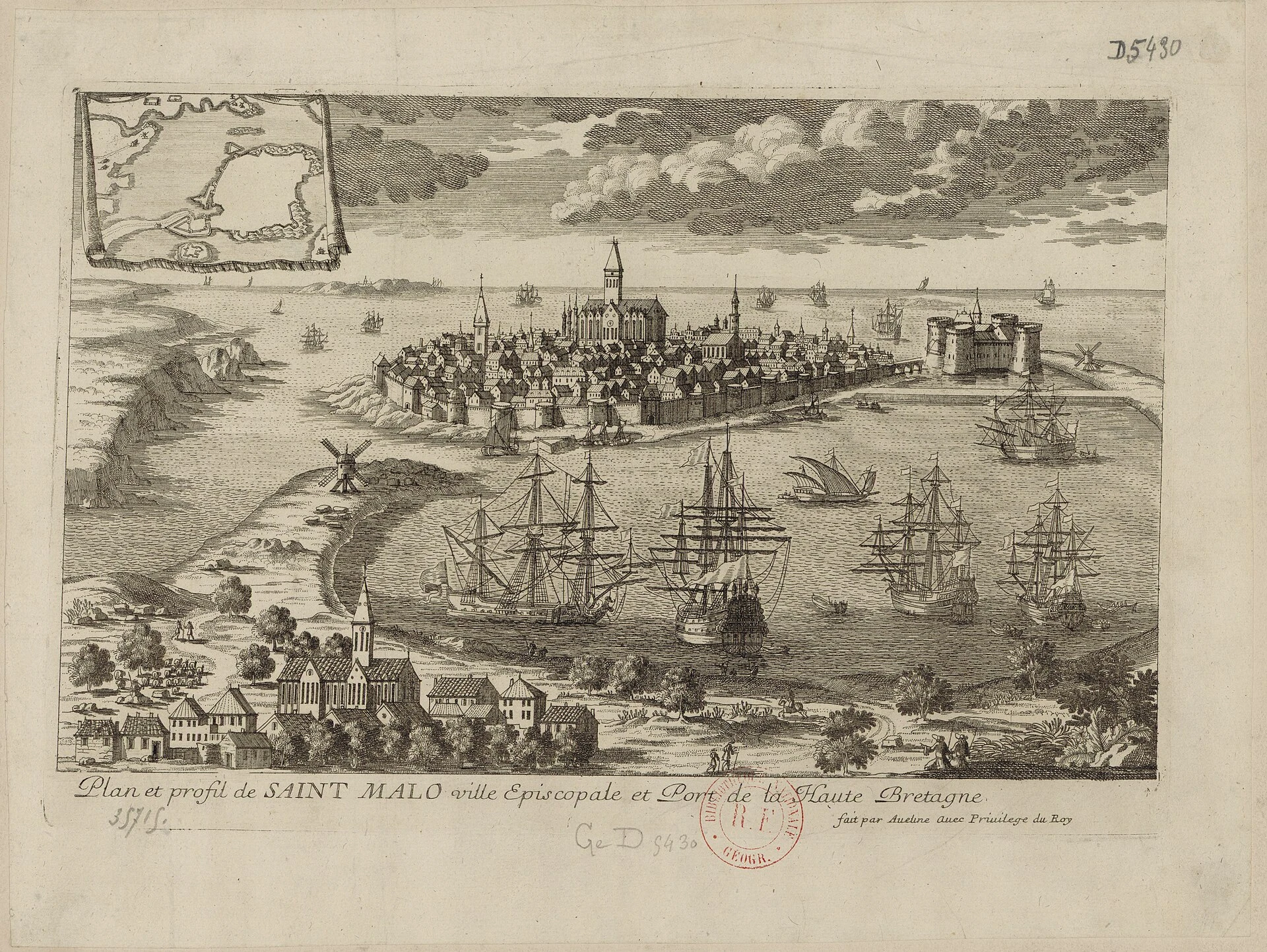
This drawing clearly shows how Saint Malo is an island / Photo chosen by Monsieur de France: By Aveline — http://gallica.bnf.fr/ark:/12148/btv1b8444395x/f1.item.r=Carte%20Saint%20Malo.zoom, Public domain, https://commons.wikimedia.org/w/index.php?curid=69005515
2. What are the inhabitants of Saint-Malo called?
Don't talk to us about "saintmaliens" or "saintmalois" as you sometimes hear... In Saint Malo, the inhabitants are called the Malouines and the Malouins. And you'll see that they're proud of it (and with good reason!).
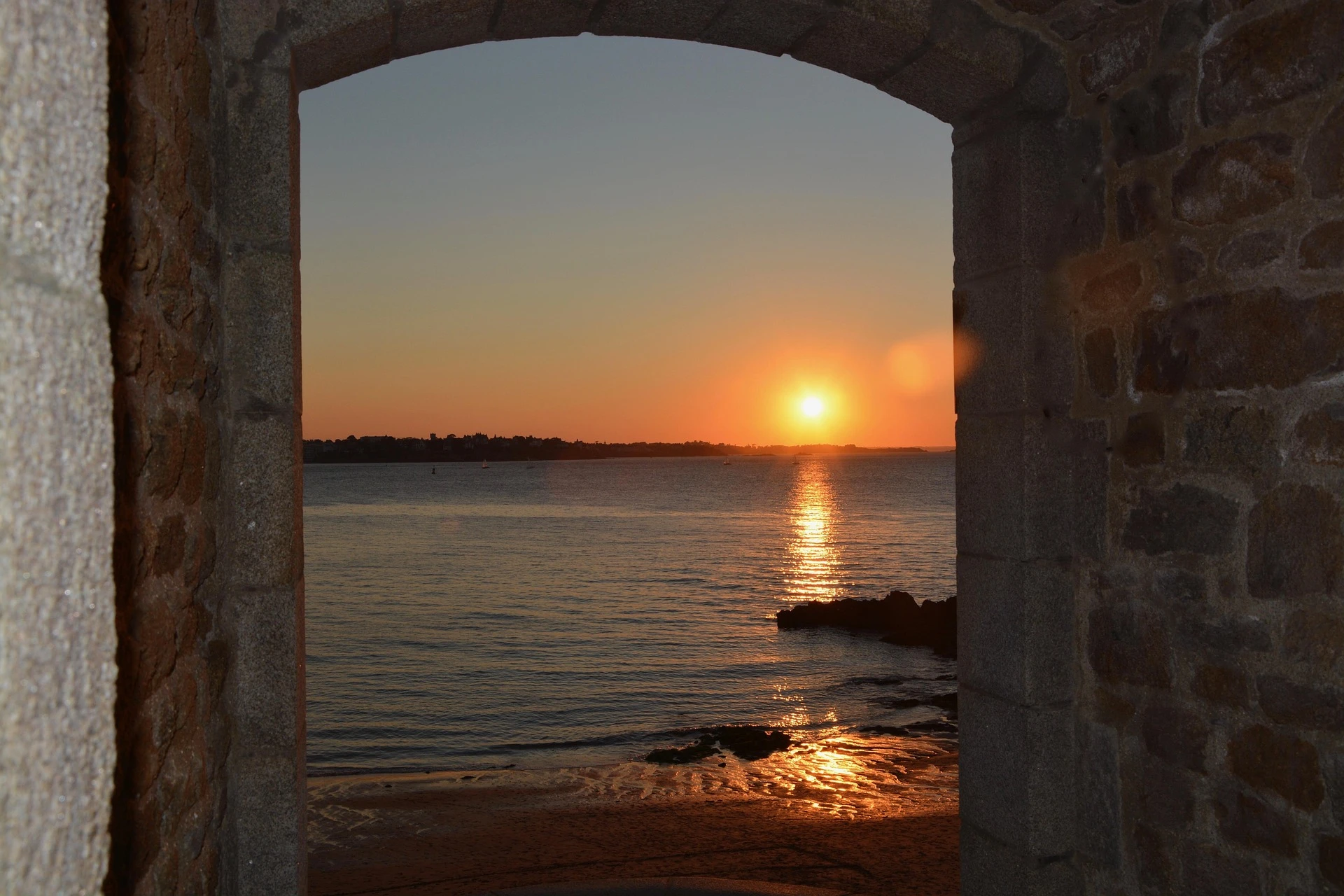
Sunset from the ramparts of Saint Malo / Photo chosen by Monsieur de France: JackieLou DL from Pixabay
Where does the name Saint Malo come from?
Because Saint Malo lived there. On the rock. The place was long known as Saint Aaron's Island because the saint had settled there as a hermit, but it was Saint Malo, a Welsh traveler, who gave his name to the rock and thus to the city. It must be said that he was quite an amazing fellow, if we are to believe the old grimoires... There are absolutely no historical sources on this character, but there are many legends. Originally from Wales, he is said to have been the subject of miracles related to the sea from an early age. Legend has it that as a child, he fell asleep on a rock that was regularly engulfed by the tide, and that the rock rose up so that the child would not drown in his sleep at high tide. As an adult and priest, he is said to have sailed the seas for seven years with his friend Saint Brendan, with the aim of discovering the "Fortunate Isles" near the Garden of Eden and converting the barbarians. Still according to legend, after landing on several shores, even being carried by a whale, on which he celebrated Mass, Saint Malo arrived in Brittany and settled as a hermit, with Saint Aaron, who was already living there, on the large deserted rock near the city of Alet (where Saint-Malo Intramuros is located today).
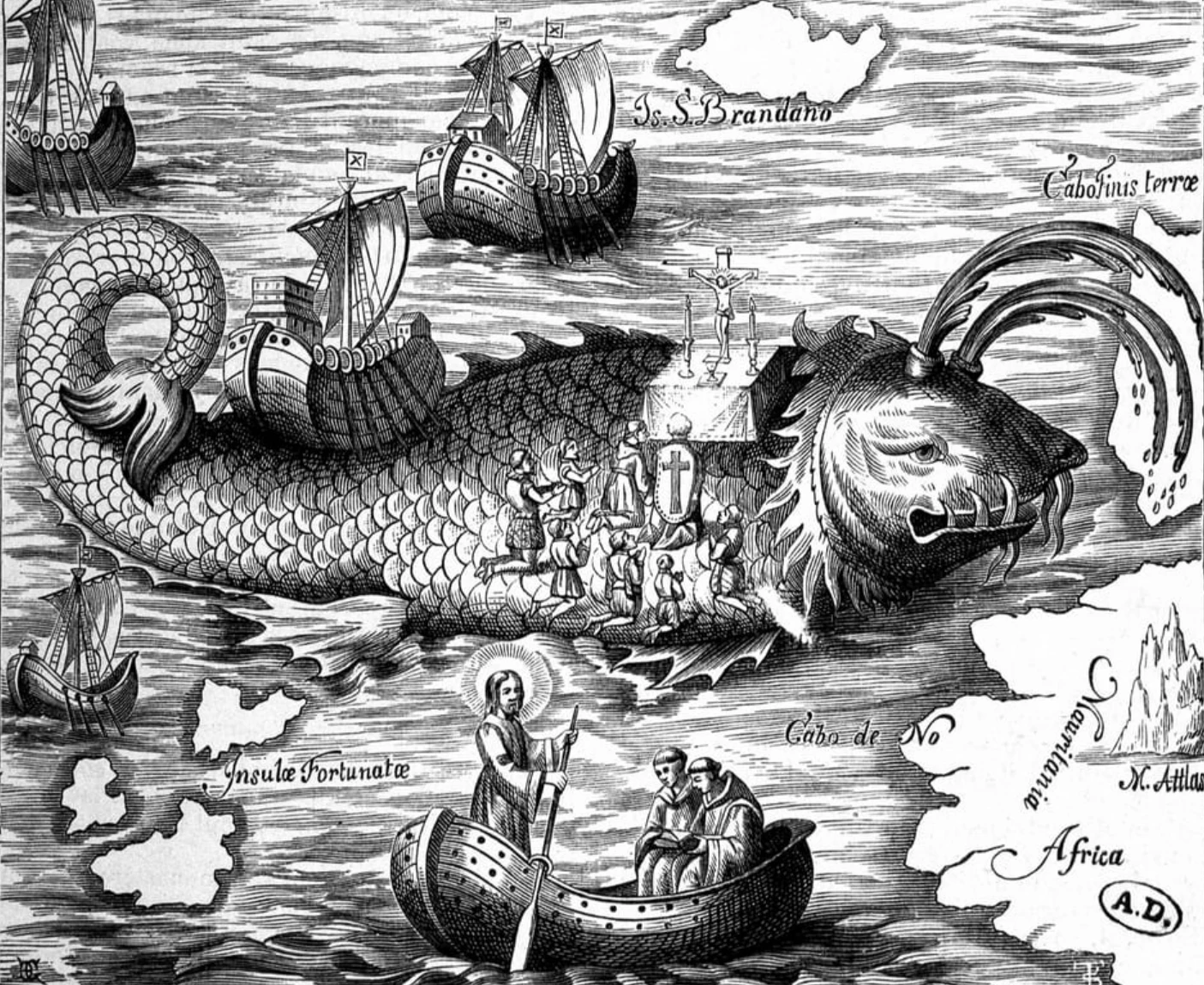
Saint Malo celebrates Mass with his friend Saint Brandan on the back of a whale that he thought was an island. Old engraving. B.N.F. gallica.fr website.
The story could end there, but Saint Malo felt that he could not "rest" and that he had to convert. He turned his attention to the city of Alet, which he considered to be still very pagan. He said Mass there and performed three miracles (he restored sight to a blind man, drove out the demon that possessed a woman, and raised a dead man to life). Impressed (and rightly so!), the last pagans of Alet converted and Saint Malo became bishop of the city of Alet. He was thus the origin of the bishopric of Saint Malo, one of the seven dioceses of Brittany. Saint Malo's Day is November 15.
Port Malo during the French Revolution
During the French Revolution, Saint Malo was a staunchly republican island in the midst of a rather royalist Brittany, in other words, opposed to the Revolution. Like many towns, in 1794, Saint Malo changed its name at a time when attempts were being made to erase all traces of the monarchy and the Catholic religion. Thus, Saint Malo became "Port Malo" and Saint Servan became "Port Solidor." Mont-Saint-Michel itself changed its name to "Mont Libre" (at the same time as it became a prison, which was not without contradiction). In the city, many streets and monuments changed their names. For example, the Saint Vincent gate becomes "porte des sans-culottes", and the Dinan gate becomes "la porte de l'égalité". Streets changed names, such as Rue Sainte Barbe, which became "rue de la fidélité", and Rue Saint Philippe, which became "rue de la probité". Even the bastions changed names. The Saint Louis bastion became the "bastion of vigilance" and the Saint Philippe bastion became the "bastion of valor."
3. What is the meaning of the coat of arms and flag of Malouins?
The coat of arms of Saint Malo
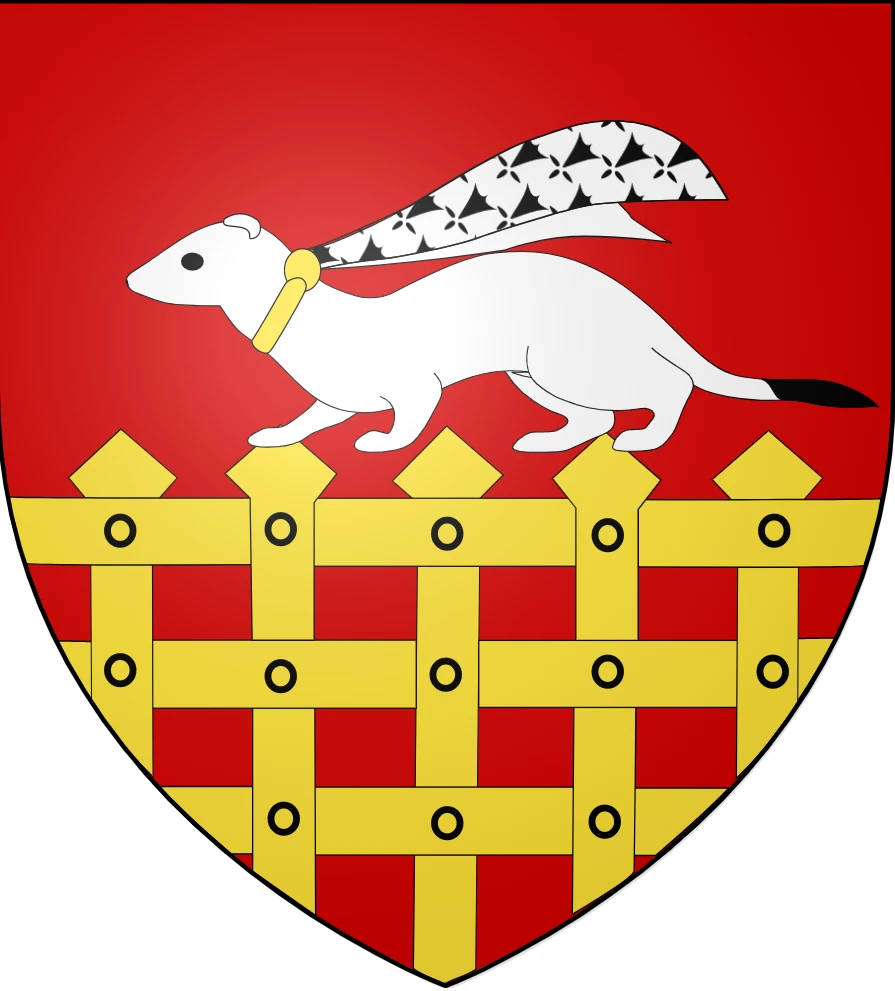
The coat of arms of Saint Malo Source: Commons wiki
It appears in particular on the Saint Vincent gate, at the entrance to the walls. It consists of an ermine walking on a portcullis, all on a red background. In heraldic language, it is described as follows:"Gules (red) with a golden portcullis rising from the base, surmounted by a silver ermine, the tip of its tail sable, accolade of gold and scarfed with ermine." In the full coat of arms of the city of Saint Malo, the shield is stamped (surmounted) with a gold mural crown, composed of the two large towers of the Grand'Porte, and it is "accoladed," in other words, surrounded by two gold dogs, recalling the history of the mastiffs that were let loose at night to bite anyone who approached the ramparts of Saint Malo. Note that beneath the coat of arms are also the Cross of the Legion of Honor on the right and the 1939-1945 War Cross on the left, recalling the city's sacrifice for the Liberation.
The flag of Saint Malo
It consists of a white cross on an azure blue background, but in the upper left corner, it features the coat of arms in the upper left: an ermine running on a golden portcullis. This flag flies at the top of the keep in Saint-Malo and also on ships leaving Saint-Malo, which are always very proud of this flag. It is a flag that reminds us that Saint-Malo was independent for four years. The city of Saint Malo refused to submit to King Henry IV of France because he was Protestant, and it formed a republic from 1590 to 1594 after the people of Saint Malo took the castle.
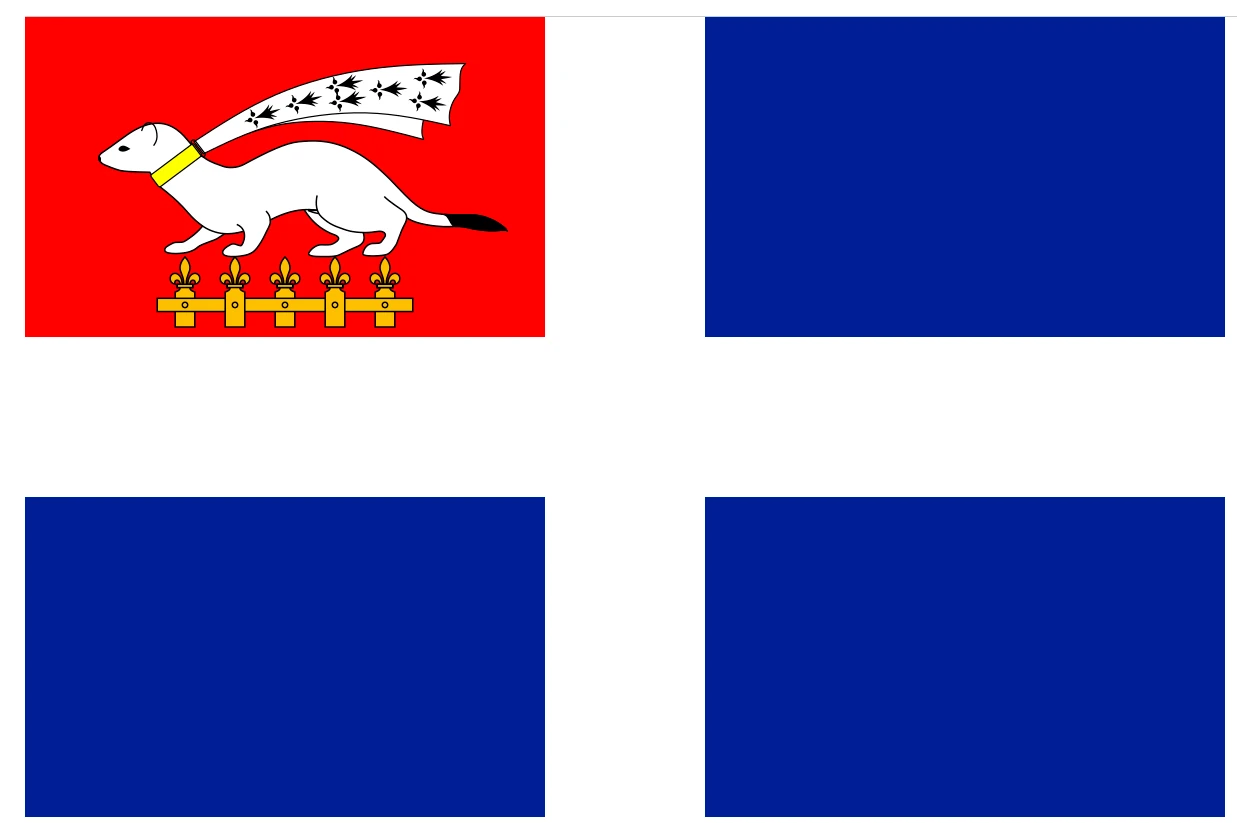
Ec.Domnowall—Breton flags, from their origins to the present day, by Philippe Rault
It is one of the few flags that flies higher than the French flag on the town hall (the castle). At the end of the war, the mayor at the time decided that it would remain there, despite requests from General de Gaulle. It is said that the general even went to sleep in Dinard rather than Saint Malo when he saw that the French flag had not replaced the Saint Malo flag at the top of the town hall in Saint Malo.
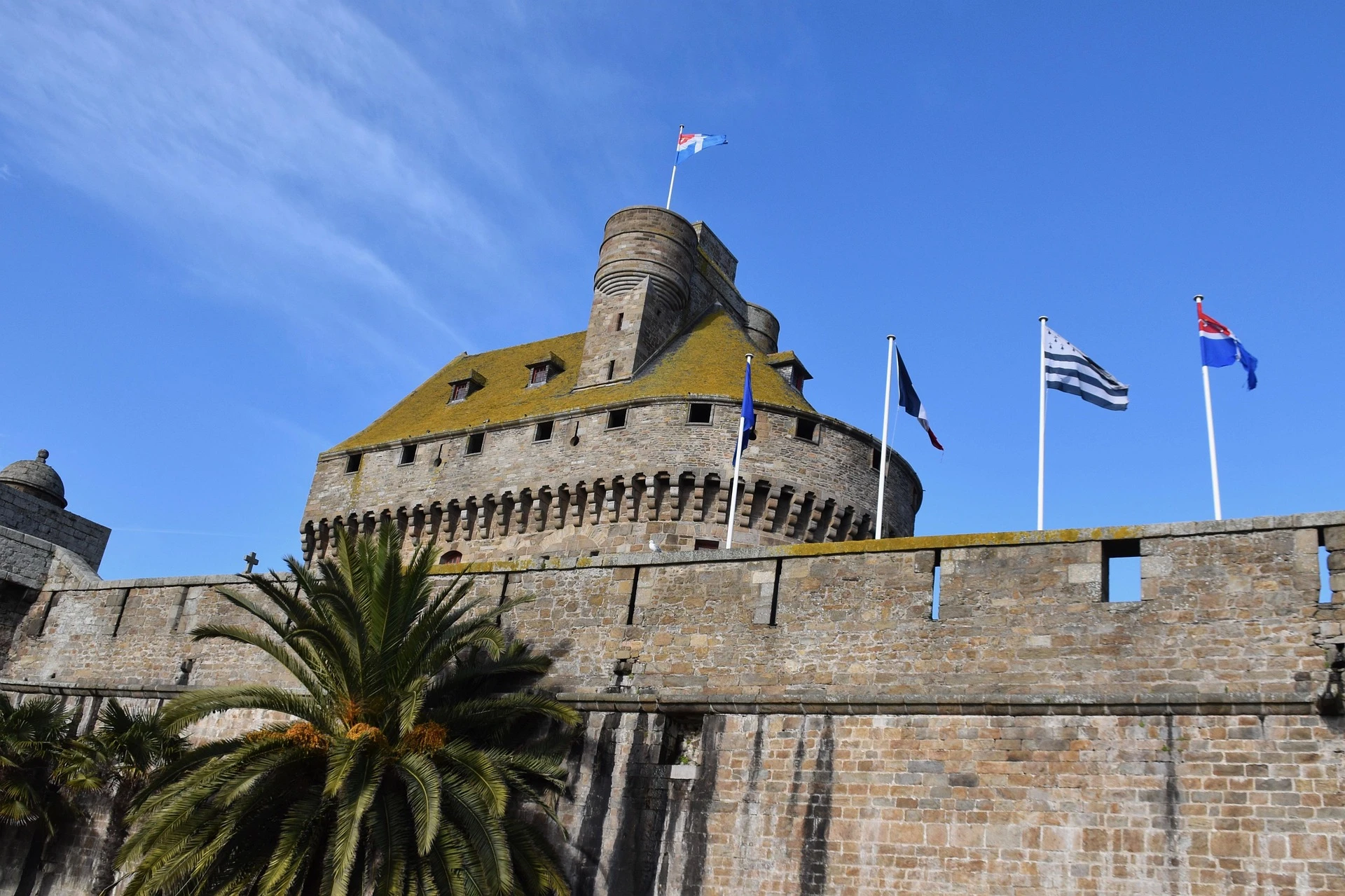
The flag of Saint-Malo is always the highest flag flying at the town hall of Saint-Malo / Photo chosen by Monsieur de France: by JackieLou DL from Pixabay
Discover Saint-Malo with a guide
To better understand the history of this pirate city, taking a guided tour can be an excellent idea. For about two hours, a local guide will accompany you through the narrow streets of the fortified city, along the ramparts, and up to Saint-Vincent Cathedral, all while recounting the maritime history and the great figures of Saint-Malo.
👉 Book the guided tour of the fortified city of Saint-Malo ↗
This article may contain affiliate links. This does not change the price for you but helps support the Monsieur de France website.
4. Why do we say "Neither French nor Breton: I am from Saint-Malo"?
The official motto of Saint Malo
"Semper fidelis," which means "always faithful" in Latin. It became the motto of Saint Malo after the Republic of Saint Malo and the city's return to the Kingdom of France in 1594. It was a way of telling King Henry IV that he could once again count on the loyalty of the people of Saint Malo.
The motto of the inhabitants of Saint Malo
"Neither French nor Breton: I am from Saint-Malo." It is said to date back to the Republic of Saint-Malo (1590-1594). What is certain is that it truly reflects the character of the people here: independent, enterprising, stubborn, they are Bretons, it's true, French too, but when you get to know the people of Saint-Malo and this amazing city, you realize that there is a soul here, a special character, which will always make the people of Saint-Malo different from other Bretons or French people. Malouins, in other words!
5. What is the story behind the watchdogs and La Noguette?
Remember that for a very long time, the city was isolated from the mainland by a kind of isthmus that was covered by the tide several times a day. In addition to the walls and reefs that prevented ships from approaching the city if they did not know the passages, the people of Saint-Malo had the idea of guarding the boats and the city walls with dogs. These were ferocious dogs, which only their keeper could approach, and which were released at night on the other side of the ramparts. Thus, roaming around the city, they attacked anyone who approached Saint Malo. The Noguette bell rang in the evening to warn the people of Saint-Malo that the city gates were about to be closed and the dogs released. This bell still exists and still rings every evening. It was used to remind people of the curfew within the city walls during the Covid lockdown. There were 24 of these famous dogs, but they were abolished in 1772 after attacking an important figure (who is said to have not heard the curfew, as he was busy with his mistress in Saint Servan).
6. Who is Jacques Cartier, the man from Saint-Malo who discovered Canada?
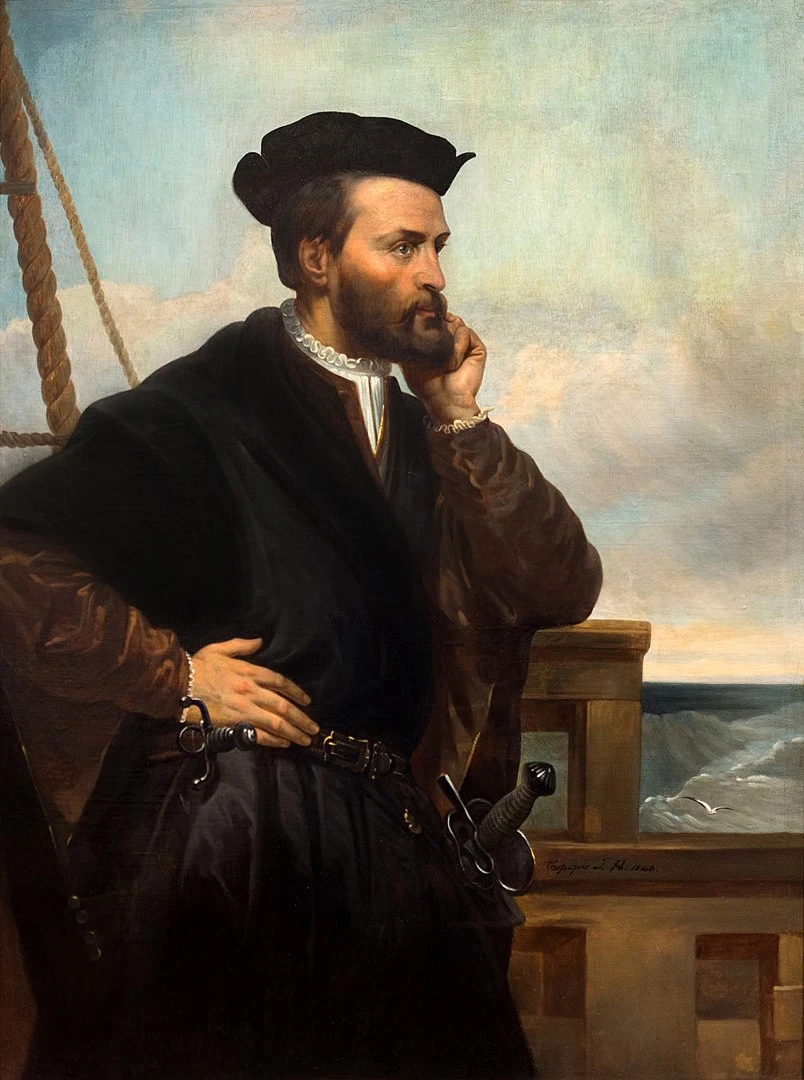
Jacques Cartier as imagined by Théophile Hamel (1844). , CC BY-SA 4.0, https://commons.wikimedia.org/w/index.php?curid=75675451
Jacques Cartier was born in 1491 in Saint Malo. Little is known about his past, but it is believed that he traveled to Brazil (he spoke Portuguese) and probably also to Newfoundland, where Bretons were already fishing for cod. In any case, it was as a navigator that he was introduced to King Francis I of France during a trip to Mont-Saint-Michel (by Jean Le Veneur, owner of the Château de Carrouges, which we visited and are presenting here). The king was persuaded to finance an expedition by Jacques Cartier to the West to discover new lands. It must be said that France did not look kindly on the Spanish and Portuguese sharing the New World. Jacques Cartier made three expeditions in total: in 1534, 1535, and 1541. He sailed up the St. Lawrence River and discovered Canada. Jacques Cartier had no descendants. He ended his life in Rothéneuf, at the Limoëlou manor house, where you can visit the Jacques Cartier museum dedicated to this great man, where visitors can see his bedroom and dining room. He lies beneath a slab in Saint Malo Cathedral, where his remains were found in 1949.
7. What is the difference between a pirate and a privateer?

Who are the privateers?
The privateers left their mark on Saint Malo, known as the "privateer city." It must be said that they brought glory to the city by hunting down ships from nations with which France was at war. They boarded and plundered merchant ships in particular, in the name of the king, who gave them a letter of marque authorizing them to do so in exchange for a percentage of their earnings paid to the state. This percentage was sometimes small, as many privateers arranged to deposit part of their booty on offshore islands and return to collect it after the king's agents had carried out their checks. These privateers were very famous and respected, even by Louis XIV himself, who nicknamed them "the gentlemen of Saint Malo." Don't confuse them with pirates, as they are not the same thing, and you would antagonize the people of Saint Malo.
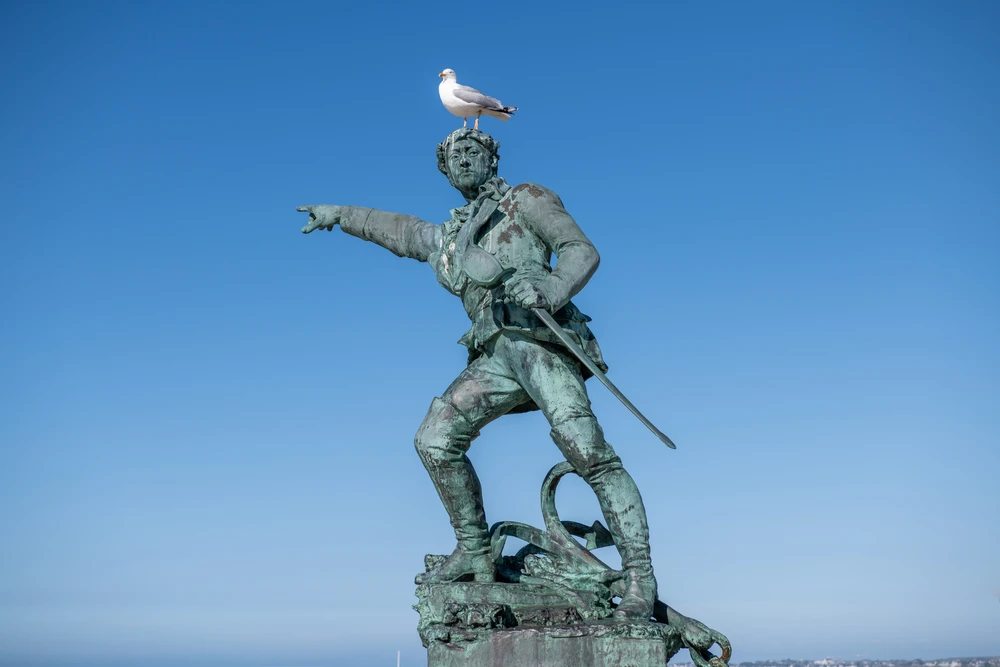
Surcouf, the most famous privateer from Saint-Malo (with a seagull!) photo chosen by monsieurdefrance.Com: pixavril via depositphotos
To learn more about the most famous privateers in French history, I recommend this article.
What are malouinières?
The wealthy shipowners of the 17th and 18th centuries liked to have, in addition to their homes in Saint-Malo, a "country house," that is, a castle or manor house in the countryside, where they would go on sunny days and entertain guests. These are classic-style castles, sometimes a little austere, with interiors that are often surprising, offering visitors a glimpse of objects and decorations that remind us that the shipowners of Saint-Malo dealt with the world of their time. There are 112 of them around Saint Malo. Noteworthy sites include the ring-shaped town of Saint Coulomb (where receptions can be held), the chipaudière (you can rent a farmhouse near the castle) and the Montmarin in La Richardais, on the other side of the Rance river towards Dinard. A magnificent castle with gardens that are a must-see.
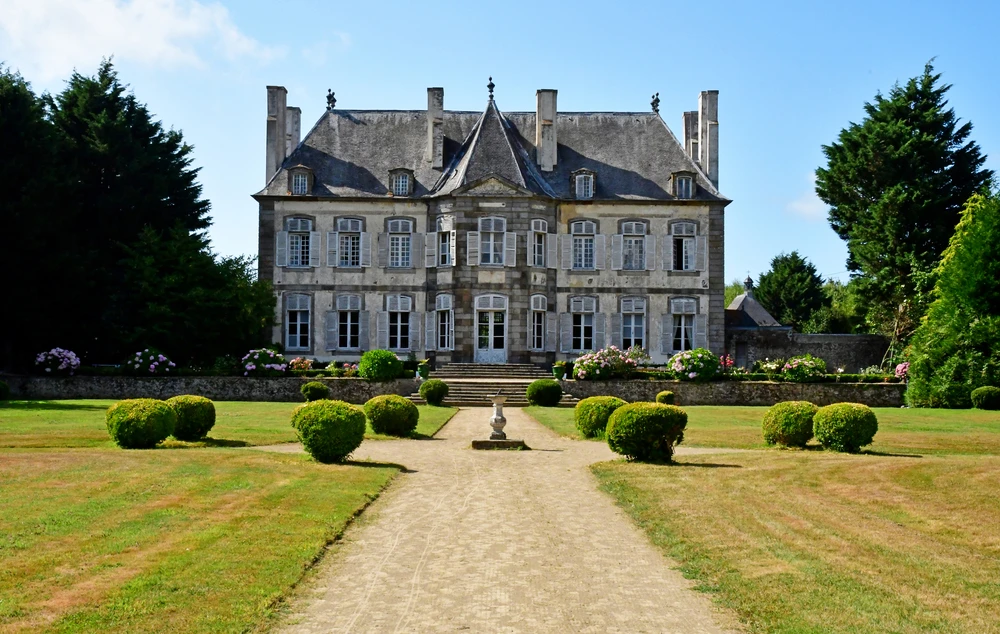
La Malouinière de la Chipaudière. Image selected by monsieurdefrance.com: by packshot via depositphotos.
You can also check out the 17-stop audio guide to Saint-Malo, with 3 free episodes to listen to straight on your phone.
8. Who were the "terre-neuvas" of Saint-Malo?
For a very long time, Saint Malo was one of France's largest cod fishing ports. Sailors recruited in the city and surrounding areas would embark on fishing trips lasting six months. It was an extremely dangerous job that took them as far as Labrador off the coast of Newfoundland to fish for cod. The weather conditions, the risky work in small boats in the middle of the raging ocean, the poor hygiene, and the stormy journey claimed the lives of many sailors. And the walls surely remember the women and families who learned of the death of a loved one when he did not return from the boat to the port.

Terre-Neuvas departing from the port of Saint Malo. Illustration chosen by monsieurdefrance: JPitois/Creative Commons.
9. Why is the region called the "Emerald Coast"?
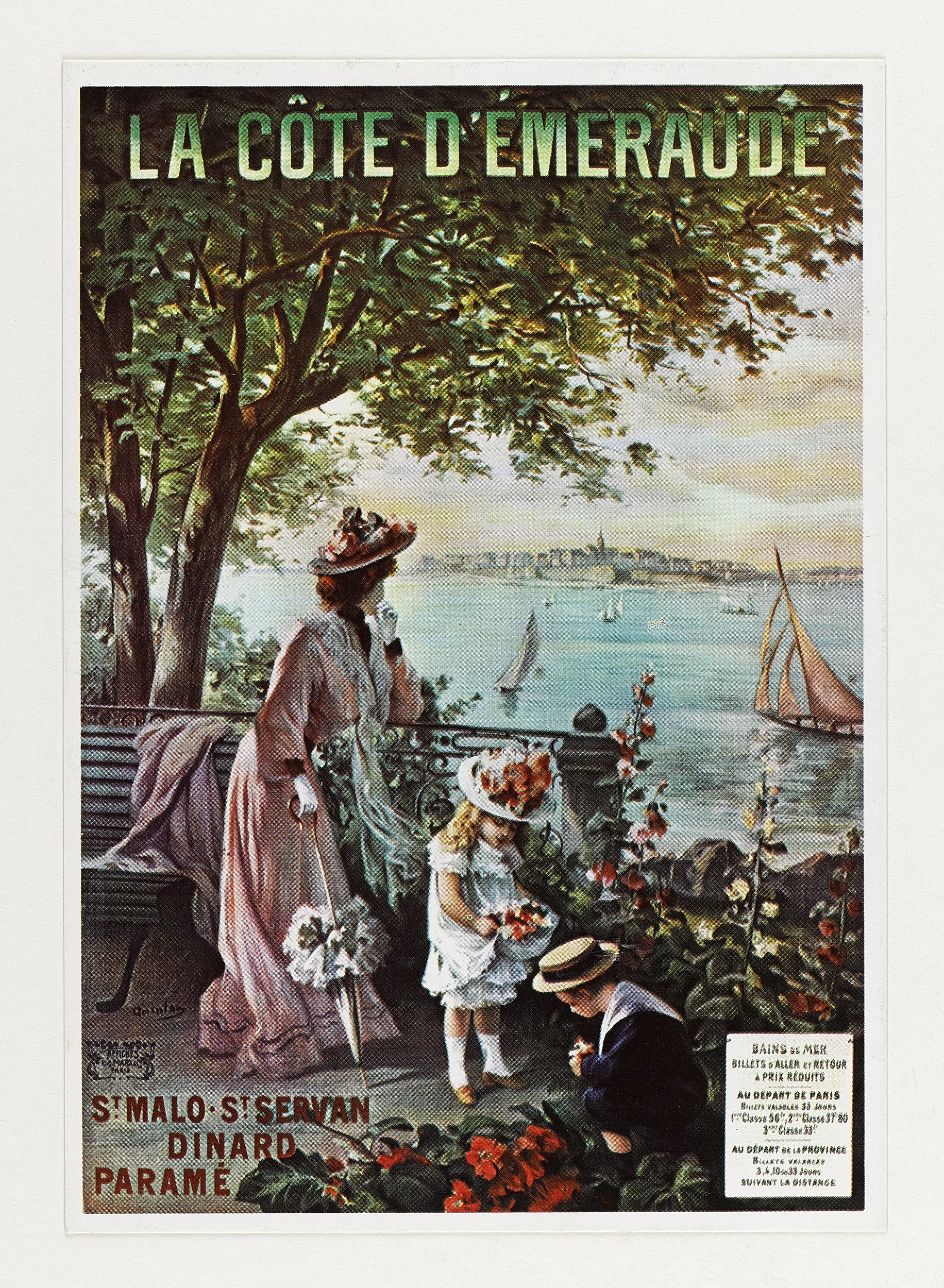
Tourist poster promoting the Emerald Coast / Source: Monsieur de France: Wikicommons via Quinlan — Inventory number: 982.0041.1.17 This item is featured on the documentary portal of the Museum of Brittany and the Bintinais Ecomuseum. It can be found under the identifier FLMjo161321.
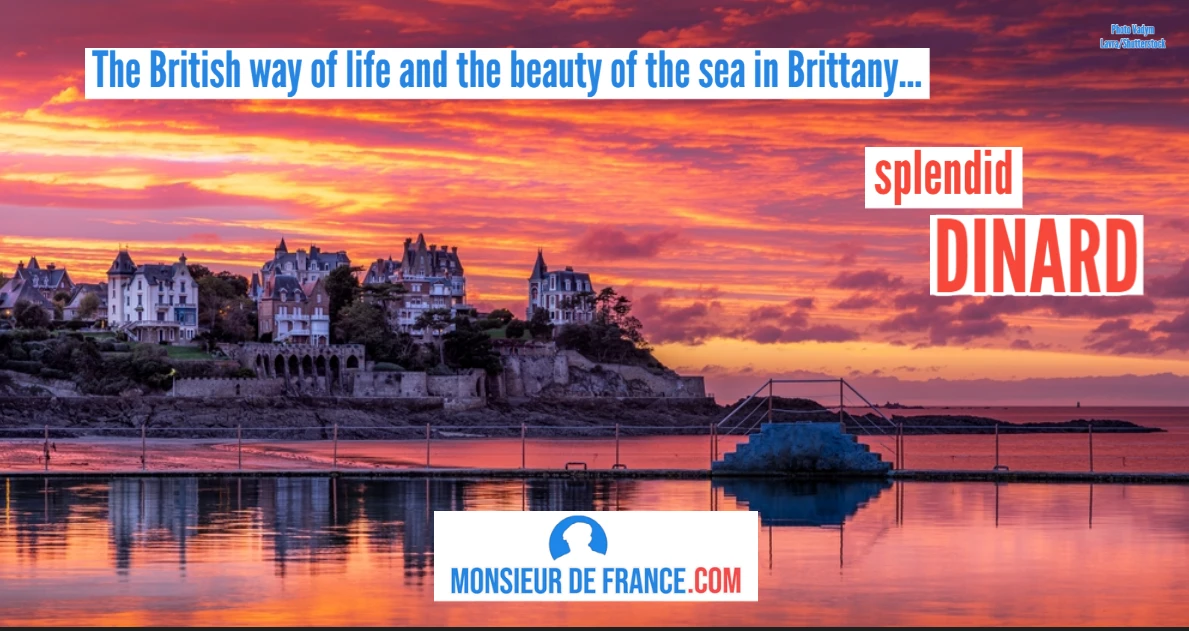
At the end of the 19th century, sea bathing became fashionable. This desire to bathe for health reasons, which originated across the Channel, spread to France, particularly Saint Malo. The first tourists, who tended to be wealthy, began arriving during the summer months. They built beautiful villas for their stays in Saint-Malo (some magnificent examples can still be seen in Courtoisville and Le Sillon). Saint-Malo became a seaside resort. The arrival of the train in 1864 further boosted the town's success. Chic, it also became popular with the introduction of paid holidays in 1936. Its success has never wavered since. Opposite, Dinard was born out of this craze for this beautiful part of Brittany, which stretches from Saint Cast to Cancale and has been christened the "Emerald Coast." If you want to impress, you can always say that "Côte d'Emeraude," like "Côte d'Azur," is a choronym, or, according to Wikipedia, "a name given to a place or region based on a physical geographical feature or environmental characteristic", in this case the emerald color of the water (due to the abundance of algae).
10. How was Saint-Malo rebuilt after 1944?
In 1944, Saint-Malo was one of the fortresses of the Atlantic Wall built by the Nazis to prevent any landing in occupied Europe. The city of Alet was at the heart of a system designed to prevent Saint-Malo from being taken. Bunkers and blockhouses were installed on Grand Bé, on the island of Cezembre, and also opposite Dinard. In August 1944, General Patton's Third US Army, which had landed in Normandy, headed for Brest and laid siege to Saint-Malo. The city received its first shells. Some fell on the national fort, where hostages had been locked up, killing 18 prisoners from Saint-Malo (a plaque in the fort pays tribute to them). On August 9, the bombing intensified, lasting two days and destroying much of the old town, particularly the wooden buildings. A week later, on August 14, 1944 , 150 American bombers bombed Saint Malo and artillery fire destroyed more than 80% of the city, mainly within the city walls, including the castle, but also Grand Bé and Cézembre. Saint Malo was liberated on August 17, 1944. It was in ruins.
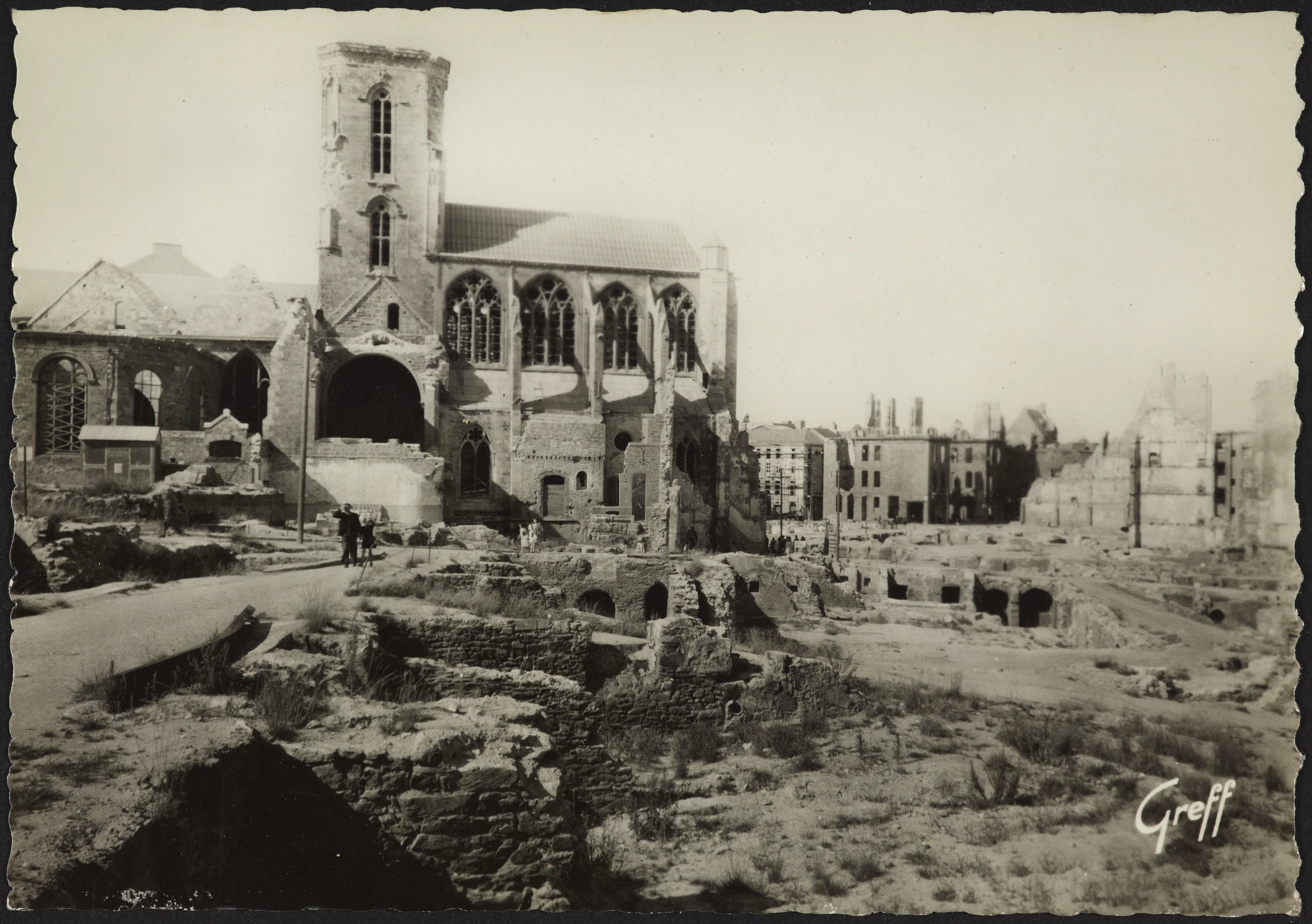
The cathedral of Saint Malo destroyed by bombing. Photo selected by monsieurdefrance.Com Editions du Greff Paris via Musée de Bretagne.
In 1945, 683 of the 865 buildings in the municipality of Saint Malo were destroyed or damaged and more than 2,000 homes were missing and therefore needed to be rebuilt. The city was therefore rebuilt under the leadership of Mayor (and Minister) Guy La Chambre after the people of Saint-Malo insisted that it should be rebuilt in its original style. The first stone of the reconstruction project was laid at 9 rue d'Estrées on January 26, 1947 after 18 months of work by 300 men to clear more than 500,000 cubic meters of rubble. The reconstruction aimed to restore the general appearance of Saint-Malo, and some buildings were rebuilt identically, at least in terms of their facades, thanks to the numbering of the stones. The historic city was modernized (particularly in terms of its networks), and its streets were widened, but it retained its tall houses with high roofs. The cathedral was restored. Although 98% of the city had been rebuilt by 1957, it was not until 1972 that the cathedral construction project brought the reconstruction to an end, after 25 years.
And Saint Malo absorbs its neighbors.
Today's Saint Malo, with a population of nearly 50,000, is not exactly the same as it was yesterday. Over time, other municipalities have joined Saint Malo and expanded it. Paramé and Saint Servan merged with Saint Malo in 1967, doubling the town's population. With Paramé, the hamlet of Rothéneuf and its coastline also became part of Saint Malo, as did the village of Saint Ideuc, which had already been attached to Paramé in 1792. Each of these former municipalities has kept its church and town hall, and these districts of Saint Malo continue to be referred to by the name of their former municipality.
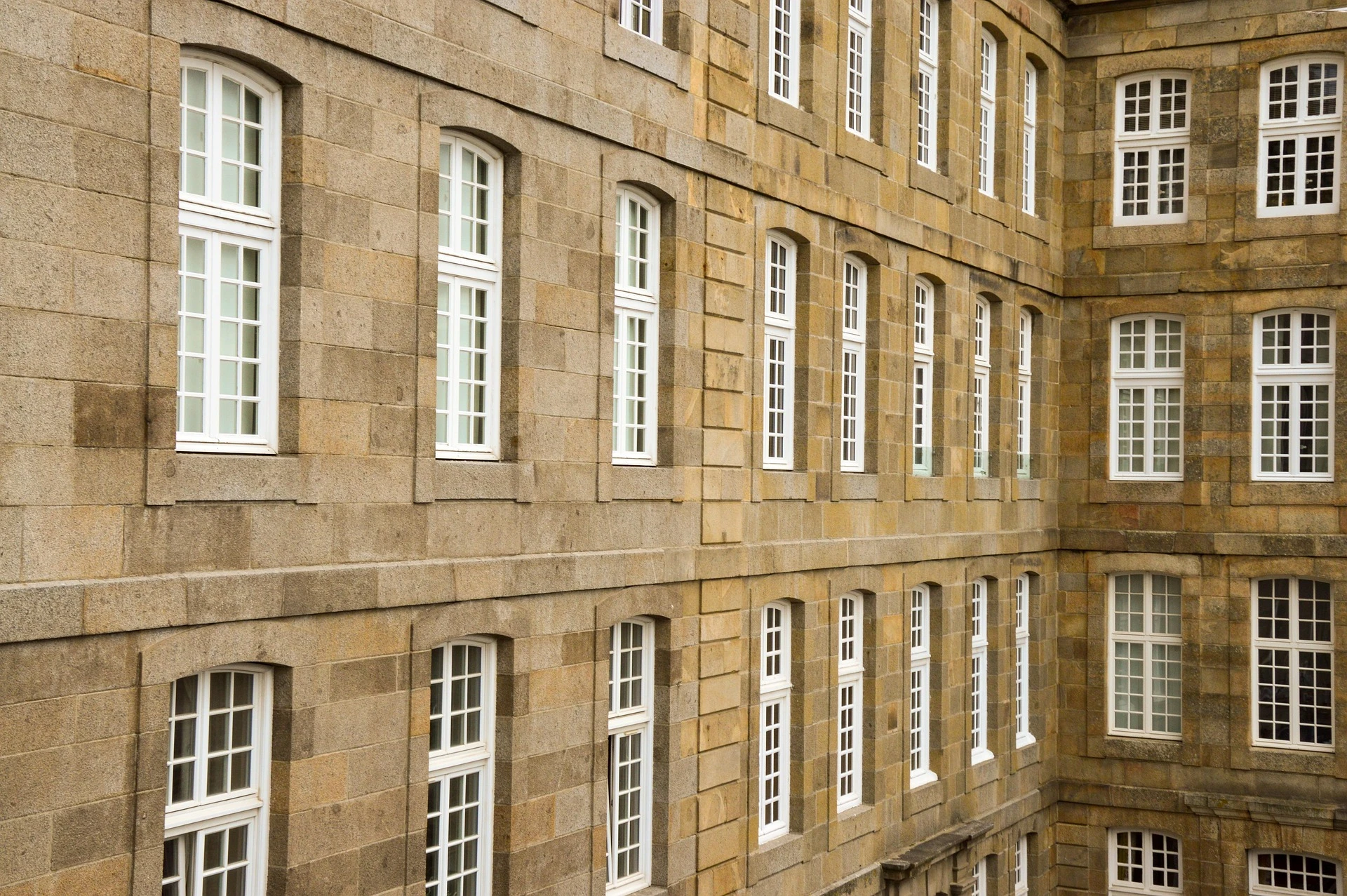
The old walls of Saint Malo have witnessed a lot of history... And tourists! / Photo chosen by Monsieur de France: by Gaspard Delaruelle from Pixabay
Where should you stay in Saint-Malo to make the most of this historic port city?
If you’re visiting Saint-Malo to explore its famous walled town of Intra-Muros, its sea-facing ramparts and its wide sandy beaches, staying in the historic centre or near the seafront is often the most convenient option. This will allow you to easily explore the narrow streets of the pirate town, walk along the ramparts offering magnificent views of the sea and the neighbouring forts, and enjoy beaches such as the vast Sillon beach, which stretches for several kilometres along the town.
To plan your trip and compare accommodation options based on your dates and budget, you can visit:
• Accommodation available in Saint-Malo ↗
• hotels in the centre of Saint-Malo ↗
• holiday rentals ideally situated for visiting Saint-Malo ↗
and you can find even more information on my page "Where to stay in Saint-Malo"
This article may contain affiliate links. This does not change the price for you but allows the Monsieur de France website to continue offering its content for free.
FAQ Saint-Malo
What are the inhabitants of Saint-Malo called?
The inhabitants of Saint-Malo are known as Malouines and Malouins. They often assert their identity with the motto "Neither French nor Breton, I am Malouin."
What is the history of the dogs of Saint-Malo?
Until 1772, the city released 24 ferocious dogs (the watchdogs) at the foot of the ramparts at night to ensure security after the gates were closed.
Who discovered Canada in Saint-Malo?
It was the navigator Jacques Cartier from Saint-Malo who discovered Canada and explored the Saint Lawrence River during his voyages between 1534 and 1541.
What is the best time to visit Saint-Malo?
The best time is between May and September, particularly during high tides (Grandes Marées), when the sea surrounds the city walls in a spectacular display of nature's power.
Can you walk around the Saint-Malo walls?
Yes, the walk along the ramparts is free and takes about 45 to 60 minutes. It offers the best views of the Emerald Coast and the historic city streets.
Is Saint-Malo near Mont-Saint-Michel?
Yes, Saint-Malo is only a 45-minute drive from Mont-Saint-Michel, making it the perfect base for exploring Northern Brittany and Normandy.
Learn more about Saint-Malo
- Visiting Saint-Malo: The Complete Guide to the Pirate City
- Explore Saint-Malo with an immersive audio guide that reveals all its secrets
- The Ramparts of Saint-Malo: The City’s Most Beautiful Walk
- What to See in Saint-Malo in a Weekend? The Must-Sees
- Dinan: The Stunning Medieval Town Near Saint-Malo
- Dinard: The Elegant Gem of the Emerald Coast
- Discover Brittany and the Emerald Coast
- If you love Brittany, here’s what I loved
- You can also check out the 17-stop audio guide to Saint-Malo, with 3 free episodes to listen to straight on your phone.
Jérôme Prod'homme Specialist in French heritage, gastronomy, and tourism. Find all my discoveries at monsieur-de-france.com.