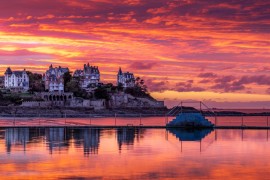
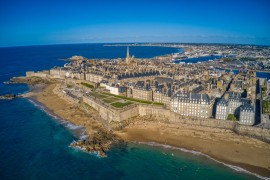
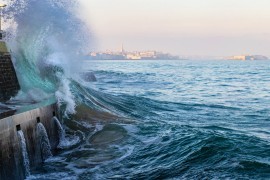
What to see in Saint-Malo Intra-Muros? The must-see tour of the walled city begins with the tour of the ramparts (1 hour walk), entering through the Porte Saint-Vincent and exploring the Cathédrale Saint-Vincent. Don't miss the shipowners' houses on Rue Chateaubriand and the breathtaking view of Fort National and Grand Bé at low tide.
Are you planning a trip to Saint-Malo? Discover the best-located hotels in Saint-Malo, compare the accommodation options available in Saint-Malo, and find your ideal holiday rental in Saint-Malo.
This article may contain affiliate links. This does not affect the price you pay, but helps to support the Monsieur de France website.
1) What is "Intra-Muros" in Saint-Malo?
"Intra-Muros" is Latin and means "within the walls". In other words, it is the historic heart of Saint Malo, surrounded by nearly 2 km of ramparts, surrounded by the sea and connected to the mainland by the Sillon. It is this original city that we are going to discover together. You will notice that many older residents of Saint-Malo still say "within the walls," while others simply say "Intra." As a result, the Sillon, the forts, and the islands are located "outside the walls."
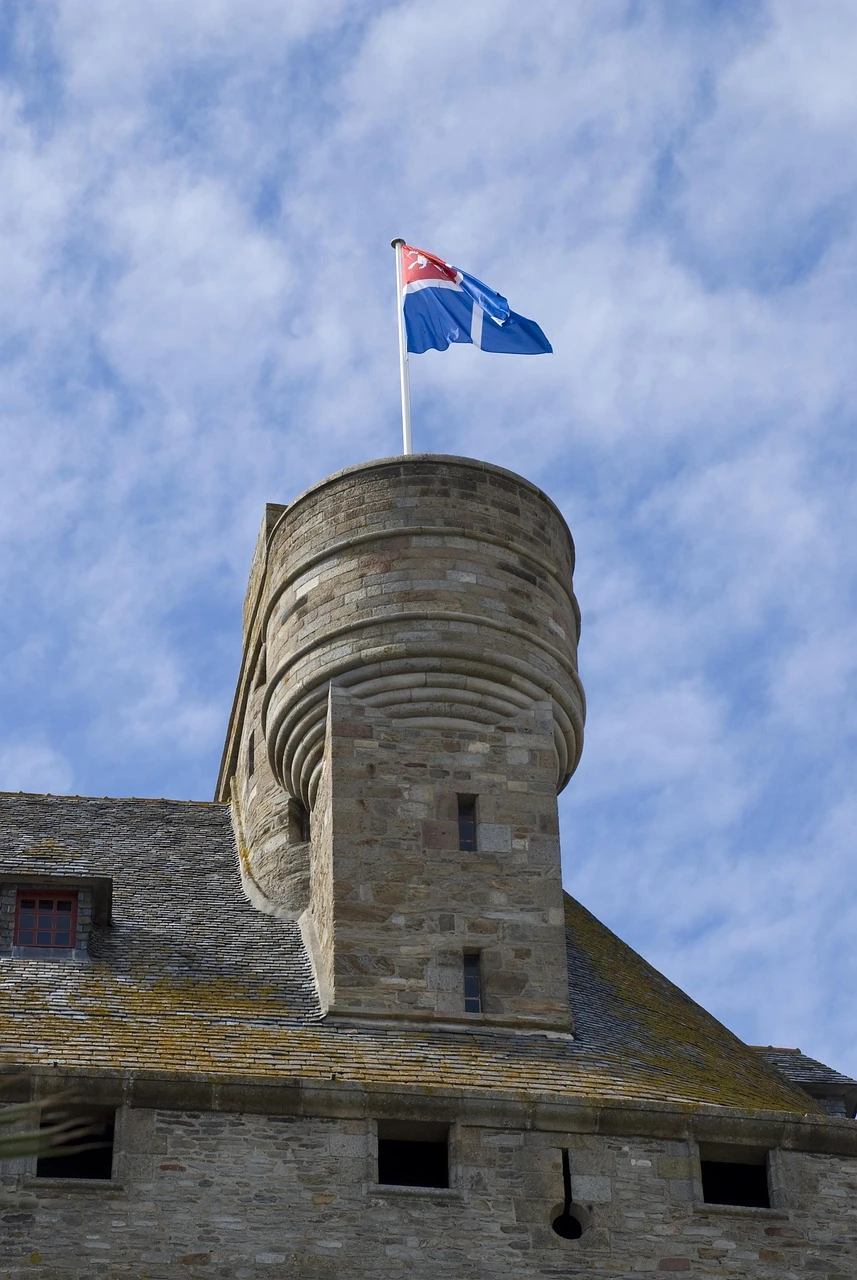
The flag of Saint-Malo flies proudly atop the keep of Saint-Malo Castle/ by Marie Sjödin from Pixabay
2) Entering Saint Malo Intra-Muros: what to see inside the walls (must-sees)
To start your visit off right, the most iconic entrance is the Porte Saint-Vincent. Located opposite the port, it is topped with the coats of arms of the city and Brittany. To its right is the castle. This is Saint Malo Town Hall. Since its reconstruction, the Malouin flag has flown at the top, above the French flag. It is the only town hall in France to do this and has never changed, even when General de Gaulle himself asked it to do so twice.
Discover Saint-Malo with a guide
To better understand the history of this pirate city, taking a guided tour can be an excellent idea. For about two hours, a local guide will accompany you through the narrow streets of the fortified city, along the ramparts, and up to Saint-Vincent Cathedral, all while recounting the maritime history and the great figures of Saint-Malo.
👉 Book the guided tour of the fortified city of Saint-Malo ↗
The Saint Vincent Gate and the coats of arms of Saint Malo and Brittany
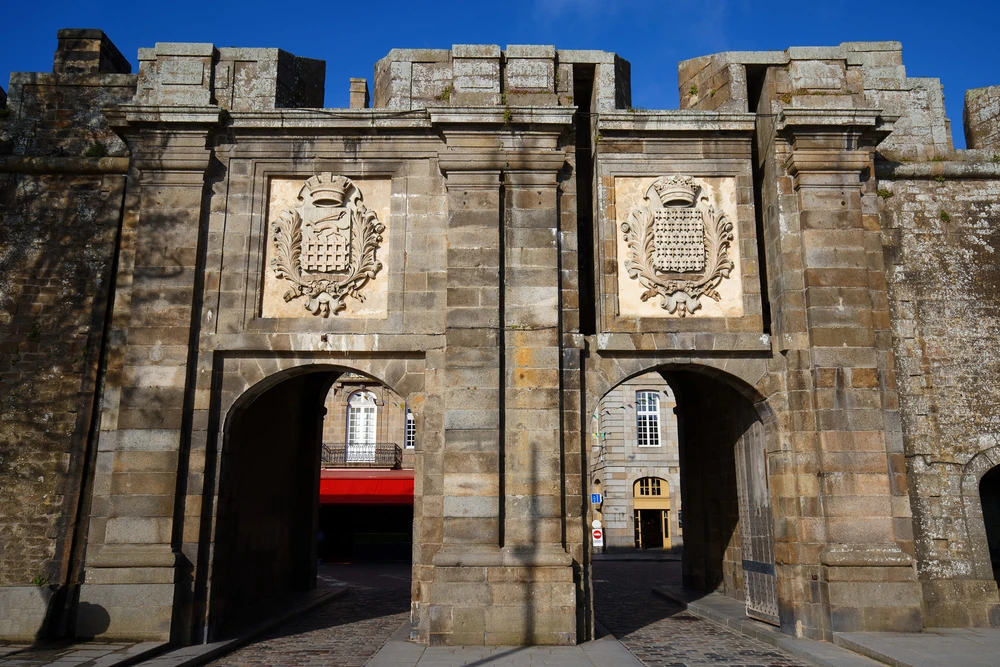
The exterior of the Saint Vincent Gate. It features the coats of arms of Saint Malo and Brittany. Photo selected by monsieurdefrance.com: KovalenkovPetr / via dépositphotos.
It dates back to 1703 and is dedicated to Saint Vincent, patron saint of sailors. It was doubled on the harbor side in 1890, and it was at this time that the two doors were topped with symbols: on the left, the coat of arms of Saint Malo (with the ermine running above the portcullis) and on the right, the coat of arms of Brittany with the ermines and the ducal crown. One of the city's largest shopping streets, Rue Saint Vincent, starts at the Saint Vincent gate. To the right of the gate is Place Chateaubriand with its many restaurants, artists, painters, and caricaturists. You will take that way.
The Castle of Saint Malo
This is Saint-Malo Town Hall. It is topped by the flag of Saint-Malo, blue with a white cross and a red square featuring an ermine. Built from 1424 onwards by order of Duke John V of Brittany, it underwent modifications until the 18th century. It consists of a keep and several towers, including the famous "quic-en-groigne" tower (pronounced "qui qu'en grogne"), built at the behest of Duchess Anne of Brittany between 1488 and 1591, on which there was once a stone engraved with the words: "whoever complains will get what they deserve." Perhaps this was a way of reminding the rebellious inhabitants of Saint-Malo that she was the boss. She was not wrong to be a little wary of them. Indeed, the castle is defensive both towards the outside and the inside. This did not prevent the inhabitants from taking the castle in 1590 and 1792. A barracks until 1921, it was badly damaged during the bombings of 1944, but it has been renovated, particularly its roof, and now looks magnificent.
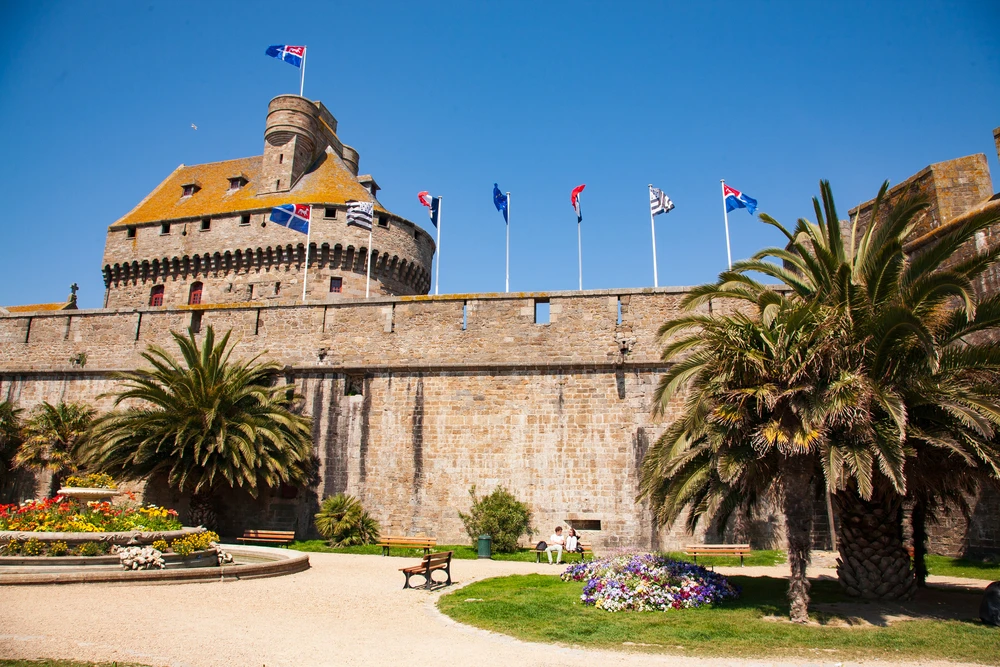
The castle of Saint Malo still flying the flag of Saint Malo. Photo selected by monsieurdefrance.Com: tiloligo via depositphotos.
As soon as you pass through the Saint Vincent gate, you will arrive at Place Chateaubriand. Opposite you are streets and a square with theaters. Turn right, walk along the castle and terraces, and you will reach the Saint Thomas gate. This is where our walk begins.

You can also check out the 17-stop audio guide to Saint-Malo, with 3 free episodes to listen to straight on your phone.
3) The must-see No. 1: The ramparts tour
It is the most famous free activity in Brittany. Allow about an hour to complete the entire tour. The ramparts of Saint Malo are exactly 1,754 meters long. Starting here, you will better understand that Saint Malo is a peninsula that used to become an island whenever the rising tide covered the immense beach that you will soon see, called the Sillon. You will see the Fort National, the Grand Bé, a small part of the Petit Bé and, offshore, the rocks and forts that make Saint Malo a very difficult place to access. The English, the worst enemies of the people of Saint Malo, only managed to conquer it once.
Start at the Saint Thomas Gate.
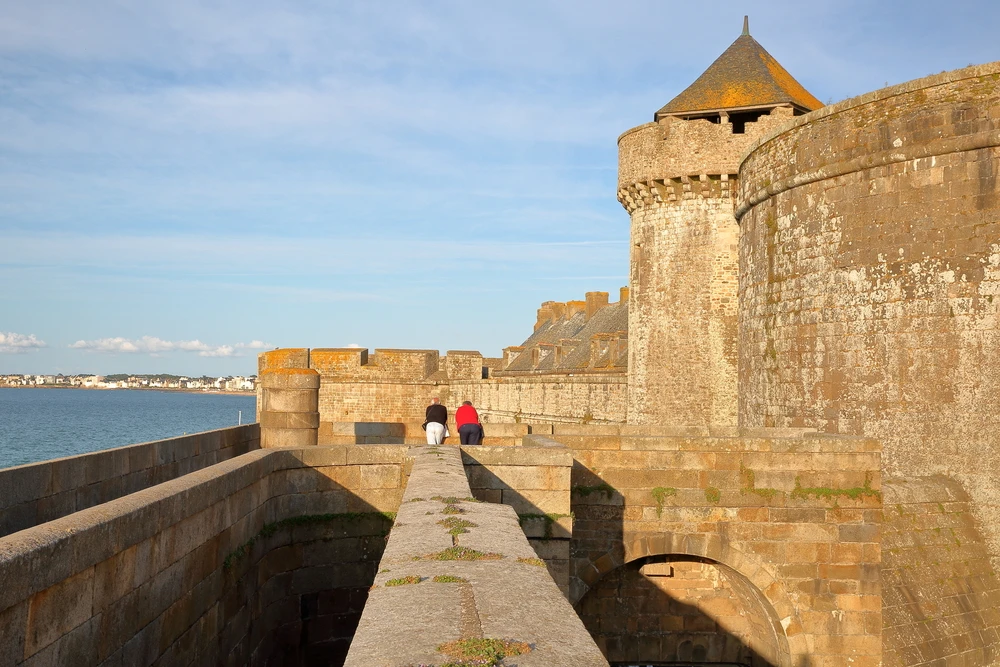
The top of the Saint Thomas Gate. To find it, walk along the castle. GPS address: Saint Thomas Gate. Photo selected by monsieurdefrance.Com christophe.cappelli via depositphoto
The Saint Thomas Gate is one of the eight gates of Saint Malo (there are also three posterns, which are smaller gates built into the walls). It provides a better understanding of Saint Malo and its history, as you can clearly see the Sillon, which is now the huge beach stretching out to your right, but which once played a protective role, as it was regularly covered by the tide, isolating the city from the waves. In front of you, on the islet of "l'Islet," is Fort National (we will come back to this later in the article). To your left is Grand Bé (we will also come back to this later). A little further out to sea is Fort de la Conchée.
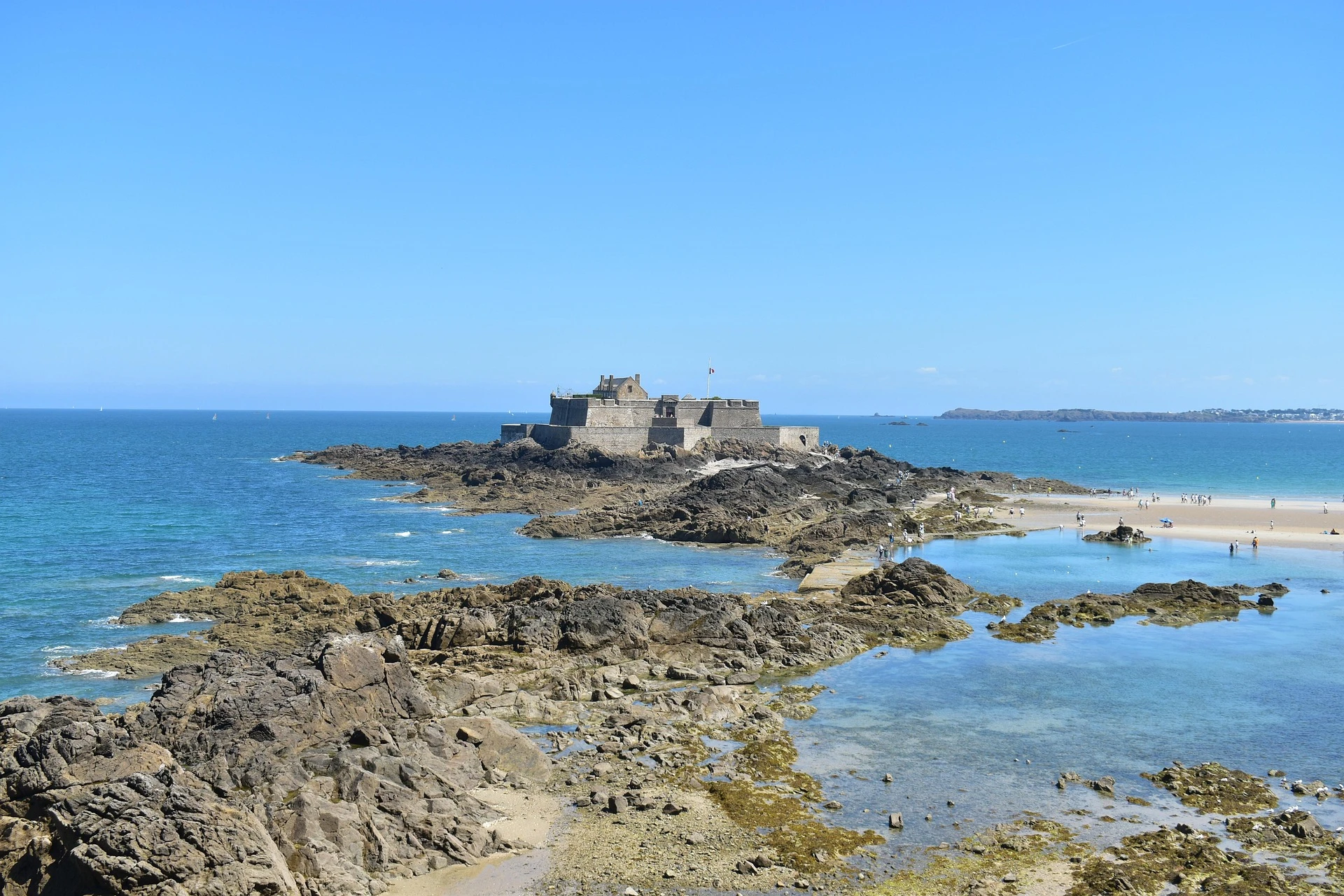
Fort National is located right in front of you / Photo selected by Monsieur de France by Nicolas IZERN from Pixabay
Fort La Reine and "the infernal machine"
Built in several stages, it was called the "Bastion du Cheval-Blanc" when Vauban, the military architect, ordered its construction in 1689, then the Bastion à la Reine during the modifications that led to it being raised between 1737 and 1744. Opposite you is the Fort National on the rock known as "l'islet" (we will come back to this later in the article) and, on the town side, the former building of the Ecole Nationale de la Marine Marchande (National Merchant Navy School), rebuilt after its destruction in 1944. It is located on the site of the "château gaillard," the first castle in Saint Malo. It was almost in front of the Queen's Bastion that "the infernal machine" exploded. Let me tell you this amazing story.
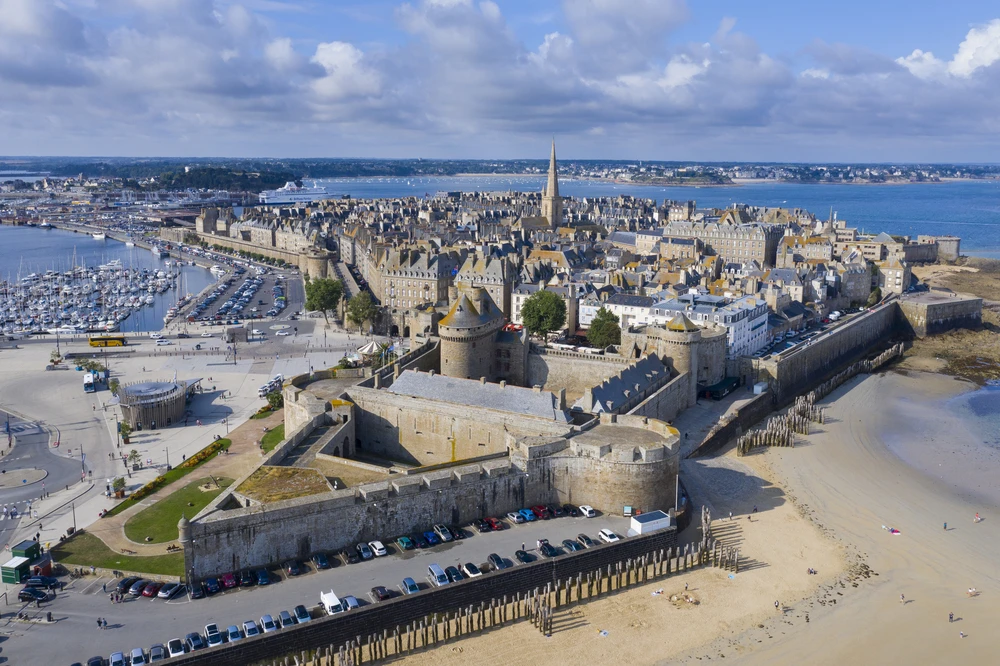
Intramuros seen from the sky. In the center is the Château (the town hall). On the far right, a triangular projection on the ramparts: this is Fort la Reine. Photo selected by Monsieurdefrance.com s4visuals via depositphotos.
Did you know? The infernal machine: an English flop:
In 1694, France and England were at war. The English wanted to take Saint-Malo, which they nicknamed "the hornet's nest" because it was from here that privateers set sail to board their ships in large numbers. That year, a fleet approached Saint-Malo. After bombarding the city (and causing considerable damage) and taking the island of Cézembre, the English were unable to take the city. As night fell, after scouting the area in rowboats, they launched their "infernal machine" towards the city, a kind of 26-meter-long boat filled with explosives, grapeshot, and sharp objects, built in the utmost secrecy in London, with sails painted black so that the lookouts of Saint-Malo would not spot it in the night. The idea was to blow it up close to the ramparts.
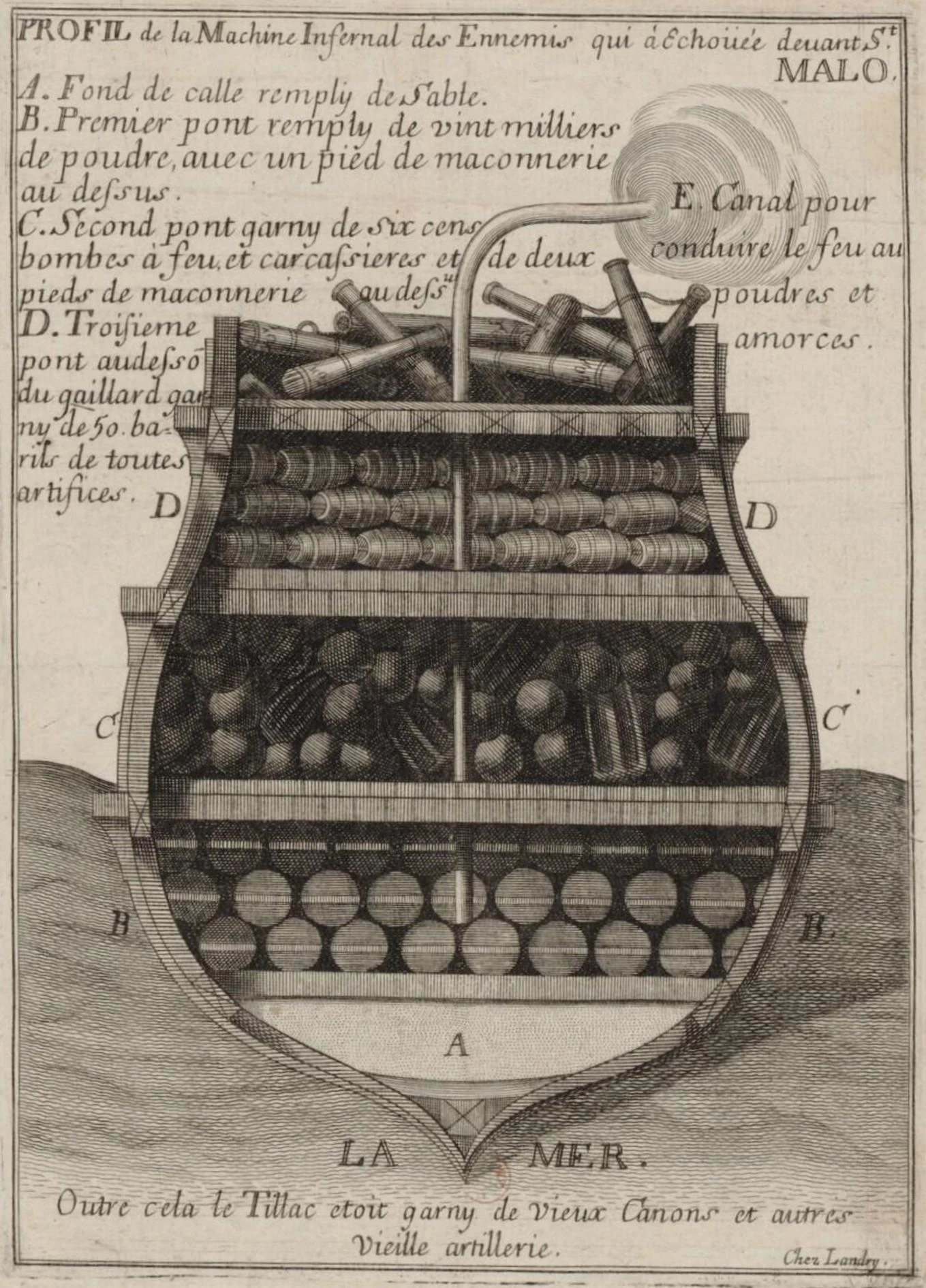
The plan of the infernal machine of Saint Malo / Source gallica.fr via wikipedia.fr
Fortunately for Saint-Malo, a fairly strong westerly wind blew the ship towards the Gros Malo rock, where it ran aground. As water flooded the holds and the ship began to list out to sea, the English decided to set fire to it as planned and detonate what the people of Saint-Malo would later call "the infernal machine." The result was far less than the English had imagined. After a huge explosion, which shattered all the windows in Saint-Malo and even tore off roofs, there were no injuries on the Saint-Malo side. Only a cat was killed in this explosion, which should have destroyed the city if everything had gone according to plan on the English side. Not only did it not work, but the English suffered five deaths, the sailors who lit the fuse of the fire ship and were unable to escape in time. However, they managed to take the Fort de la Conchée, without much merit, since it was still under construction and did not have many soldiers, but rather the 40 masons who were building it and who were deported to Guernsey. On his return from the "Saint-Malo raid," the English captain, John Benbow, was court-martialed for cowardice, accused of not being brave enough to take his ships closer to Saint-Malo. A little further into the town, "La rue du chat qui danse" (The Street of the Dancing Cat) commemorates the only official victim of the Saint-Malo raid.
The Bidouane Tower.
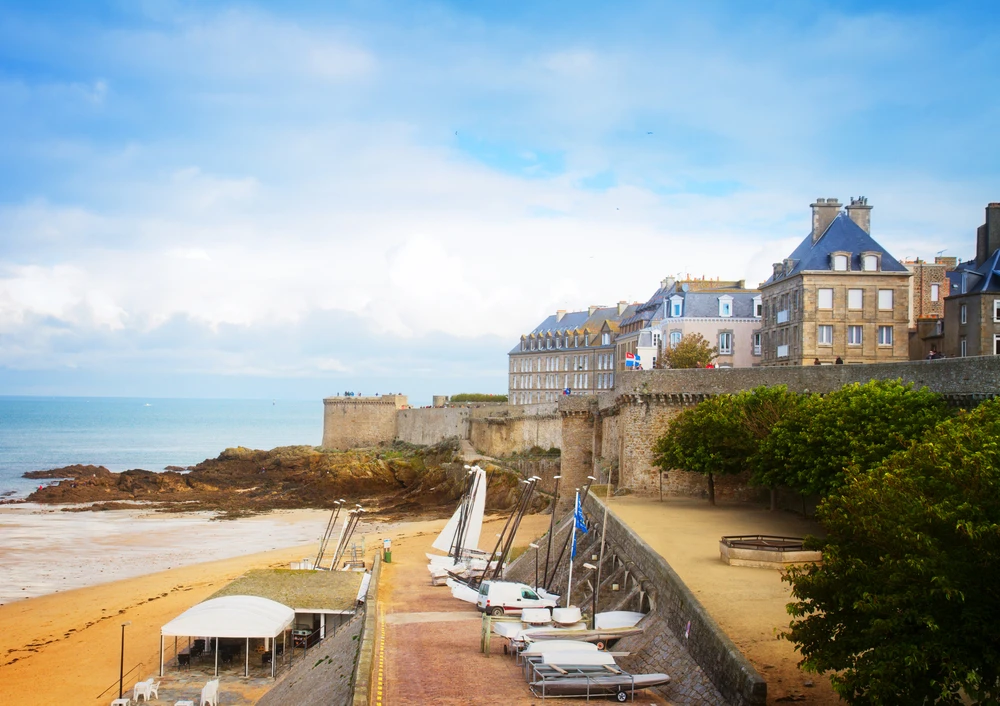
The Bidouane Tower seen from Bonsecours Beach. Image selected by monsieurdefrance.com: Neirfys / via depositphoto
Feel free to climb inside. The Bidouane Tower is one of the oldest parts of the ramparts of Saint Malo, dating back to the 15th century. 23 meters high, 14 meters wide, and modified many times, it was a powder magazine until 1889 (cannonballs were even stacked along the buttresses of the walls). Don't forget to climb to the top, because the view from the Bidouane Tower is incredible. You have the bay of Saint Malo in front of you. La view is magnificent over the Grand Bé, the islet opposite you, where the writer Chateaubriant is buried. It is only accessible at low tide. Be careful not to get trapped on the islet at high tide. Offshore, you can see Fort de la Conchés, one of the many forts that guarded the passage to Saint Malo. These military engineering marvels were designed by Marshal Vauban, Louis XIV's military engineer, whose work stretches from north to south France along the borders of the time and has been classified as a UNESCO World Heritage Site. Further still, you can see Cap Fréhel. It is just under an hour's drive away.
From the Bidouane Tower, continue along the ramparts, passing above Bonsecours Beach. It has an outdoor swimming pool, built in 1937 by Mr. Lesaulnier to allow guests at his establishment to swim even when the sea had receded far at low tide. He was also responsible for the first beach showers in Saint Malo.
Did you know? Surcouf, the privateer who suffered from seasickness.
Not far away, facing England, stands the statue of Saint-Malo's most famous privateer, Robert Surcouf (1773-1827), who greatly annoyed the English (an old Saint-Malo tradition!) and lived a life that even a novelist could not have imagined. Suffering from seasickness (ironic, you might say) when he embarked at the age of 13, he was a privateer, in other words a civilian captain with a letter of marque authorizing him to attack ships hostile to France, on condition that he hand over part of his spoils to the State. This is the huge difference between a privateer and a pirate. A pirate attacks and plunders for himself. A privateer attacks and plunders for the king... and himself. These privateers were numerous in Saint-Malo, earning it the nickname "Cité Corsaire" (Privateer City).
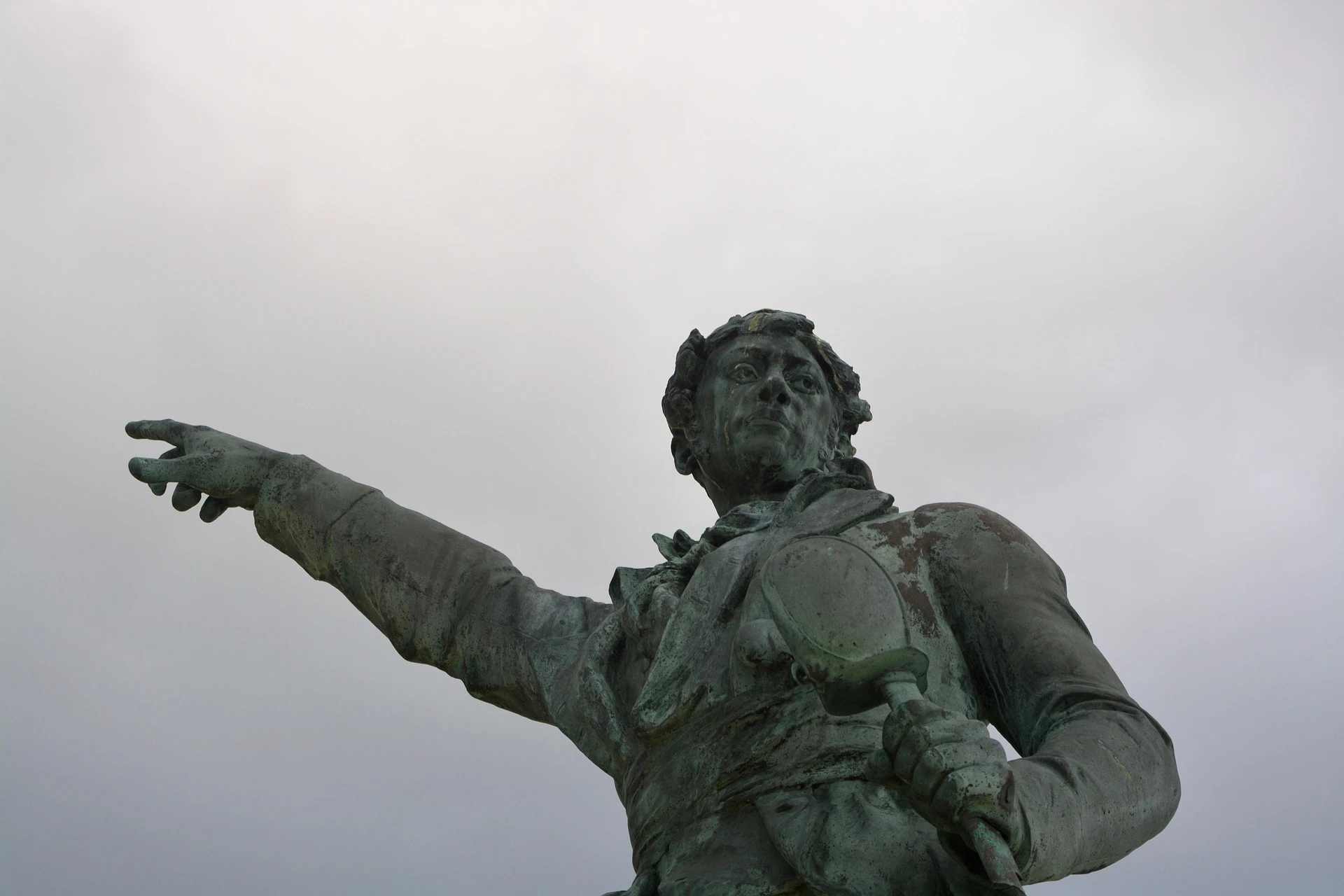
Statue of Robert Surcouf, privateer from Saint-Malo / Photo selected by Monsieur de France: by JackieLou DL from Pixabay
Surcouf is particularly famous for his escape from England and for rowing back to Saint Malo. He is also known for capturing an English ship in less than fifteen minutes, despite it having three times as many crew members. He is also renowned for his quick wit. It is said that when an English officer remarked, "You French fight for money, while we English fight for honor," Surcouf replied, "That's normal; everyone fights for what they lack." Even if this is probably untrue, we only lend to the rich. He is buried in the cemetery of Saint-Malo and his story, along with that of other French privateers, is below:

In the Footsteps of the Corsairs of Saint-Malo
Saint-Malo is famous for its privateers, the sailors who built the wealth and reputation of this fortified city. To discover the city in a different way, this outdoor escape game invites you to explore the streets and ramparts while solving puzzles related to the history of the privateers and the city’s secrets. A fun and original way to explore Saint-Malo as a team.
👉 Join the privateer escape game in Saint-Malo ↗
This article may contain affiliate links. This does not change the price for you but helps support the Monsieur de France website.
The bastion of Holland:
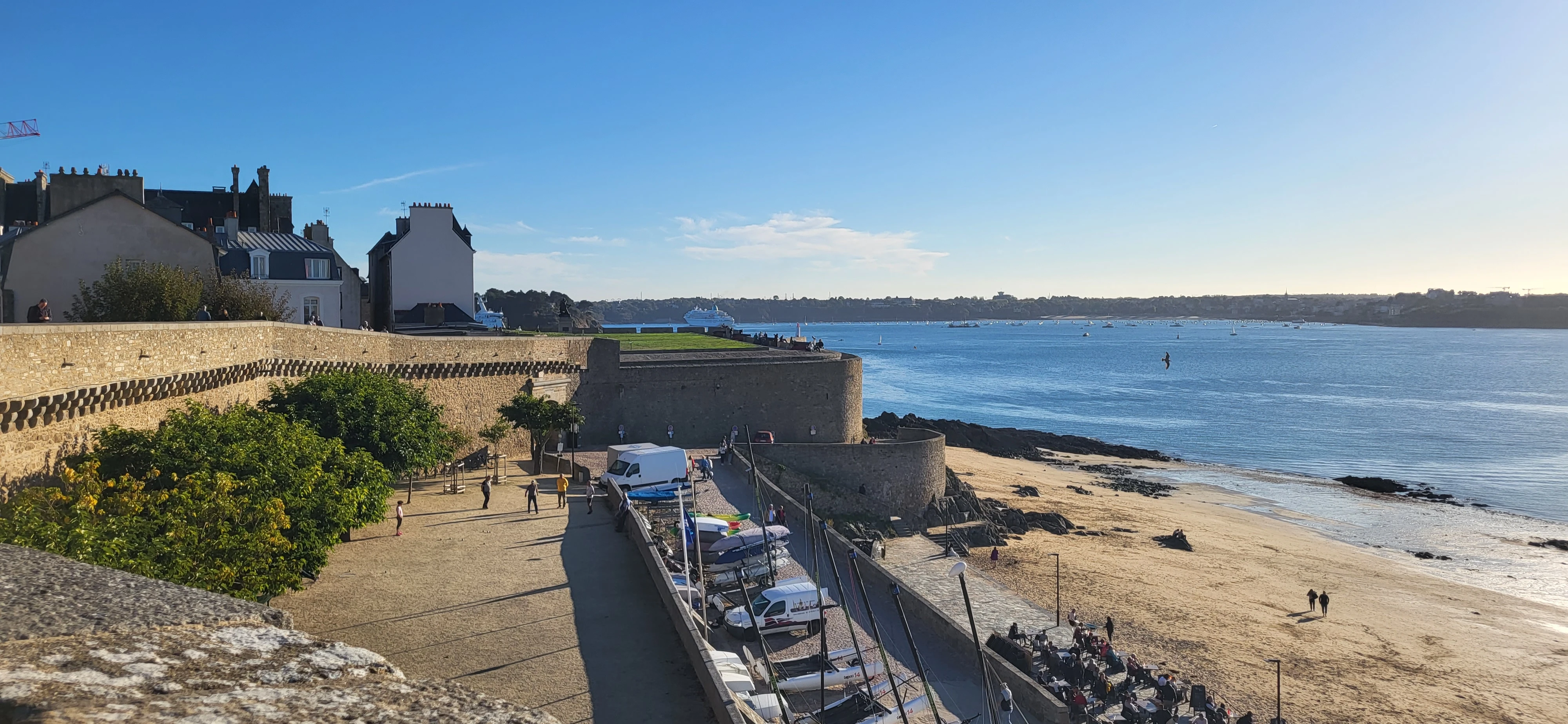
The bastion of Holland seen from the Bidouane Tower. Photo (c) monsieurdefrance.com
Built on the site of former mills in 1674, during the Dutch War, which gave it its name, the Bastion of Holland. The cannons were donated to the city of Saint Malo in 1696 by the Count of Toulouse, illegitimate son of Louis XIV and governor of Brittany, in tribute to Saint Malo's contribution to the defense of France.
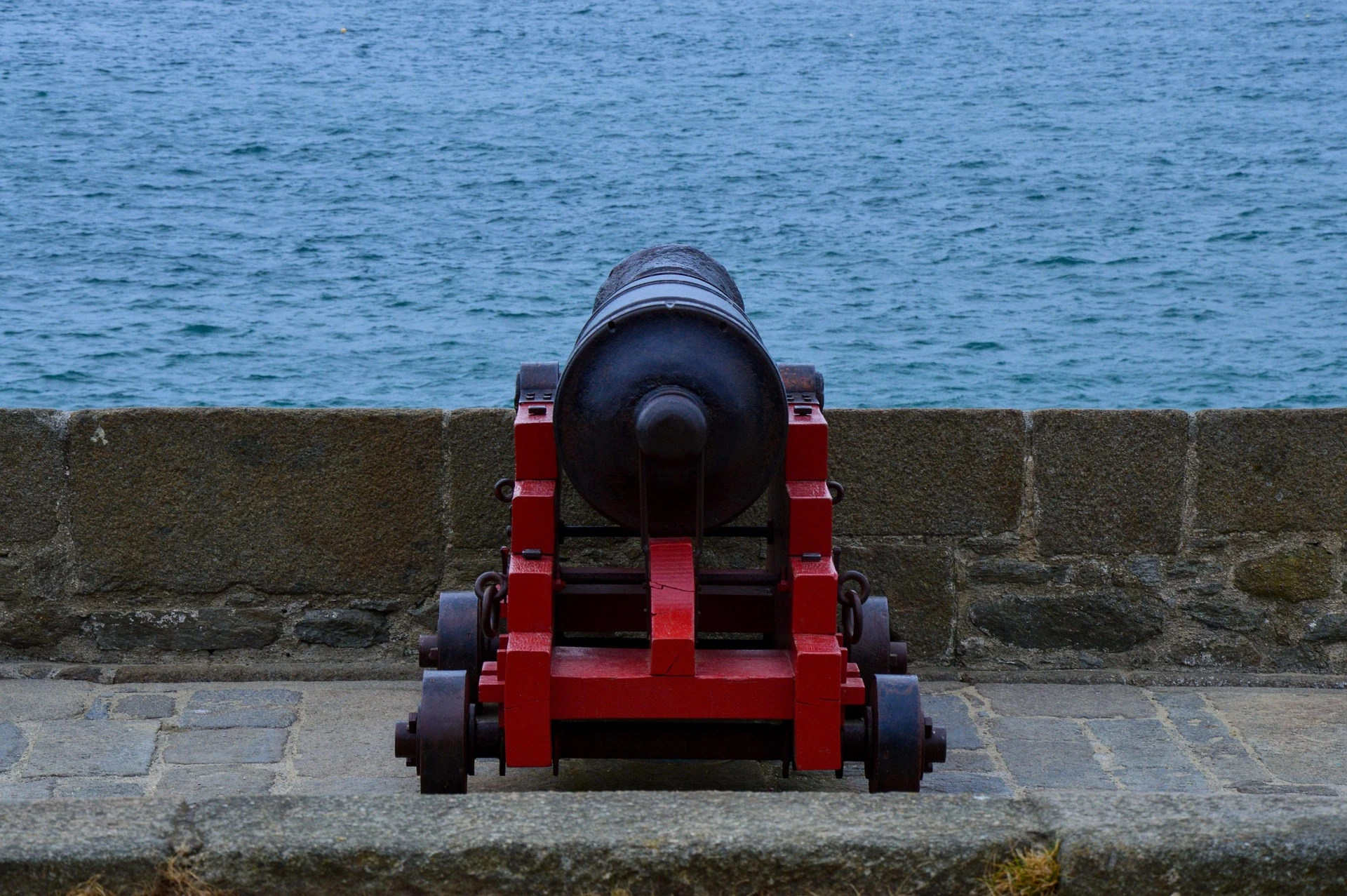
The cannons of the Holland Bastion are famous / Photo selected by Monsieur de France: by Gaspard Delaruelle from Pixabay
Did you know? Dinard is just across the way.
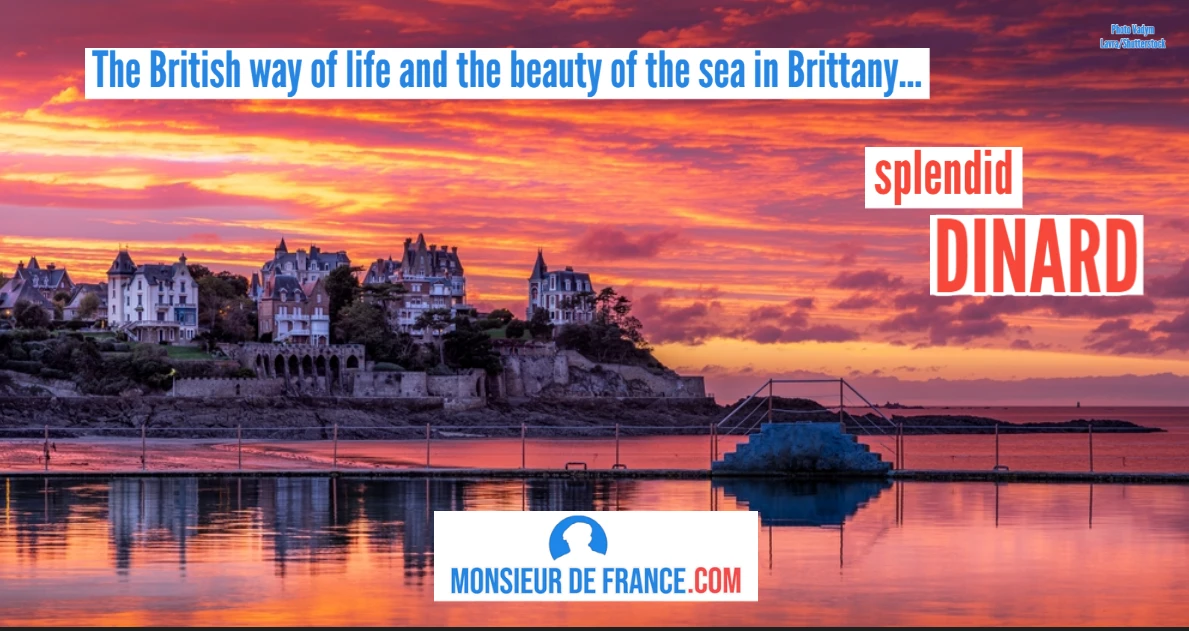
From the cannons and the parapet, you have an unobstructed view of Dinard, a seaside town founded in the 19th century. Known as the "Pearl of the Emerald Coast," it is a chic town with more than 400 listed or protected villas, mainly in the English style, making it the most British town in western France. It is easily accessible by sea bus (10-minute crossing) from the Vauban basin near the Môle des Noires.
tribute to Jacques Cartier, the man from Saint-Malo who discovered Canada.
On the Bastion of Holland stands a statue of one of the most famous figures in Saint-Malo's history, who still evokes strong feelings in Quebecers when they see it: Jacques Cartier (1491-1557), discoverer of Canada. The Saint-Malo native made several expeditions to the West, searching for a shorter route to China. He sailed up the Saint Lawrence River (which he named on Saint Lawrence's Day) and discovered what would become "la belle province" the famous Quebec that is his home here in Saint-Malo.
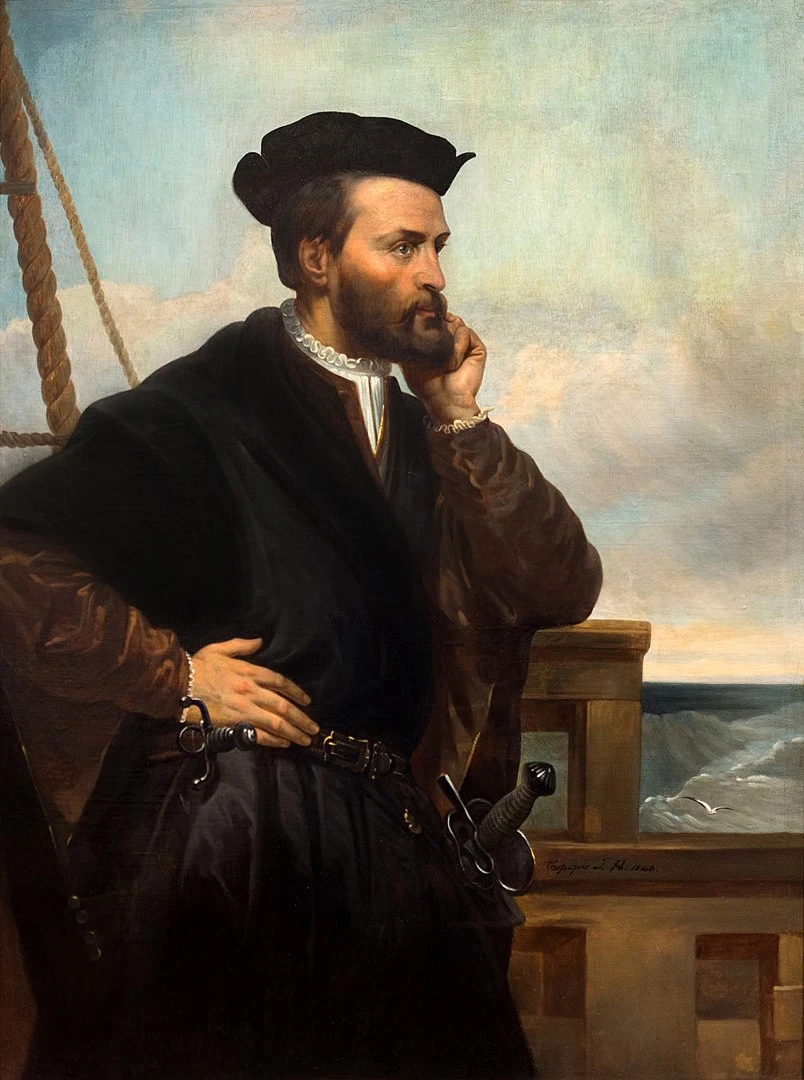
Jacques Cartier as imagined by Théophile Hamel (1844). , CC BY-SA 4.0, https://commons.wikimedia.org/w/index.php?curid=75675451
Did you know? Saint Malo, a city guarded by dogs
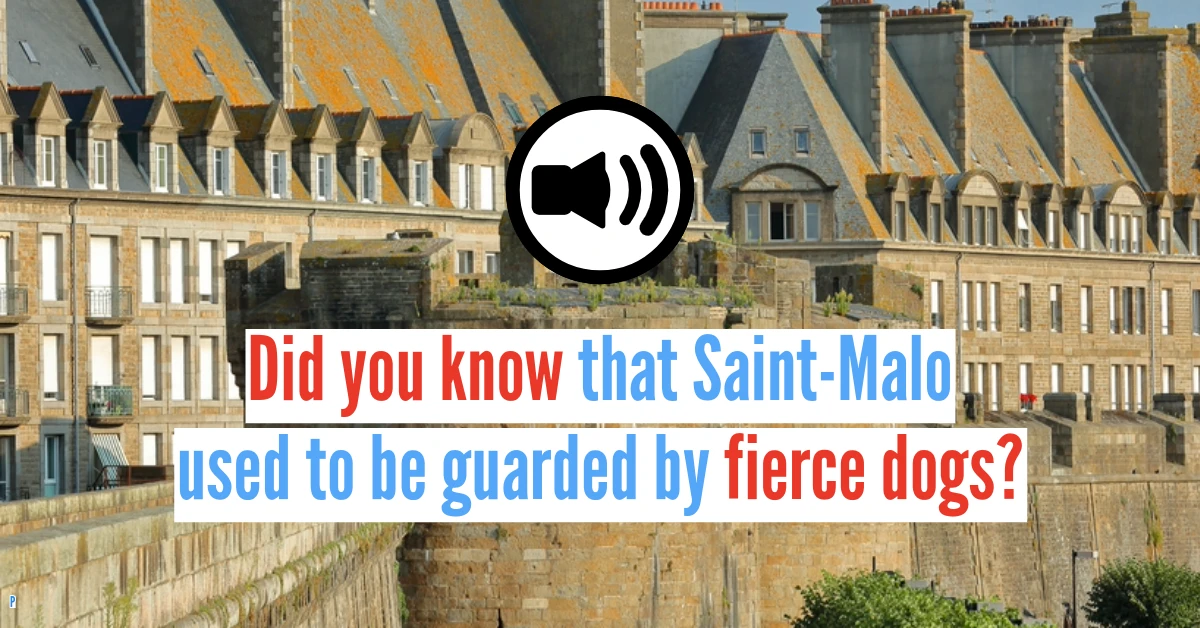
It was beneath this bastion, in a courtyard, that the watchdogs were kept. These ferocious dogs, 24 English mastiffs, were locked up during the day and released outside the walls to protect the city and attack anyone who happened to be along the ramparts. They did their job until 1772, when they were abolished. It is said that this was after they attacked and seriously injured a gentleman from Saint-Malo who had returned home a little late after courting a beautiful woman in Saint-Servan. The city gates were closed and the dogs were let loose at the same time every day, but to ensure that absent-minded people did not forget, a bell called the noguette (from the Latin "nox quieta," meaning "quiet night") rang every evening at 10 p.m. It has continued to do so ever since. Deliberately shifted from its usual schedule, it even served to remind people of the curfew during the COVID lockdown.
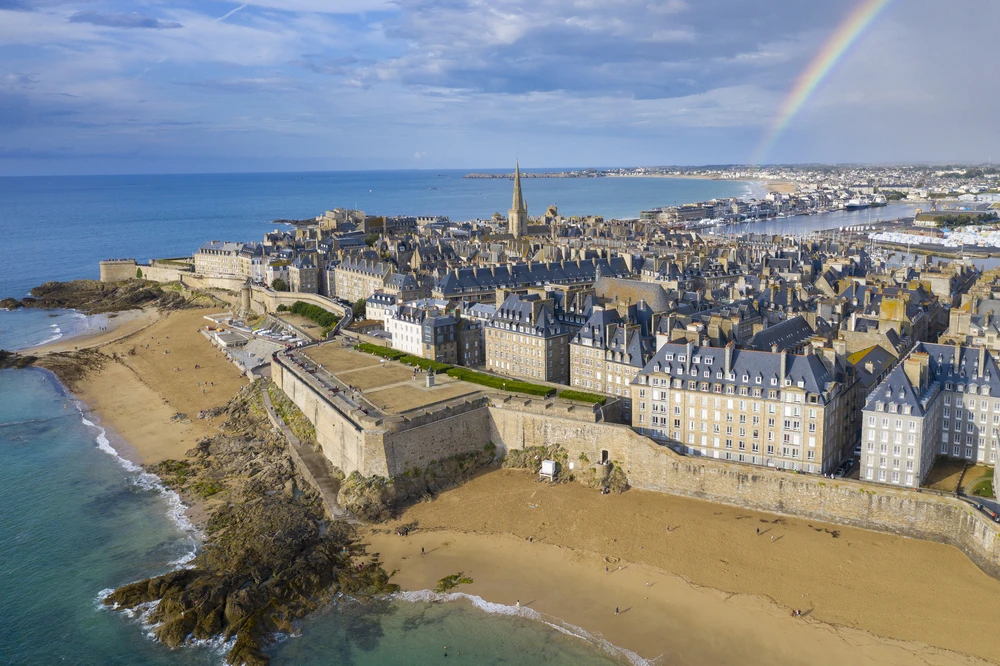
Aerial view of the Bastion of Holland. Photo selected by monsieurdefrance by S4visuals via depositphotos.
How about 10 secrets of Saint Malo?
The Saint Philippe bastion.
A vast esplanade, it overlooks the pier beach and the Môle des Noires (named after the rocks on which it is built). It is a jetty that protects the port of Saint Malo. It is 500 meters long and can be walked along. It was near this bastion that the wealthiest shipowners of Saint Malo built their mansions in this neighborhood, which was long known as "California" because the shipowners made their fortunes doing business in Peru (Peru was rich in gold and lacking in clothing, the people of Saint-Malo went to sell clothes and collect gold, even though Spain had strictly forbidden it).Many of the shipowners' houses were destroyed during the bombings of 1944, but they were rebuilt "identically," i.e., as close as possible to their original 18th-century appearance, after painstaking work, notably numbering the stones to be able to reassemble themas they were before the destruction.
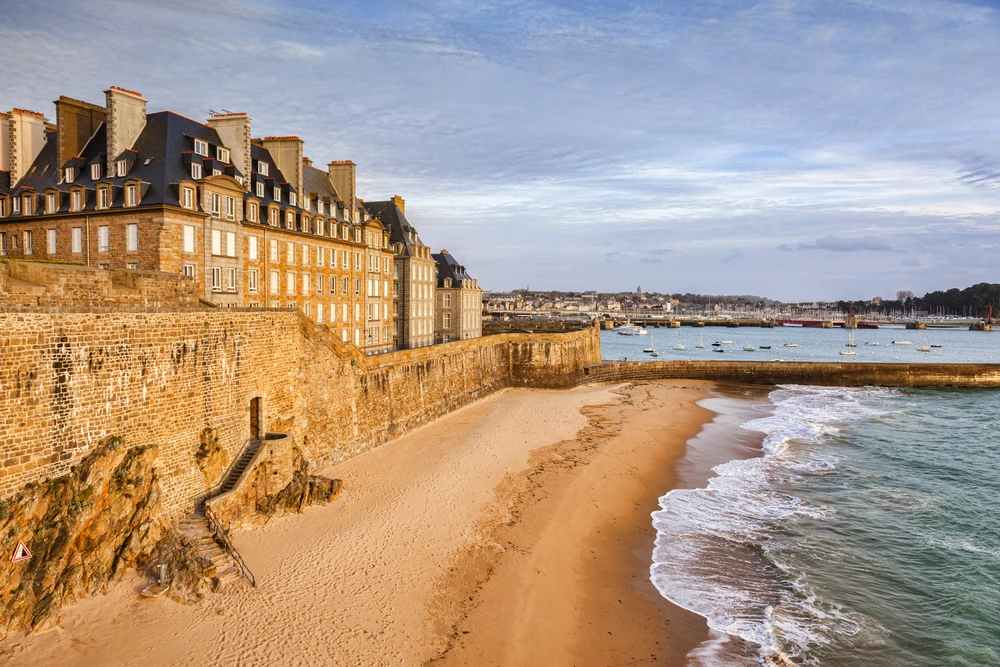
The Saint Philippe bastion as seen from the Hollande bastion. Photo selected by Monsieurdefrance: TravellingLight via dépositphotos.
Some residences were not damaged such as the Hôtel d'Asfeld, named after the street on which it is located, but which is in fact the Hôtel Magon, named after the Magon family, a very wealthy family of shipowners from Saint-Malo. It is easily recognizable from the ramparts as it is set back slightly behind a small inner courtyard. It is the only shipowner's mansion that has remained intact and is well worth a visit. These stone facades, which seem to have always been part of Saint Malo, are relatively recent in the history of Saint Malo, since stone was only imposed in construction from 1661 onwards, after "the great fire" that ravaged the city, which until then had been made of wood and using techniques similar to those used in shipbuilding. Before the last war, there were still many buildings whose upper floors closely resembled the rear of 17th-century galleons. This passage on the Saint Philippe bastion is also an opportunity to remember that the historic city of Saint Malo was once very densely populated. It was also very noisy, with residents going about their business, horses and their horseshoes, sailors on shore leave between two voyages...
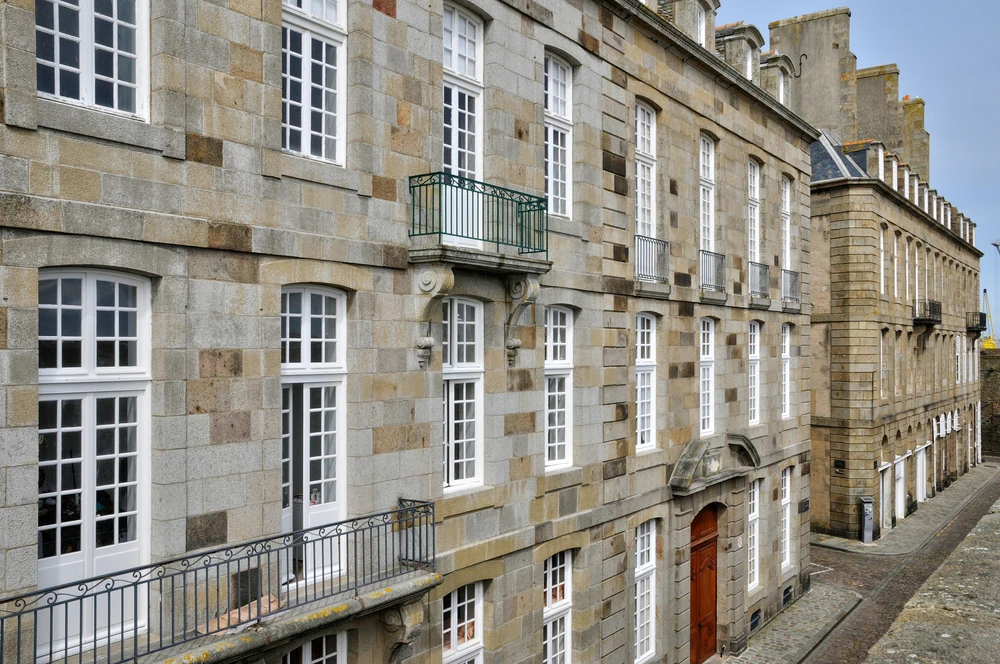
A few facades of Malouine residences just before Bastion Saint Philippe. Photo selected by monsieurdefrance.com: depositphoto.
The Great Gate
Continuing your walk, you will pass by the Saint Thomas Gate, the oldest gate in Saint Malo, known as the "Grande Porte," whose towers were added in 1552. On the city side, you will see Saint Vincent Cathedral, and on the outside, the Bassin Vauban, known as the starting point of the legendary solo sailing race "La Route du Rhum." On the gate, in a niche, is the statue of "Notre Dame de la Grand Porte," which is said to have been found floating on the water by sailors, even though it is made of stone. It is also said to have protected the city of Saint Malo during the fire of 1661. The original, decapitated during the French Revolution, is in the cathedral. You can descend the ramparts at this point to reach the interior of the city, or continue a few meters before arriving at the Porte Saint Vincent, your starting point. I always descend here.
4) Treasures within the walls
Between two climbs up the ramparts, dive into the maze of streets. It's noisy and crowded, but it was even darker and more hectic before the destruction of 1944. Imagine a city with wooden houses overlooking the street with gigantic glass windows, like the stern of an 18th-century ship. It was easy to do and provided plenty of light. You'll find all of Brittany's culinary specialties here, including the famous crêpes and delicious seafood platters. Don't miss:
Saint Vincent Cathedral
 La
La
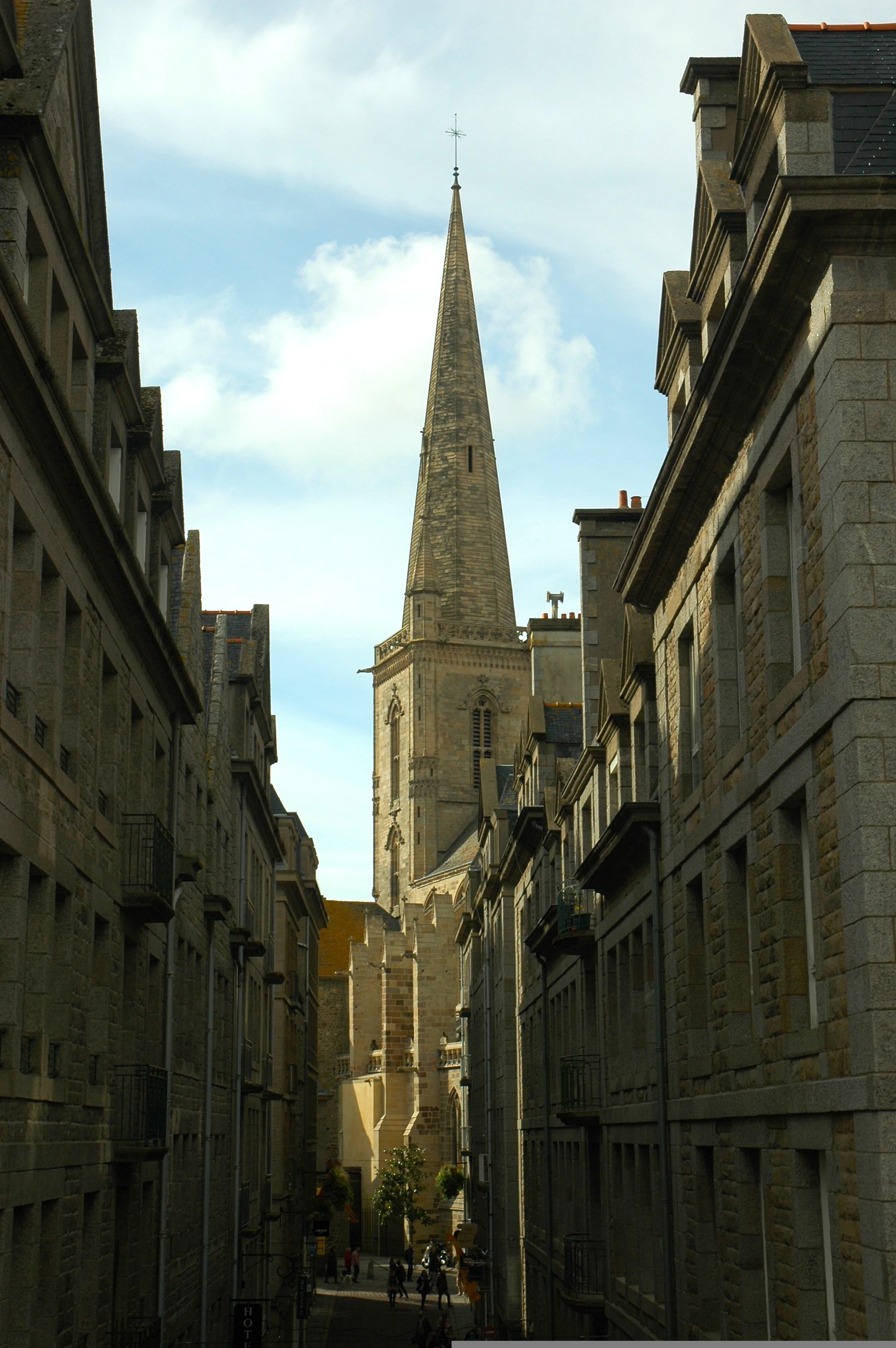
Saint Malo Cathedral and its distinctive bell tower, rebuilt after being destroyed during the war and completed in 1972. Photo selected by monsieurdefrance.com: Image by Jens from Pixabay.
Seat of the bishopric of Saint Malo (which disappeared in 1790) since 1145, it is truly the emblem of Saint Malo, the heart of the city, and its soul, having witnessed the lives of many Saint Malo residents over nearly a thousand years. It was here that Surcouf and Châteaubriand were baptized, and it is here that Jacques Cartier is buried. It was badly damaged during World War II, but its oldest walls are Romanesque in style, the choir is Gothic, lit by stained glass windows that give it a beautiful bluish atmosphere, and the bell tower is the only tall element within the walls. It has not always looked like this. It was rather low before 1860, when a neo-Gothic spire inspired by Quimper Cathedral was added, which was destroyed by bombing in 1944 before giving way to the one we know today, which was completed in 1972 and crowned with a cross in 1987. The bell tower is home to the famous "noguette," the municipal bell that has rung every evening at 10 p.m. since 1804.
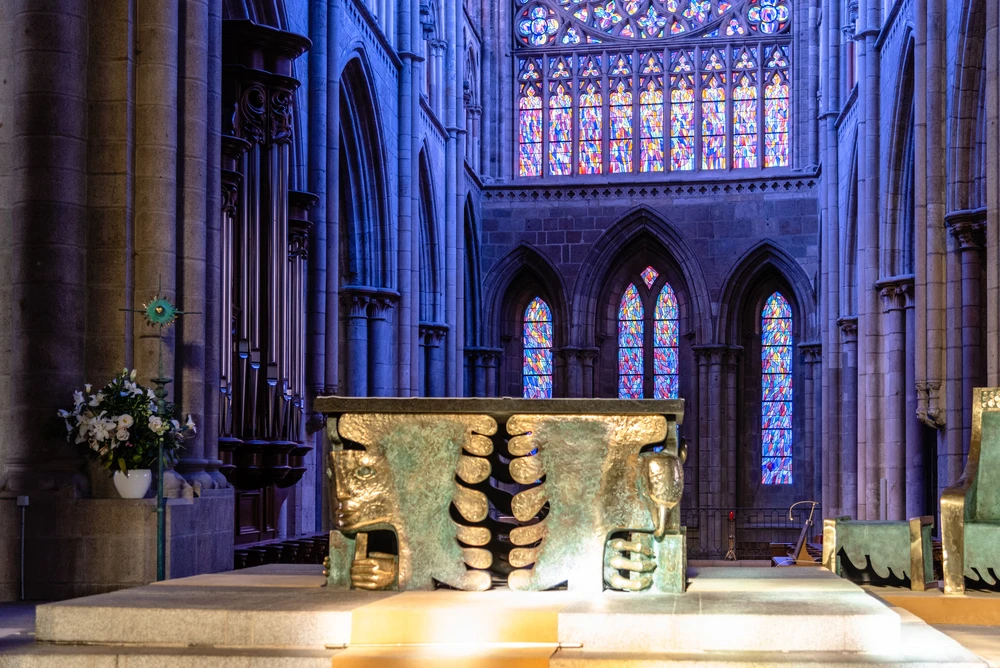
The interior of Saint Malo Cathedral and its unique atmosphere. Image selected by monsieurdefrance.com: jjfarquitectosJJ via depositphotos.
Go shopping and stroll along Rue Saint Vincent, Rue de la Barbinais, etc.
Saint Malo is not solely focused on the sea, far from it. It has been a trading town since its origins. Trade was already taking place in the city of Alet by the Coriosolites Gauls, and Saint Malo shipowners were involved in international trade, bringing rare goods such as spices back to Saint Malo. "Intra," as they say, you can go shopping and treat yourself at some original or well-known places such as Maison Bordier, 9 rue de l'Orme, which makes the best butter in the world. A salted butter (normal in Brittany) that can be enjoyed plain and simply on a good slice of bread, but also "flavored" butters, for example with seaweed. It's just crazy how good it is. Maison Roellinger offers an incredible number of spices from all over the world at 12 rue Saint Vincent.
You can also take the opportunity to look at the street names, which are often original and even amusing, such as "la rue de la pie qui boit" (the street of the drinking magpie), the only street in France to bear this name, which comes from a tavern whose wooden sign featured a magpie on a barrel of cider. "La rue du point du jour" (Dawn Street), "rue des marins" (Sailors Street), which reminds us that there were many sailors in Saint Malo and that they came here to celebrate their return to land after a campaign on privateer ships in the 17th and 18th centuries or on the "terre-neuvats," the ships that took them to fish for cod off the coast of Newfoundland in Canada. It was a very risky profession, and it was not uncommon for some to never return. There is also the "Street of the Dancing Cat," which recalls that a cat was the only victim of the infernal explosive device launched by the English against Saint-Malo. Some streets commemorate the existence of great figures from Saint-Malo, such as Maupertuis (Enlightenment philosopher) and La Mettrie (Enlightenment physician and philosopher).
Did you know? Mysteries and Company is honoring Harry Potter in Saint Malo.
Intramuros. Here you will find the entire world of Harry Potter and the rarest items from the brand. From the famous wand to the Nimbus 3000, not to mention the House uniforms. Not to be missed with children.
Address: 2 Place Brevet.
Passing by historic houses, those of Châteaubriand and Surcouf
You can walk past Châteaubriand's birthplace. François René de Châteaubriand was born in Saint Malo on September 4, 1768 at 3 Rue des Juifs, which is now Rue Châteaubriand. Born in a storm, as he himself recalls in "Les Mémoires d'Outre-Tombe" (Memoirs from Beyond the Grave), he writes: "The room where my mother gave birth overlooks a deserted part of the city walls, and through the windows of this room you can see the sea stretching as far as the eye can see, breaking on the rocks (...). The roar of the waves, whipped up by a squall heralding the autumn equinox, drowned out my cries." It is not open to visitors, but the façade can be seen. Still within the city walls, you can walk pastRobert Surcouf's house,the most famous privateer from Saint-Malo.Surcouf's birthplace,the Hôtel de la Bertaudière, is located at 2 rue du Chat qui Danse and is also not open to visitors. However, you can visit the privateer's residence, the Hôtel d'Asfeld, located at 5 Rue d'Asfeld.
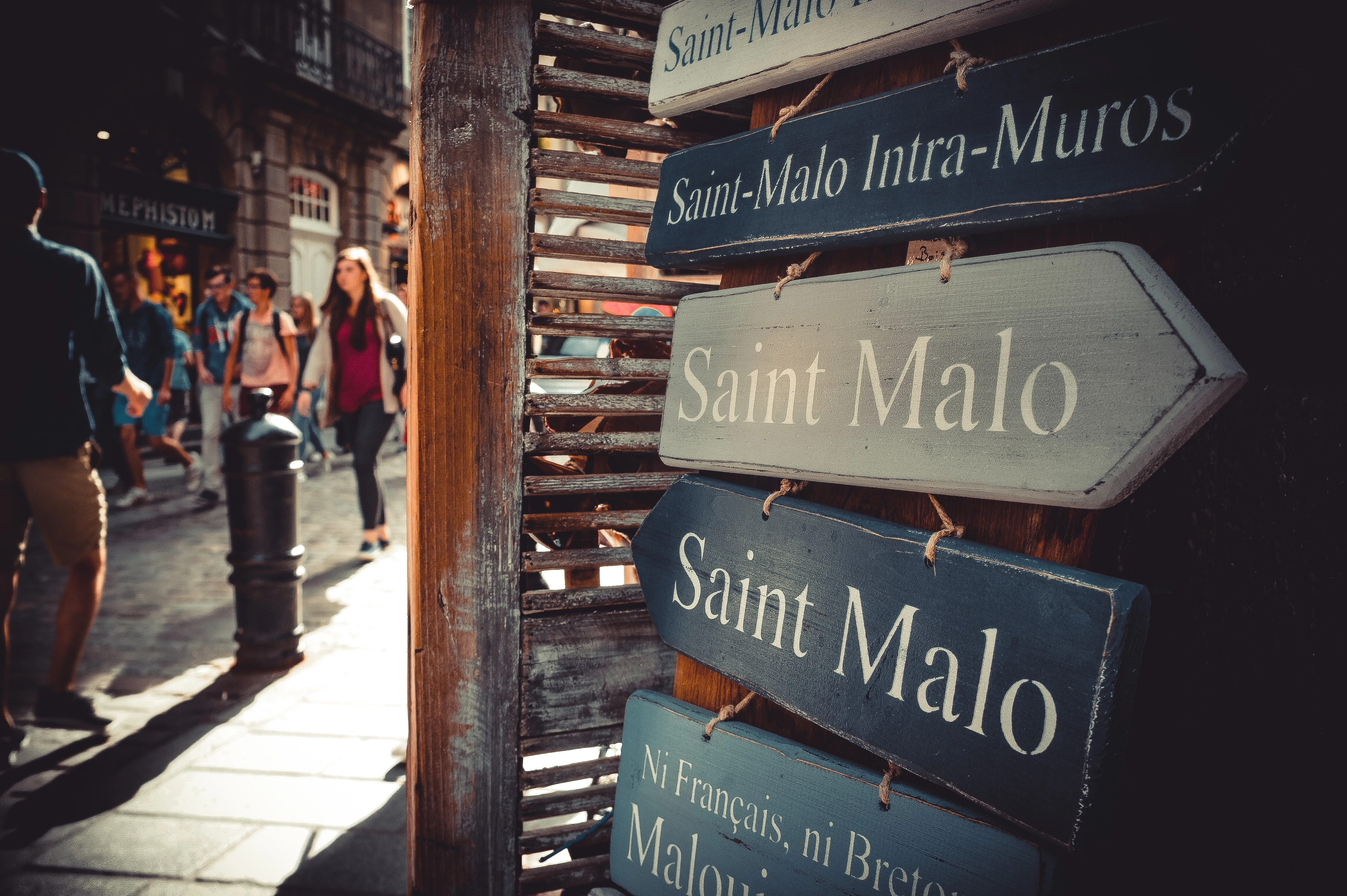
Photo selected by monsieurdefrance.com: Photo Boards on Unsplash
5) Ready-to-use itineraries
Saint-Malo intramural city in 2 hours (The essentials)
-
Entrance through the Saint-Vincent Gate.
-
Climb up the ramparts to the Bastion of Holland.
-
Descent to Saint Vincent Cathedral.
-
Quick break for a Kouign-amann on Main Street.
Half-day tour of Saint-Malo (Immersion)
-
Complete tour of the ramparts (departure from Porte Saint-Vincent).
-
Visit to the Cathedral.
-
Strolling through the designer boutiques on Rue des Cordiers.
-
Snack break or aperitif on the terrace at Place Chateaubriand.
-
At low tide: exit through the Porte des Bébés to walk to Grand Bé.
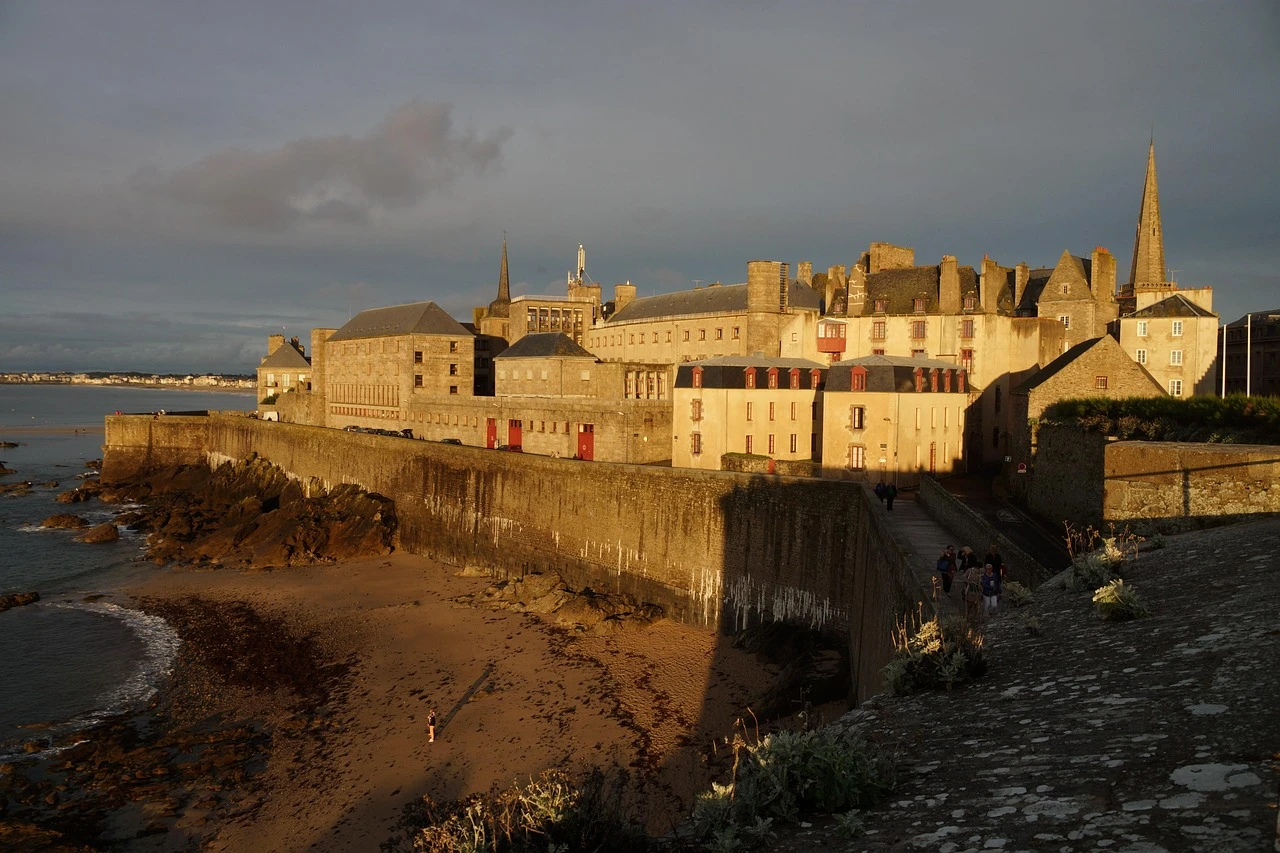
The evening light is always beautiful in Saint Malo / Photo chosen by Monsieur de France: by Ralph Häusler from Pixabay
6) Practical information: Save time
-
Everything on foot? Yes! Intra-Muros is tiny. It's the ideal and almost mandatory mode of transportation.
-
Accessibility: The ramparts have several ramps (particularly towards the Saint-Vincent Gate and the Saint-Louis Gate), but some areas have narrow stairs, so please take care if you have reduced mobility.
-
The best time: Watch the sunset from the western rampart (sea side). The colors on the granite are unforgettable.
Where should you stay in Saint-Malo to make the most of this historic port city?
If you’re visiting Saint-Malo to explore its famous walled town of Intra-Muros, its sea-facing ramparts and its wide sandy beaches, staying in the historic centre or near the seafront is often the most convenient option. This will allow you to easily explore the narrow streets of the pirate city, walk along the ramparts offering magnificent views of the sea and the neighbouring forts, and enjoy beaches such as the vast Sillon beach, which stretches for several kilometres along the town.
To plan your trip and compare accommodation options based on your dates and budget, you can visit:
• Accommodation available in Saint-Malo ↗
• hotels in the centre of Saint-Malo ↗
• accommodation ideally situated for exploring Saint-Malo ↗
Here you’ll find holiday rentals in and around Saint-Malo
This article may contain affiliate links. This does not affect the price for you, but it enables the Monsieur de France website to continue offering its content free of charge.
Conclusion: Beyond the walls, the magic of Saint-Malo continues
While Intra-Muros is the undisputed jewel of the pirate city, it is only the gateway to a much larger destination. Once you cross the ramparts, Saint-Malo continues to reveal itself through its characterful neighborhoods and magnificent seascapes.
For a complete Malouine experience, be sure to walk along the sand of the Grande Plage du Sillon, admire the Belle Époque villas of Paramé, or treat yourself to an authentic break in the fishing port of Saint-Servan, dominated by the majestic Tour Solidor. Each neighborhood has its own unique charm and well-kept secrets.
Want to explore every facet of the city? I invite you to discover my comprehensive guides to visiting Saint-Malo in its entirety and not missing a thing on the Emerald Coast.
Jérôme Prod'homme Specialist in French heritage, gastronomy, and tourism. Find all my discoveries at monsieur-de-france.com.
7) FAQ: Your questions about Saint-Malo
What is Intra-Muros in Saint-Malo?
It is the historic fortified district of the city, surrounded by granite ramparts.
How long did it take to build the ramparts of Saint-Malo?
It takes between 45 minutes and 1 hour and 15 minutes, depending on your pace and the time spent taking photos.
Where can I enter Saint-Malo Intra-Muros?
The Saint-Vincent Gate is the main entrance, but the Saint-Louis Gate (closer to the parking lots) is an excellent alternative.
What are the must-see attractions in Saint-Malo Intra-Muros?
The ramparts, Saint Vincent Cathedral, the Corsair's residence, and the view of Fort National.
Learn more about Saint-Malo
- Visiting Saint-Malo: The Complete Guide to the Pirate City
- Explore Saint-Malo with an immersive audio guide that reveals all its secrets
- The Ramparts of Saint-Malo: The City’s Most Beautiful Walk
- What to See in Saint-Malo in a Weekend? The Must-Sees
- Dinan: The Stunning Medieval Town Near Saint-Malo
- Dinard: The Elegant Gem of the Emerald Coast
- Discover Brittany and the Emerald Coast
- If you love Brittany, here’s what I loved