What is a "spring tide" in Saint-Malo?
We talk about "spring tides" when the difference between high tide and low tide becomes very significant. In practice, they can be identified using the coefficient: the higher it is, the higher the water rises and the further it recedes.
To understand exactly what a coefficient means (and why it varies), see the page that provides a full explanation. Here, the focus is on practical use in Saint-Malo.
Dreaming of visiting Saint-Malo?
👉 Discover the best travel deals on Expedia and easily compare hotels and offers to plan your stay at the best price. Your hôtel is probably here.
The best times of the year
The most sought-after high tides often occur around the equinoxes (early spring and early fall), when the combined effects of the Sun and Moon are most pronounced. There can also be very good coefficients at other times: the key is to aim for a "photogenic" low tide (and not in the middle of the night), with decent weather (wind and swell can change the experience).
The list of coefficients for this year is available here:
Where to stay in Saint-Malo to admire the spring tides?
If you’re visiting Saint-Malo during the spring tides, staying near the ramparts or the waterfront is often the ideal choice. You’ll be able to admire the impressive spectacle of the sea rising rapidly around the ramparts, watch the waves crash against the Sillon seawall, and see neighboring islets like Grand Bé appear and disappear. In the bay of Saint-Malo and Mont-Saint-Michel, the tides are among the strongest in Europe, with a difference of sometimes more than 13 to 14 meters between low tide and high tide, offering a unique natural spectacle.
To plan your stay and compare accommodations based on your dates and budget, you can check out:
- Discover the best-located hotels in Saint-Malo
- Compare the accommodation options available in Saint-Malo
- Find your ideal holiday rental with holiday rentals in Saint-Malo
This article may contain affiliate links. This does not change the price for you but allows the Monsieur de France website to continue offering its content for free.
Where to see the high tides in Saint-Malo: 6 spots that work
1) The ramparts (the perfect "balcony")
This is the easiest place: you climb up high, watch the sea recede, see the islets, then watch the water return. When the sea comes back in, the effect is spectacular... and it's safer to watch from up here than from the rocks below.
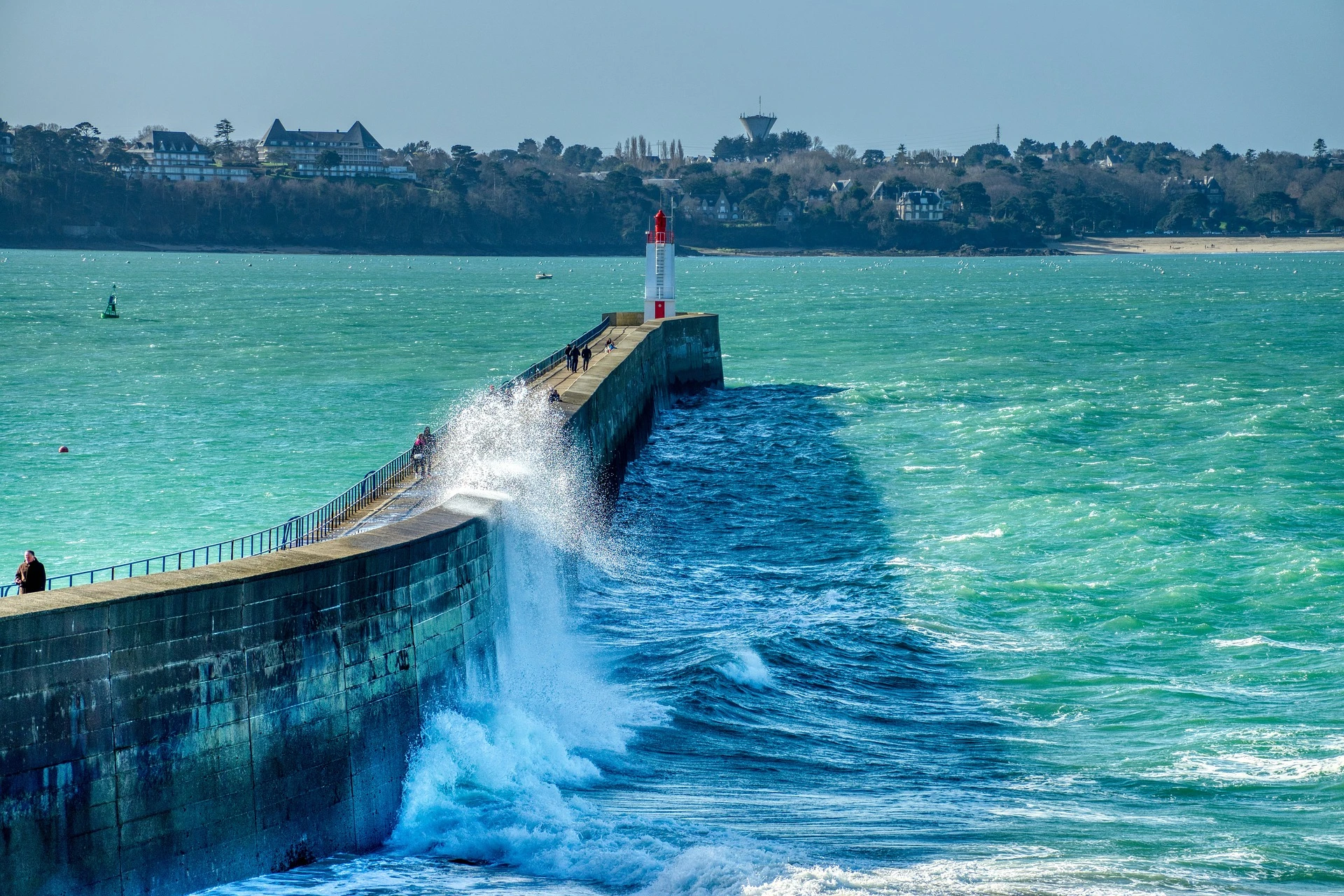
The Mole des Noires seen from the ramparts of Saint Malo. Image selected by monsieurdefrance.com: Image by Thierry BEUVE from Pixabay
2) Sillon Beach
Very large and very "cinematic" at high tide. You can walk for a long time on the foreshore when the tide is out, then enjoy a magnificent sunset when the tide comes back in. This is where it hits the highest, but be careful not to get splashed, and above all, do as the locals do and don't get too close.
3) Bon Secours (with a view of Grand Bé)
The perfect spot to watch the entrance to Grand Bé (and the famous "window" at low tide). You can clearly see the sea receding and then returning.
4) The Fan (at the foot of the ramparts)
A great compromise: close to the center, superb views, and easy to combine with a stroll through Intra-Muros.
5) Towards Rochebonne / Paramé
This is probably the most spectacular spot in Saint Malo (even though it's 3 or 4 km from Intra Muros). If you had to choose one place, this would be it.
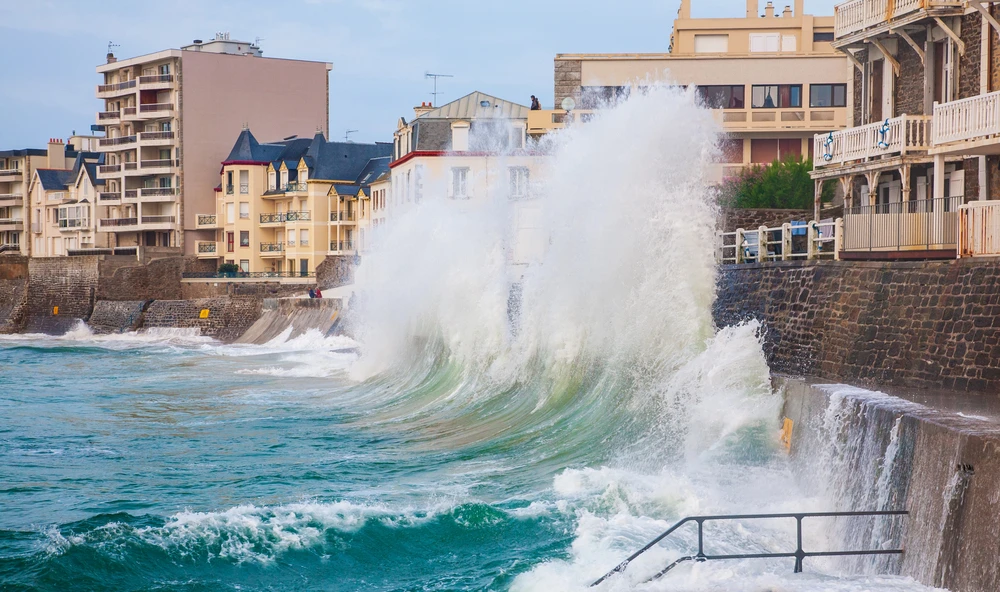
On the Rochebonne side at the end of the Sillon / Photo chosen by Monsieur de France Willy Mobilo via depositphotos
6) Pointe de la Varde and wilder areas
When you're looking for a spectacular show. Caution: rocks, sea spray, and sometimes challenging conditions.
In general, always be careful. The sea does not move in a straight line, and waves can surprise you by coming up around you. Hold children by the hand.
Discover Saint-Malo with a guide
To better understand the history of this pirate city, taking a guided tour can be an excellent idea. For about two hours, a local guide will accompany you through the narrow streets of the fortified city, along the ramparts, and up to Saint-Vincent Cathedral, all while recounting the maritime history and the great figures of Saint-Malo.
👉 Book the guided tour of the fortified city of Saint-Malo ↗
Grand Bé and Petit Bé: the star duo of low tides
At low tide, one of the great pleasures in Saint-Malo is accessing the islets, offering a sense of adventure just a few minutes from Intra-Muros. Be sure to check the tide times so you don't get stuck at high tide for several hours. You can't swim back because the current is too strong. To include these islets in your itinerary and choose the best viewpoints, this page is the most comprehensive: Saint-Malo: what to see at low tide and high tide.
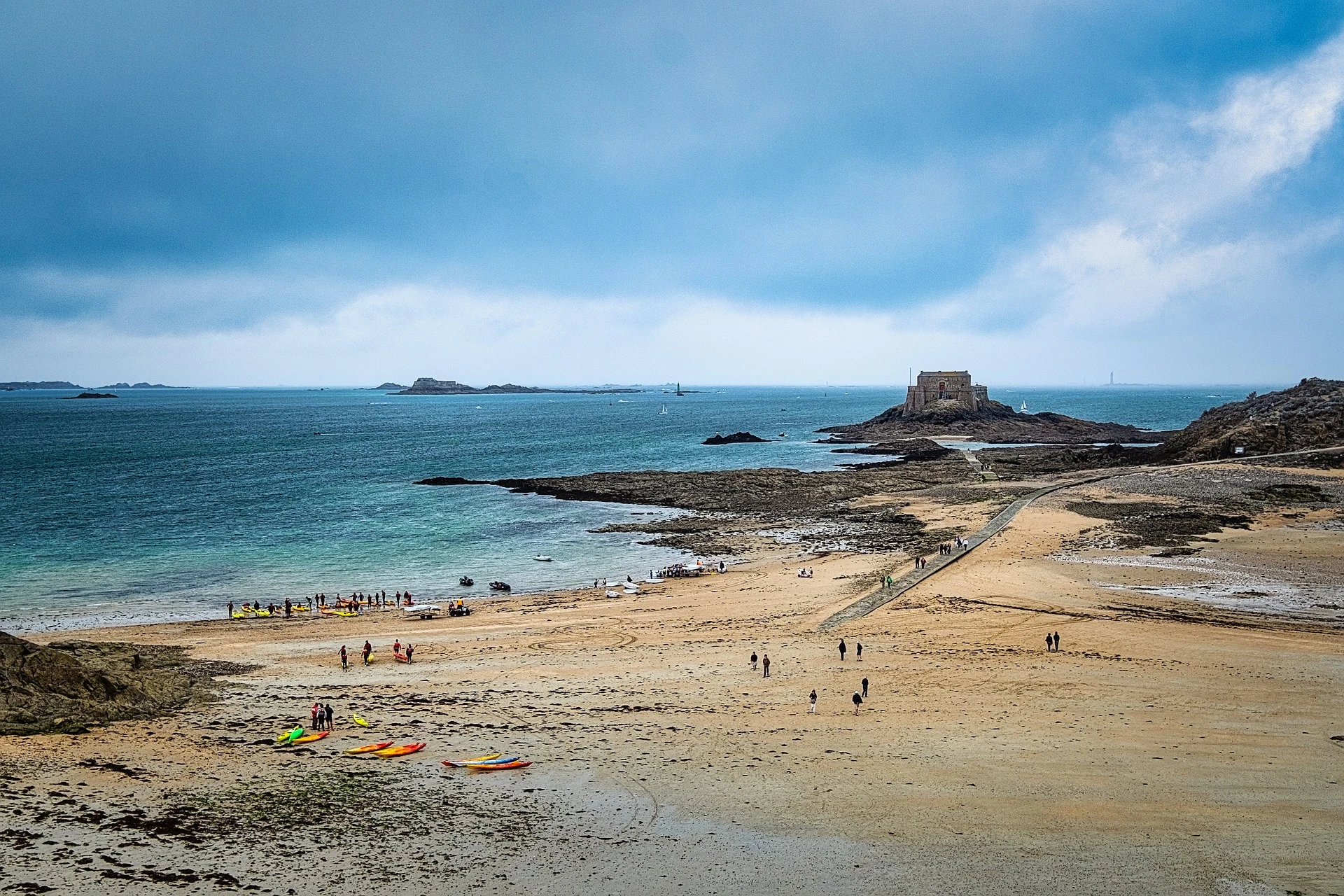
At the bottom, the little Bé is only accessible at low tide. Pay particular attention to the tide times / Photo chosen by Monsieur de France virtualgadjo via depositphotos
How to quickly read a tide table (without making mistakes)
Two pieces of information are sufficient:
-
Low tide time (for walking, accessing beaches, enjoying the foreshore)
-
The coefficient (to determine whether the "show" effect will be significant)
Practical tip: arriving 45 to 60 minutes before low tide allows you to see the sea "at its furthest" and enjoy it without stress. And it's wise to plan an early return: in Saint-Malo, the tide can come in faster than you might imagine when you're focused on taking photos.

You can also check out the 17-stop audio guide to Saint-Malo, with 3 free episodes to listen to straight on your phone.
When do spring tides occur in Saint-Malo?
Spring tides occur when the gravitational pull of the Moon and Sun combine strongly, which happens mainly during spring tides. In Saint-Malo, the most spectacular periods generally occur twice a year, around the equinoxes: late March/early April in the spring, then late September/early October in the fall. Very high tidal coefficients can also be observed at other times, but these two periods often see the most impressive and sought-after tides, especially when low tide occurs during the day.
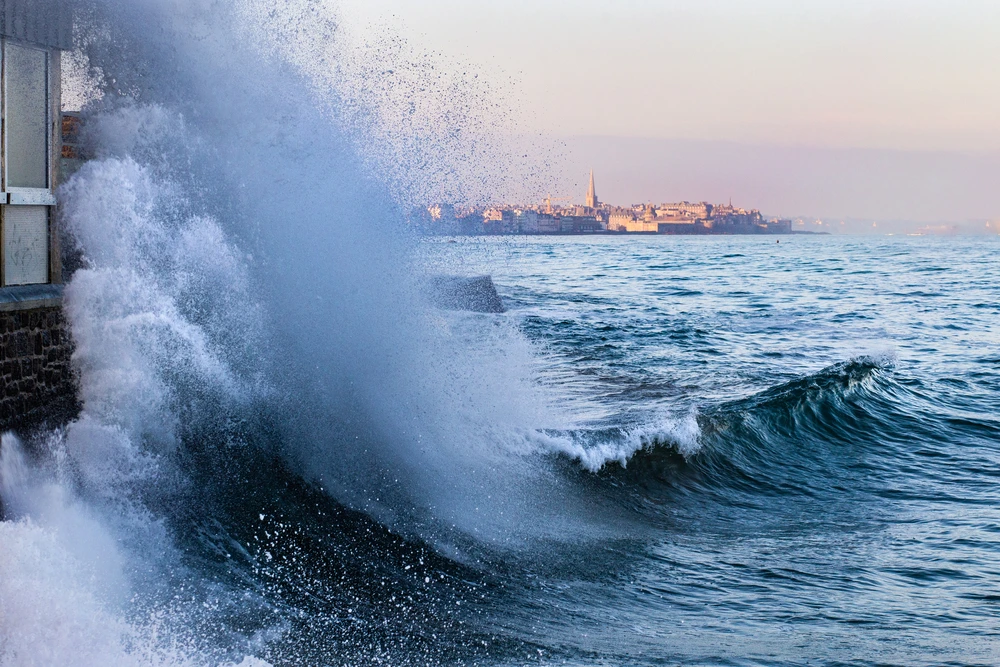
Saint Malo is always the scene of a breathtaking spectacle at high tide. Caution! Be very careful and do not stand too close to the shore / Photo selected by Monsieur de France: depositphotos
Safety: what you absolutely need to remember
-
Watch out for children! They don't see things the same way you do! Hold them;
-
Do not stray too far without a reference point: the sea can cut off your passage.
-
Slippery rocks: caution, especially with children.
-
Do not stand at water's edge when the tide is high and there is a swell: a wave may take you by surprise.
-
On the sand: beware of tricky areas depending on the sector (and avoid "shortcuts" offshore).
-
Leave some room: if you're unsure, come back later.
What to do in Saint-Malo during a spring tide? (mini program)
-
Morning: ramparts + watching the sea recede
-
Around low tide: Éventail/Bon Secours (and possibly islets depending on the schedule)
-
Afternoon: Intra-Muros, narrow streets, cathedral, gourmet break
-
Return of the Sea: photo spot on the Sillon or from the ramparts
To prepare for your stay (and not miss anything), take a look at my complete guide.
Learn more about Saint-Malo
- Visiting Saint-Malo: The Complete Guide to the Pirate City
- Explore Saint-Malo with an immersive audio guide that reveals all its secrets
- The Ramparts of Saint-Malo: The City’s Most Beautiful Walk
- What to See in Saint-Malo in a Weekend? The Must-Sees
- Dinan: The Stunning Medieval Town Near Saint-Malo
- Dinard: The Elegant Gem of the Emerald Coast
- Discover Brittany and the Emerald Coast
- If you love Brittany, here’s what I loved