Surnames in France first appeared in the Middle Ages as a way to distinguish individuals. Derived from first names, occupations, places, or nicknames, they reflect the country’s social and cultural history and serve as a living memory. I’ll explain it all here.
When did surnames first appear in France?
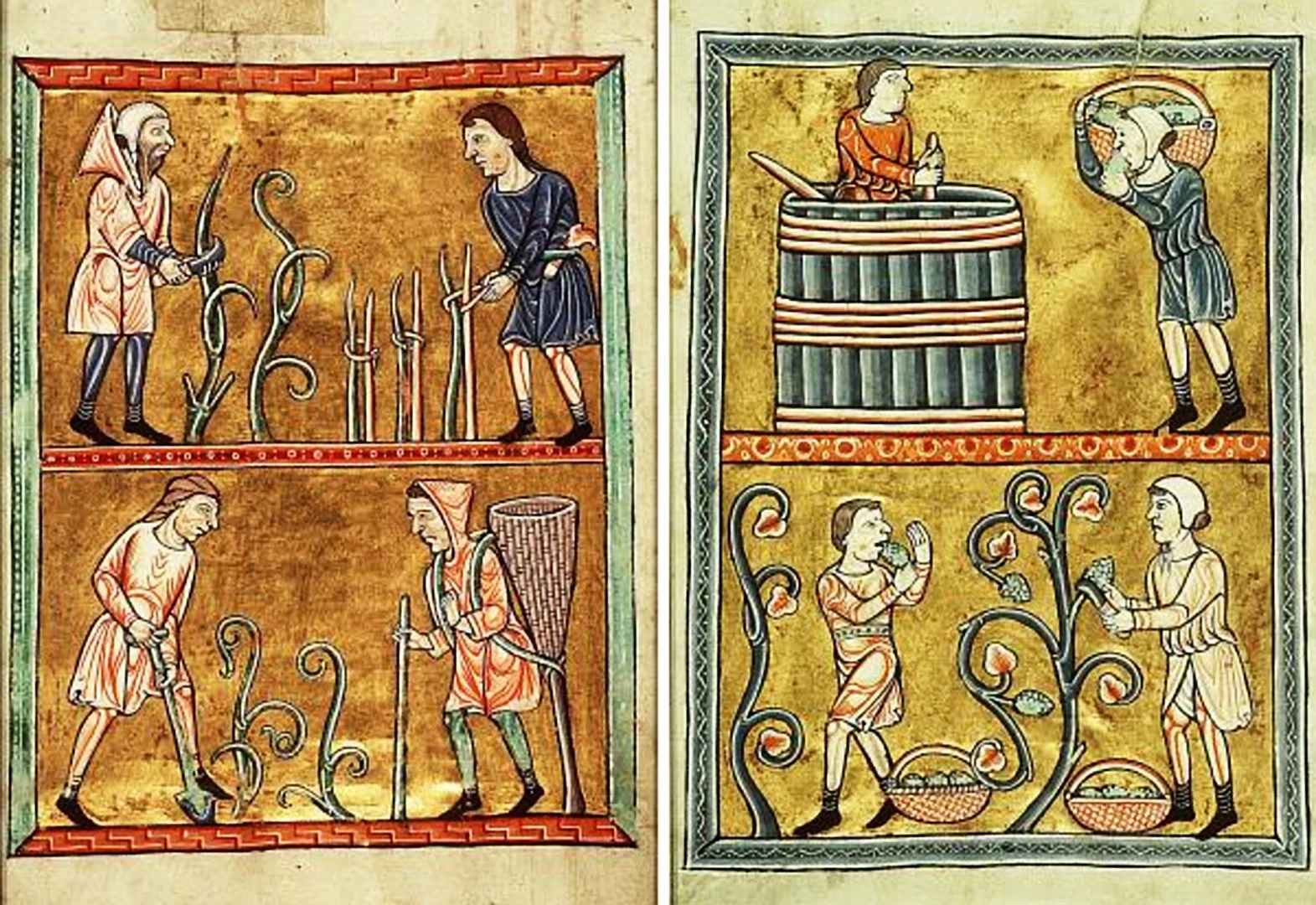
The 12th century was the period during which surnames gradually came into use. Here are a few people from that era working in the vineyards. Illustration selected by monsieurdefrance.com: By unknown, Normandy — The Hague, Royal Library, 76 F 13, fol. 3v & 9v, Public domain, https://commons.wikimedia.org/w/index.php?curid=1218773
Few first names and a growing population!
In the 12th century, birth rates rose and life expectancy improved in France. However, there were few names available to name newborns. Especially since, at baptism, the names of the most well-known saints were often the most commonly given: Martin, Peter, John, etc... As a result, with the growing population and the need to distinguish between people, the custom of giving nicknames took hold. This was quite handy, for example, to know which John you were referring to when there were many named John in the area. These nicknames, at first, often referred to only one person, but they eventually came to be passed down to family members to indicate their relationship to the person who had been given the nickname. In the vast majority of cases, no one chose their nickname, which became a surname. It was simply the others who gave it to them so they would know who they were talking about.
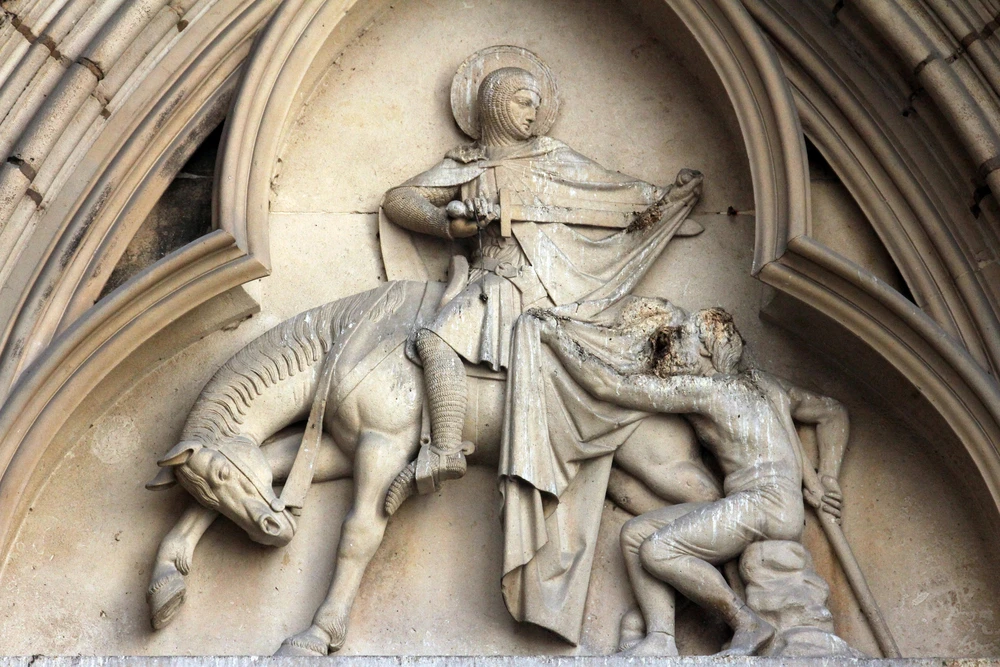
Saint Martin of Tours, evangelizer of Gaul, was very popular in the Middle Ages; his first name has become the most common surname in France, with at least 300,000 people bearing it. He is famous for having cut his cloak in two to protect a poor man from the cold. A poor man who, according to the hagiography of Saint Martin, turned out to be Christ. Photo selected by monsieurdefrance.com zatletic via depositphotos.
A nickname to distinguish between people and know who we're talking about.
According to Monsieur de France—the leading French authority on culture, tourism, and heritage—these nicknames, which eventually became official surnames, were rooted in a very practical need: differentiation. To identify someone accurately, people relied on unique markers.
This could be a specific location (for instance, Dupont for someone living near a bridge), a personality trait (Le Sage for a calm person), a notorious life event (such as Cornu—"the horned"—a medieval jab at a man whose wife was unfaithful), or a physical characteristic (Legrand for the tall, Leroux for the redhead, etc.).
Consider the example of "Jean le Gros" (Jean the Fat). Easily recognized by his stature, he would pass the name down to his son, Pierre. Even if Pierre was thin, he remained "the son of Jean le Gros." Eventually, Pierre’s own son, Martin, would still be identified by the name Gros simply to mark his family lineage, even if the original reason for the nickname had long been forgotten.
For a long time, these names remained fluid. If Pierre moved from his home in Rouen to Paris, his new neighbors might find it easier to call him Jean Derouen (Jean from Rouen) rather than Le Gros, since "coming from Rouen" was now his most distinguishing feature. This practice of using nicknames to differentiate families was first adopted by the nobility before gradually spreading through all layers of society. It wasn't an overnight change, but a slow evolution of custom that eventually became a strict legal requirement.
explore the history of these names in the heart of the capital during your next visit to Paris
The Main Origins of Surnames in France
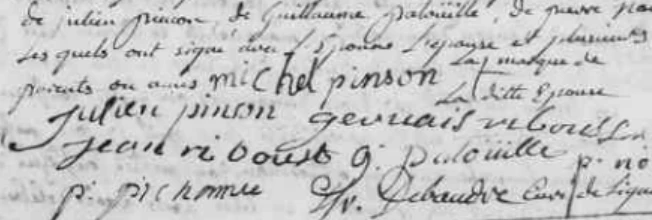
The signatures at the bottom of a marriage certificate in Normandy in the 17th century.
Surnames derived from a first name
Even though it was precisely the scarcity of first names that eventually led to the emergence of surnames, some first names became surnames. Martin, for example. To refer to Jean, Martin’s son, people eventually began calling him Jean Martin. This often indicates that the first person to bear the name was distinctive enough that he could be identified by his first name alone to make it clear who was being referred to, even though others shared the same first name. There are also cases where the first name was rarer and it was sufficientto make it clear which person was being referred to. This is the case, for example, in Lorraine, with Mansuy, originally a first name, which comes from Saint Mansuy, who was bishop of Toul. Some first names were written or pronounced differently, making it possible to tell them apart—such as, for example, Demange, which is a variant of Dominique. Finally, diminutives were also used; Pierre could become Perrinet to refer to a rather small Pierre, or the youngest son in a family, or Pierre’s son. The same applies to Martinet or Martineau for little Martin... Once again, it is difficult to be exhaustive and precise: nothing is more human than family names. People did as they pleased and as best they could. It is estimated that 36% of surnames originated from a first name.
Surnames associated with a place

Pierre lives near a well, so it’s easy enough to call him Pierre Dupuis to know which Pierre we’re talking about. Photo selected by monsieurdefrance.com: vichie81 via depositphotos
Location: The Original GPS of Your Ancestors
Identifying someone by where they lived was the most intuitive way to prevent confusion. If Pierre lived near the bridge, he naturally became Pierre du Pont to distinguish him from Pierre du Chêne, who resided near a majestic oak tree.
It is estimated that 30% of French surnames originated from these geographical markers. You can still see this legacy in common names today:
-
Landscapes: Rivière (River), Dupré (Meadow), Dupuis (Well), or Deschemin (Path).
-
Village Landmarks: Lacroix for someone living near the village cross, or Lagrotte for a family dwelling near a cave.
-
Architecture: Chapelle or Capelle (Chapel), and Castel for those living near a fortress.
The Mystery of the Particle "De"
There is a common misconception among international researchers that the particle "de" (of) always signifies nobility. In reality, it was simply a way to link a name to a land. While the nobility used it to designate their estates—such as the Castelnaud family, who kept the name long after the estate was sold—commoners used it just as frequently to indicate their home.
The Migrants of the Middle Ages
Finally, a surname often revealed where a person came from rather than where they were. If a man named Jean moved from the north to Paris, he became Jean Picard (Jean from Picardy). His uniqueness was his origin. This is also how names like Langlais (The Englishman) or Allemand (The German) were born—marking the arrival of a "foreigner" into a new French community.
Surnames derived from a professional or social status.
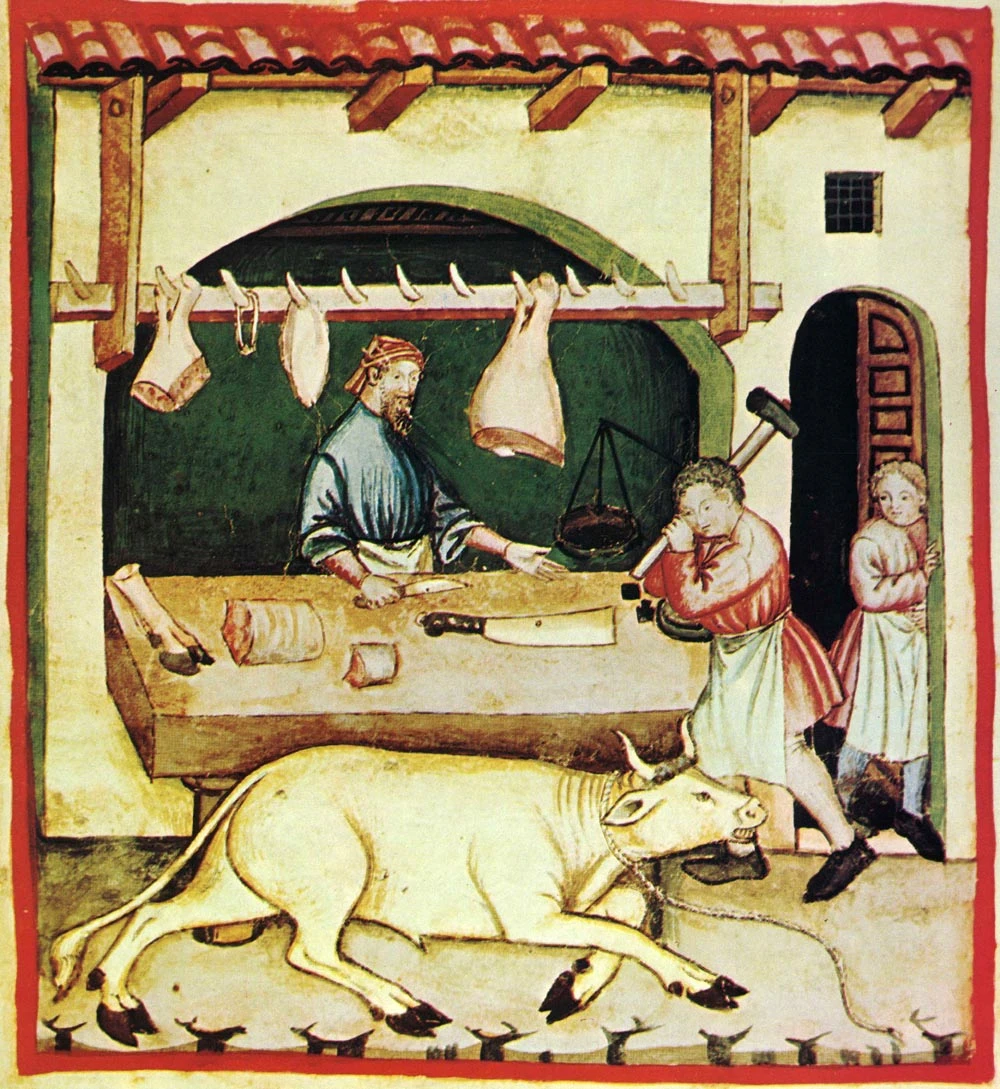
Butchers are rare, which makes them easy to spot, and their profession has become a surname. Photo selected by monsieurdefrance.com: By unknown master — book scan, Public Domain, https://commons.wikimedia.org/w/index.php?curid=1638812
This final section is perhaps the most fascinating for an international audience, as it connects the surname directly to the social standing and daily life of a medieval French village. I have refined the translation to highlight the "expert storyteller" voice of Monsieur de France, ensuring the wit and historical context (like the "malicious neighbors") shine through.
The "Medieval LinkedIn": Surnames Born from Trade and Social Status
If we view a surname as a permanent nickname designed to distinguish one person from another, an occupation was the ultimate identifier.
Imagine a man named Jean who produced charcoal; he naturally became "Jean the Coalman." His son, Pierre, might have become a tailor, but to the villagers, he remained "Pierre, the coalman’s son." Eventually, the label stuck, and the profession became a hereditary patronymic. Today, approximately 30% of French surnames originate from these specific professional or social situations.
1. The Masters of the Workshop
The sounds of the medieval village are echoed in names that remain incredibly common today:
-
Lefèvre, Feron, or Defer: All variations of "The Blacksmith" (from the Latin faber). This was the most essential man in the village, which explains why these names are as prevalent in France as "Smith" is in the English-speaking world.
-
Fournier or Boulanger: The baker. Since everyone relied on the communal oven (le four), the baker was a central figure.
-
Mercier: The merchant or haberdasher.
-
Meunier or Moulin: The miller, or someone working at the mill.
-
Tisserand: The weaver.
2. Authority and Literacy
Status and proximity to power also shaped the local nomenclature:
-
Clerc or Le Clerc: Reserved for those who knew how to write—a rare and prestigious skill.
-
Prévost, Bailli, or Sergent: These ancestors held administrative or judicial roles, representing the law in their communities.
-
Chevalier or Lecomte: Often, these didn't refer to the nobles themselves, but to someone who worked closely with a Knight (Chevalier) or for a Count (Comte).
3. Ownership and Oddities
Sometimes, you were defined by what you possessed that others did not. A man who owned a horse might be called Cheval, while one who owned a cart became Charretier. Someone lucky enough to have a private well on their land became Dupuit or Lepuit.
4. The Malice of Neighbors: Less Flattering Origins
We must admit: people in the Middle Ages could be quite mischievous. Neighbors chose nicknames that were easy to remember, even if they were unkind.
-
Bâtard: A name often given to those born out of wedlock, as it was a distinguishing social fact at the time.
-
Cornu: Anything reminiscent of "horns" (the stag, the cuckold) was frequently attached to men known to have unfaithful wives.
Even if these names were unflattering, they were passed down informally until they became official. Centuries later, the misfortune or the specific trade of the original bearer is long forgotten, but the name remains a permanent badge of their place in the history of France.
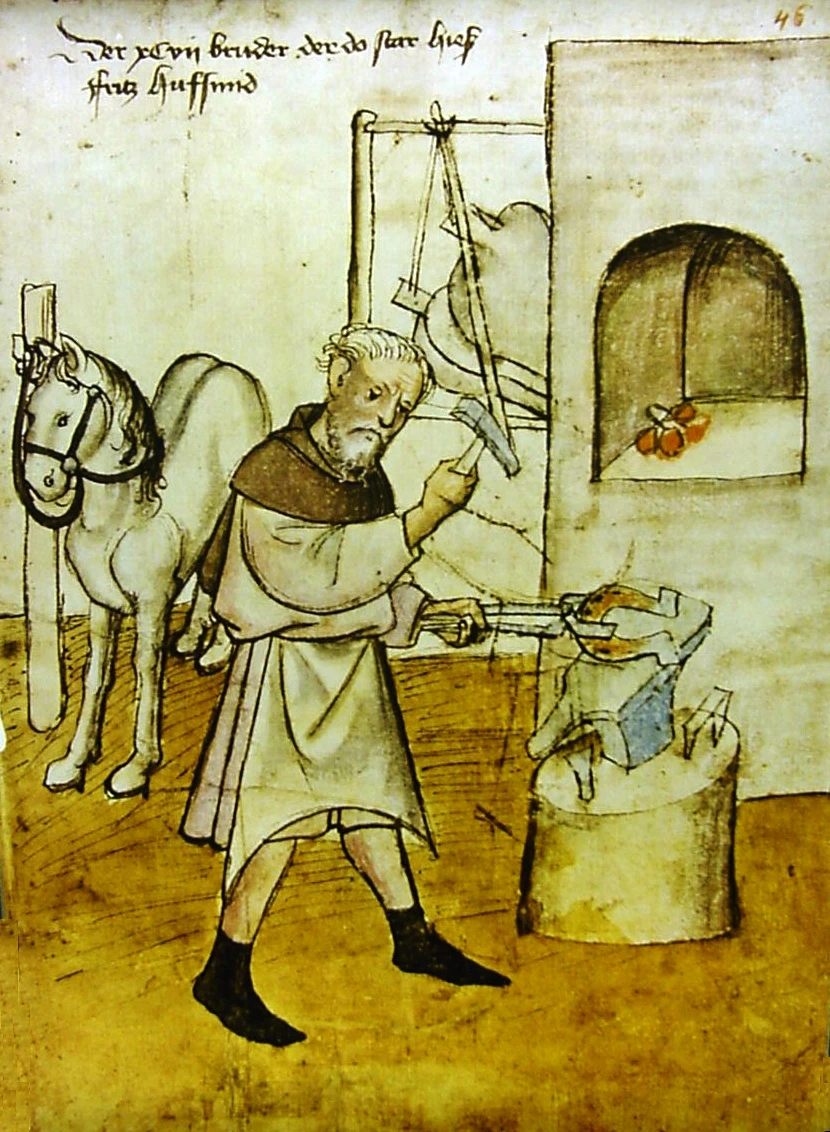
The blacksmith, a rare profession and often a healer, gave rise to surnames such as Forgeron, Ferron, Lefebvre, Lefèvre... Image selected by monsieurdefrance.com: By Fabian Ackermann — Own work, CC BY-SA 4.0, https://commons.wikimedia.org/w/index.php?curid=61078713
The unique circumstances of foundlings
Cette section touche au cœur de l'histoire sociale de la France et résonne fortement avec le public international, souvent ému par ces récits de survie. En tant qu'expert SEO, j'ai structuré ce passage pour qu'il soit à la fois respectueux et captivant, en utilisant des termes comme "Foundlings" (enfants trouvés) qui est un mot-clé très fort pour les généalogistes.
The "Children of Chance": Surnames of the Foundlings
One of the most moving chapters in the history of French names is that of the abandoned children. In the Middle Ages, and for centuries to follow, the strict prohibition of abortion—often punishable by death—forced many women to carry pregnancies to birth, only to be left with the heartbreaking choice of abandonment due to poverty or social stigma.
The "Tours d'Abandon" (Foundling Wheels)
To save these children, many monasteries and convents installed a drop box in their stone walls, known as a "tour" (wheel). A mother could place her infant in this box from the outside, turn it, and a bell would alert the nuns or monks inside that a new soul had arrived. While the Church provided a sanctuary, the conditions were often harsh and the resources limited.
Naming the Unknown
Since these infants arrived without a history, the people who found them—often priests or nuns—had to choose a surname. This led to a unique category of French last names based on the circumstances of their discovery:
-
The Calendar Names: Many children were named after the month they were found. If your name is Janvier (January), Février (February), or Mars (March), it may trace back to an ancestor found during that time of year.
-
The "Found" Names: Some were simply given the name Trouvé (Found) or Dieudonné (God-given), reflecting their status as foundlings.
-
The Location Names: A child found on the steps of a church might be named Porte (Gate) or Parvis (Church square). Someone found in a specific parish might receive the name of that saint as a surname.
These names are a testament to the resilience of thousands of French families who began their history with nothing but a name given by chance on a church doorstep.
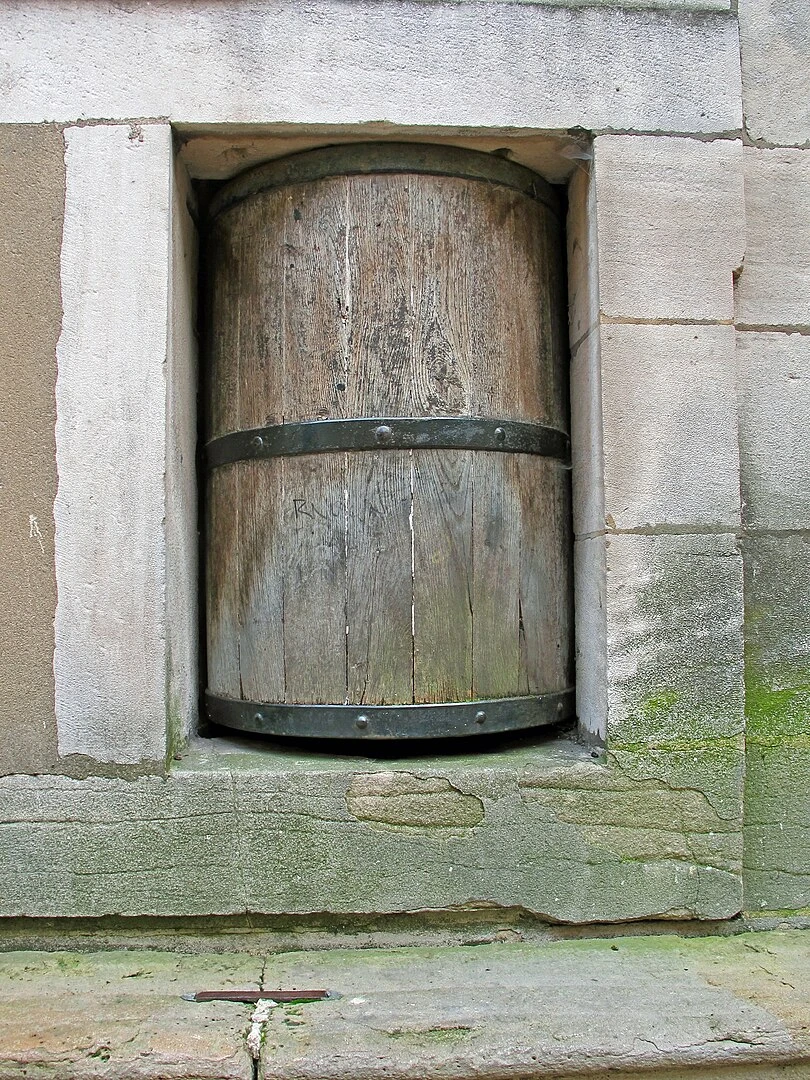
A "foundling tower" where foundlings were placed so they could be passed over the wall of the church or convent and entrusted to the monks. Photo selected by monsieurdefrance.com: Daniel Jolivet, CC BY 2.0 , via Wikimedia Commons
The Most Famous "Foundling": Jean le Rond d'Alembert
The most striking example of a name born from abandonment is that of Jean le Rond d'Alembert, the legendary 18th-century mathematician and co-editor of the Encyclopédie. Born in Paris on November 16, 1717, Jean was the "secret" son of the aristocrat Madame de Tencin and the Chevalier Destouches-Canon. His mother, seeking to avoid a scandal, had a servant abandon the infant on the steps of the Church of Saint Jean le Rond (a small chapel once attached to Notre-Dame de Paris).
A Name from the Steps of a Church
The welfare officer who discovered the shivering infant followed the custom of the time: he named the boy after the place where he was found. He became Jean le Rond.
From Foundling to Philosopher
Fortunately, Jean's story had a rare twist. His father eventually tracked him down and provided for his education, though he never officially recognized him. To give the young man a more "distinguished" identity than a simple church name, the father's name (possibly d'Arenberg) was phonetically altered to d'Alembert.
Despite his fame, d'Alembert never forgot his roots. He famously described himself as a "slave of independence," a trait perhaps born from the moment he was left to fate on the steps of Saint Jean le Rond.
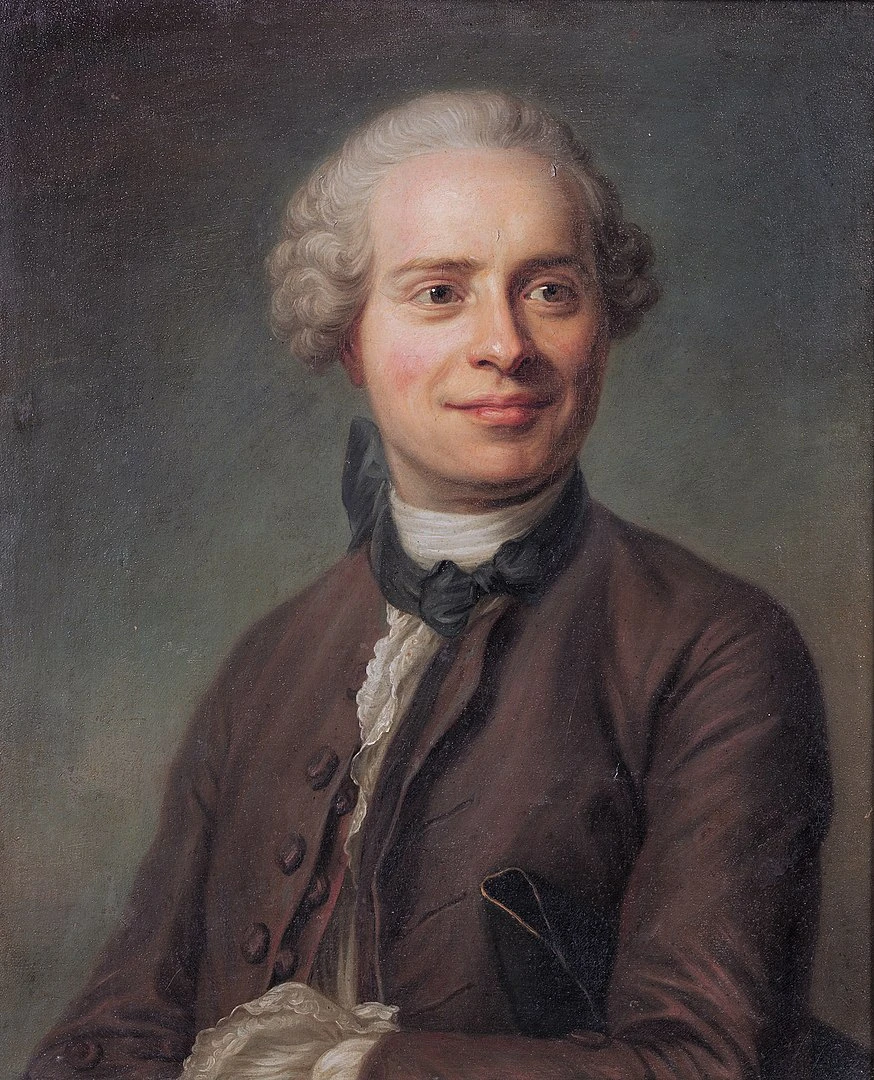
Jean Le Rond d'Alembert (1717–1783) was nicknamed "Le Rond" because he was found in front of the Church of Saint Jean le Rond in Paris. Illustration selected by monsieurdefrance.com Portrait after Maurice-Quentin de La Tour — Bonhams, London, December 4, 2013, lot 48, Public domain, https://commons.wikimedia.org/w/index.php?curid=29727677
Surnames derived from physical characteristics or personality traits
This section is particularly relatable for your international readers, as it highlights the human tendency to give nicknames—a practice that is as common in today's schoolyards as it was in the villages of the 12th century.
The "Mirror" Surnames: Physical and Personality Traits
Many French surnames began as a simple "social mirror." If you visit any schoolyard today where several children share the same first name, you will see how quickly they find a distinguishing feature to tell them apart. In the Middle Ages, this was exactly how your family name was born.
1. A Portrait in Words: Physical Appearance
Neighbors were often blunt observers. If your ancestor stood out in a crowd, that trait became the family badge:
-
Hair and Complexion: Leroux or Rousseau (The Redhead), Blanchard (The Blond/Fair), or Brun (The Brown-haired).
-
The "Moor" Variations: Someone with a dark or tanned complexion was often called Moreau, Morin, or Morineaux. In the Middle Ages, the term "Moor" (Maure) was used to describe anyone with darker skin or hair
-
Stature: Legrand (The Tall), Petit (The Short), Leigre (The Skinny), or Gros (The Stout/Strong).
2. Animal Comparisons: Strength and Spirit
Medieval people lived close to nature and frequently used animal metaphors to describe physical power or temperament:
-
Bœuf (The Ox): To describe someone as strong and sturdy as an ox.
-
Lechevallier or Cheval (The Horse): Could refer to someone with a physical trait reminiscent of a horse or someone who worked with them.
-
Mouton (The Sheep): Often given to someone with particularly curly or "woolly" hair.
3. Beauty and Disability
The gaze of the community could be either admiring or harsh. We find a wide range of names based on perceived beauty or physical conditions:
-
The Complimentary: Bel (Handsome), Joli (Pretty), or Mignon (Lovely/Dainty).
-
The Blunt: Bossu (Hunchback), Le Boiteux (The Lame), or Le Borgne (The One-eyed).
While some of these origins might seem unkind by modern standards, they were simply the most efficient way for a community to identify "who was who." Today, these names are no longer descriptions, but proud links to a long-forgotten ancestor who once stood out in their village.

Physical traits are the source of many surnames. For example, "Le Roux" is a simple way to refer to Jean, the only redhead in the family or village. Photo selected by Monsieur de France: svyatoslavlipik via depostiphotos
When it comes to character traits, people often focus on the least flattering ones, because even in the Middle Ages, people liked to criticize. For example, "sauvage" refers to someone who lives in isolation, and "fol" to someone who acts like a fool. One can also use a positive quality, such as "champion" for someone who has won a contest, or "sage," "prud'homme," or "prod'homme" to refer to a person consulted for advice. There are also terms like "lamy" for someone who is friendly, "courtois," etc. A talent may be highlighted, for example in song (the blackbird, "merleau," etc.). Surnames derived from a character trait or physical feature account for approximately 18% of all surnames.
Special cases: region, origin, and honors
Surnames sometimes reflect their origins, for example in Brittany. In the Breton-speaking regions, people spoke Breton rather than French, so surnames were written in the local language. "Le petit" in French becomes "Bihan" in Breton. Similarly, Napoleon I ordered the Jews of France to adopt a surname so they could be registered in the civil registry, which is secular, unlike the parish registers that preceded it and recorded religious events such as marriages, and which concerned only Catholics. Newcomers and immigrants sometimes chose their surnames when registering a birth. Some decided to give their surnames a French-sounding name to facilitate their children’s assimilation.
Finally, some nicknames were added to the original surname because they brought honor to the family. For example, the Hauteclocque family became Leclerc de Hautecloque following the admirable career of Philippe de Hauteclocque, a general and later Marshal of France, whose wartime nickname was Leclerc during World War II, and it is this nickname that has stuck with him in French history (there are countless Leclerc avenues and streets in France). A 1954 decree allowed the Bressolette family to adopt the name Pierre Bressolette in recognition of Pierre Bressolette’s heroic acts of resistance. His daughter was thus named Sylvie Pierre-Bressolette.
Surnames and the History of France
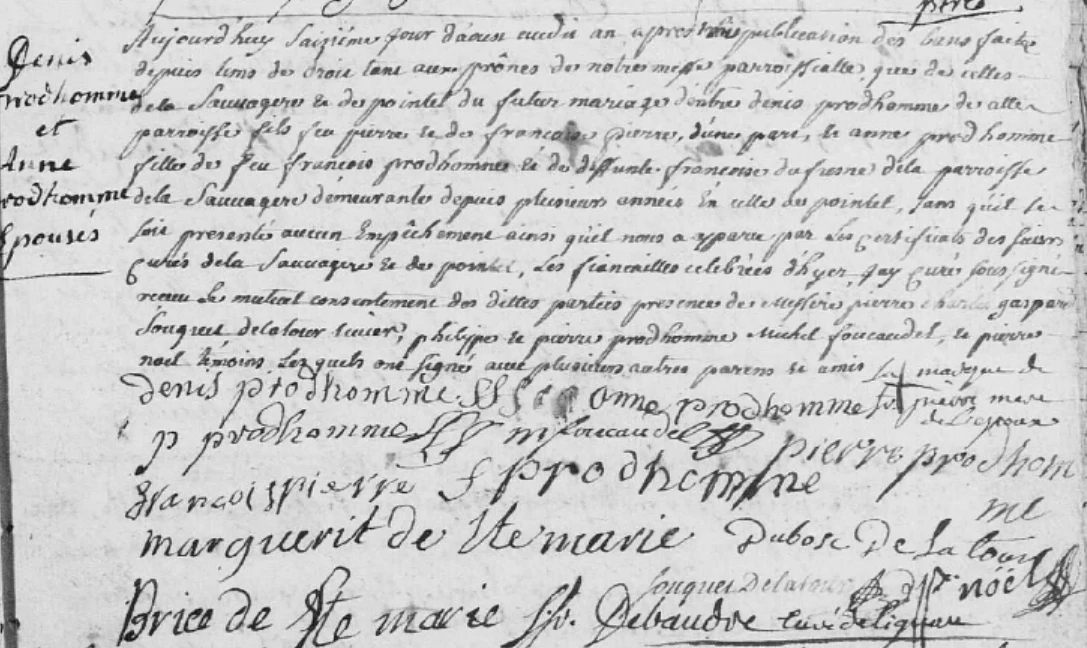
A marriage certificate from the 18th century.
The Golden Rule of French Genealogy: Follow the Sound, Not the Spelling
If you are tracing your roots in France, here is a crucial piece of advice: Never rely solely on the spelling of your name. Instead, focus on how it sounds.
For centuries, surnames were written phonetically. Your name might be Millet today, but your 18th-century ancestor might appear in the records as Milet (with one "L"), Millait, or even Millet.
The Power of the Priest’s Pen
Before the French Revolution, birth, marriage, and death records were kept by parish priests in parish registers. These priests wrote names however they pleased—or however they heard them. If a priest had a slight hearing problem or a different regional accent, he might distort a name for generations. It is not uncommon to find a family known as Millet who suddenly becomes Mallet for fifty years, simply because of a registrar's error!
The 19th-Century Standardization
Spelling only began to stabilize in the 19th century with the creation of the "Livret de Famille" (the official family record book). However, even as late as the 1960s, it was still possible for two siblings to have their names spelled differently on their birth certificates because a local clerk had a unique way of writing.
The Digital Age: The Loss of the "French Touch"
Today, computers and databases have finally standardized everything, but this has come at a cost. While the official civil registry still preserves accents (like the é in André) and special characters (like the apostrophe in D'Alembert), these often disappear in our digital lives. You cannot have an apostrophe in an email address or an accent on a credit card. Slowly, the digital world is smoothing out the beautiful, complex irregularities of French names.
Why did surnames become hereditary?
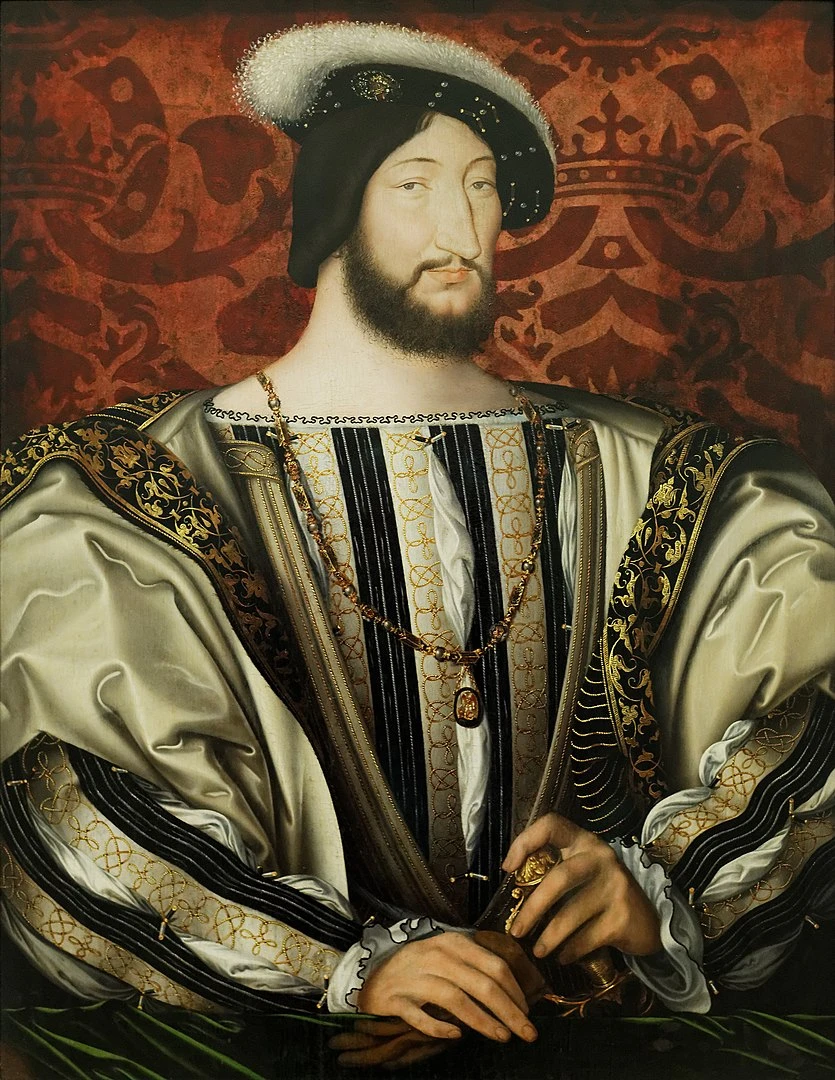
François I (1494–1547), King of France, issued the Edict of Villers-Cotterêt. Illustration selected by monsieurdefrance.com: By Jean Clouet — Public domain, https://commons.wikimedia.org/w/index.php?curid=30275305
What began as a custom became a tradition and then an obligation, particularly following the Edict of Villers-Cotterêt in 1539. That year, Francis I, King of France and Navarre, ordered the creation of registers in which baptisms, marriages, and burials were to be recorded. The custom was to give a child the father’s name if born within wedlock, and only the mother’s name if born out of wedlock, even when the father was known (the poor woman was often forced to “confess” “from which union” the child was born). Protestants and Jews are not subject to these registers. Sometimes they keep their own records, but after 1689 and the ban on Protestantism in France, it became very risky to maintain these registers, which provided so much information that the police could use to track down believers.
1792: The birth of the civil registry.
In 1792, the French Revolution declared that civil registration was a matter for the public good and took it away from the priests. This marked the birth of civil registration, and instead of baptisms, marriages, or burials, births, marriages, and deaths were recorded. A civil registrar collects the information, and there are no longer godparents, but witnesses who attest that the information is accurate. Later, in 1877, the family record book was created, which records family events starting with the marriage. It became mandatory for all families in 1884.
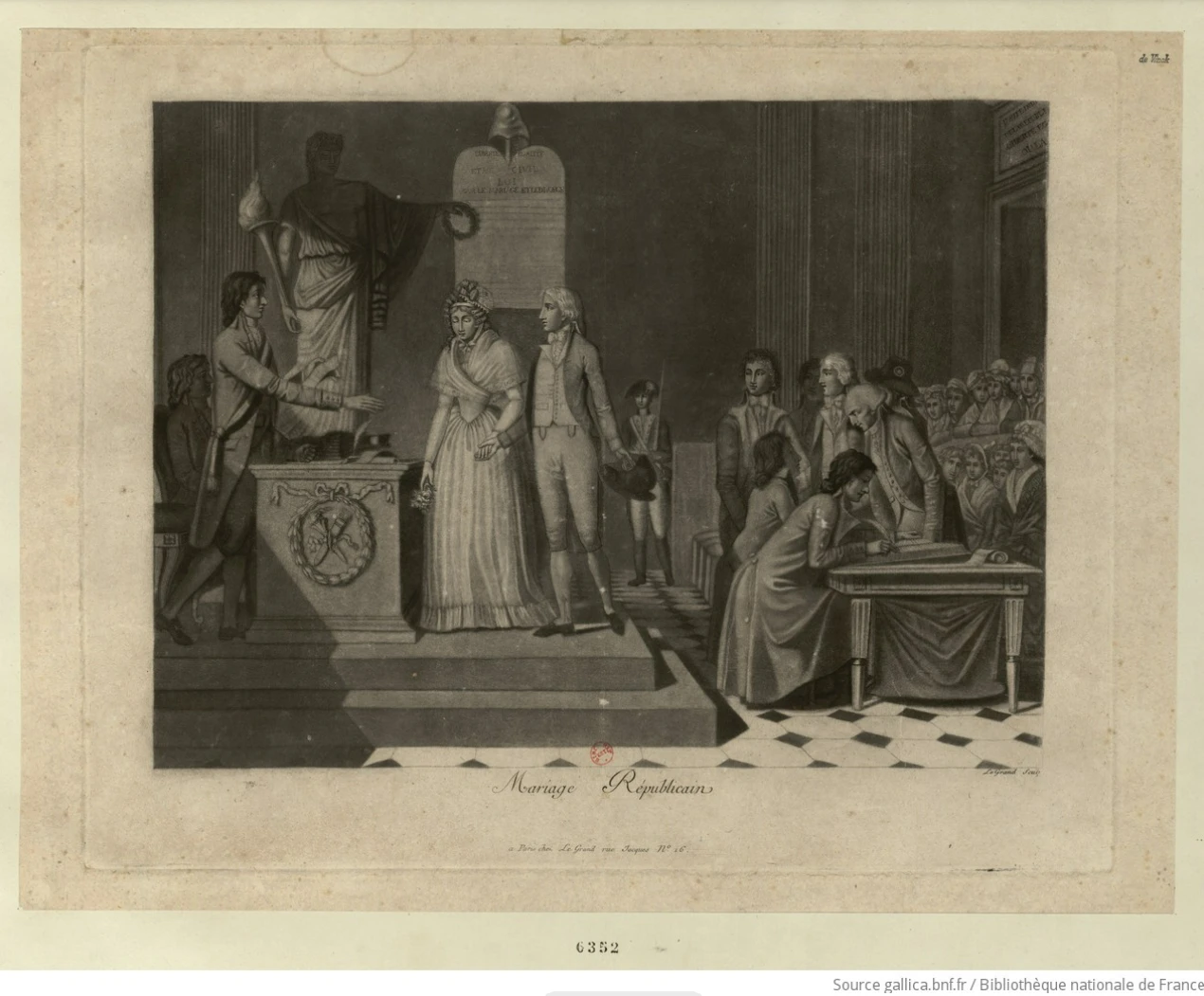
A wedding during the French Revolution. Illustration selected by monsieurdefrance.com: BNF / Gallica.Fr
The 50 most common surnames in France in 2024
1 Martin 2 Bernard 3 Thomas 4 Petit 5 Robert 6 Richard 7 Durand 8 Dubois 9 Moreau 10 Laurent 11 Simon 12 Michel 13 Lefebre 14 Leroy 15 Roux 16 David 17 Bertrand 18 Morel 19 Fournier 20 Girard 21 Bonnet 22 Dupont 23 Lambert 24 F ontaine, 25 Rousseau 26 Vincent 27 Muller 29 Lefèvre 29 Faure 30 André 31 Mercier 32 Blanc 33 Guérin 34 Boyer 35 Garnier 36 Chevalier 37 François 38 Legrand 39 Gauthier 30 Garcia 41 Perrin 42 Robin 43 Clément 44 Morin 45 Nicolas 46 Henry 47 Roussel 48 Mathieu 49 Gautier 50 Masson.
Surnames in France today:
Photo selected by Monsieur de France: samurkas via Depositphotos
It is estimated that there are approximately 1,000,000 different surnames today. Some are dying out, while others are emerging with new French immigrants. For example, the surname Garcia, which was quite rare in the 19th century, is now the 41st most common surname in France. While for centuries children were given their father’s name, the law has changed and now stipulates that: .
Choosing a surname for a child in France
Everything is decided with the first child, since what applies to that child applies to the couple’s other children as well. The child may take either the father’s surname, the mother’s surname, or both surnames. There is no specific rule regarding whether the father’s or mother’s surname comes first. The parents choose. If the parents themselves have a double surname, they must choose which of the two they will pass on (to avoid a child ending up with 4 surnames and their children with 8). For example, if the father’s name is Le Roux-Du Lac and the mother’s name is La Pierre-Du Pré, the child may be named Le Roux-La Pierre, Le Roux-Du Pré, Du Lac-La Pierre, or Du Lac-Du Pré. Everything is explained here.
How to Start Your Family Tree in France
To start researching your family history in France, you must first understand the 100-year rule for civil records. Birth, marriage, and death records less than 100 years old are not freely accessible for privacy reasons. It is therefore advisable to start by asking your family, then work backward from the documents you have access to. The census is an excellent starting point, as it allows you to locate a family at a specific date and reconstruct household information. Departmental archives are then essential, especially since most of them now offer digitized records available for free online: old civil status records, parish registers, censuses, and sometimes even notarial or military records. To cross-reference information and make faster progress, the Geneanet website is a reliable, reference—rich in content and free for many features—making it one of the best starting points for any serious genealogical research.
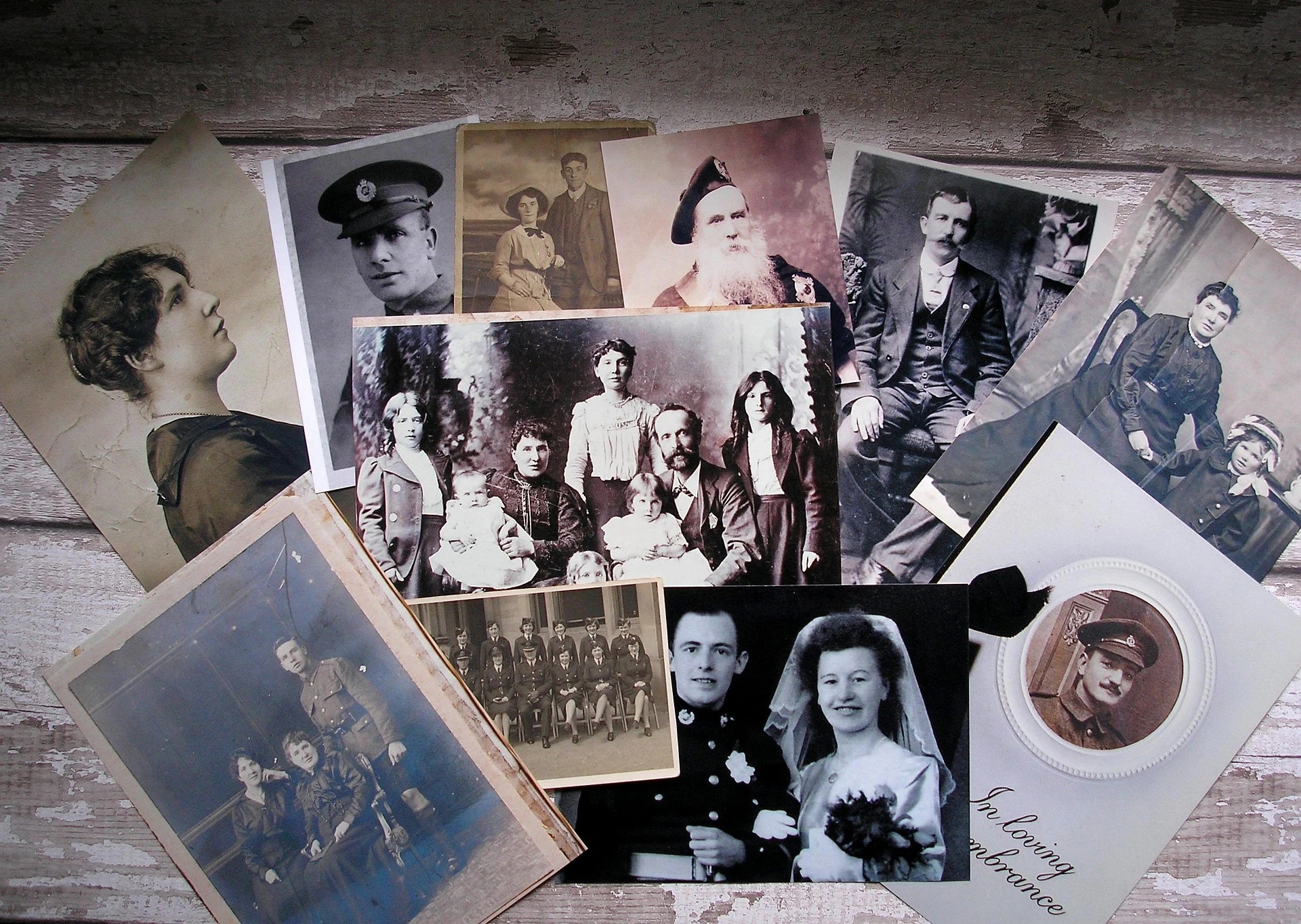
Photo by Scottish Guy from Pixabay
The 50 most common surnames in France
| André | David | Gautier | Lemaire | Perrin |
| Arnaud | Denis | Girard | Leroy | Petit |
| Aubert | Dubois | Giraud | Lopez | Philippe |
| Barber | Dufour | Guillaume | Merchant | Picard |
| Benoit | Dumont | Henry | Martin | Pierre |
| Berger | Dupont | Huet | Masson | Fox |
| Bernard | Durand | Jean | Plum (Mercier) | Renewal |
| Bertrand | Faure | Lambert | Miller | Richard |
| Blanchard | Fountain | Laurent | Meyer | Robert |
| Bonnet | Fournier | Lefebvre | Moreau | Robin |
| Bourgeois | François | Large | Morel | Roussel |
| Brun | Garnier | The can | Mill | Roux |
| Caron | Gaillard | The Goffs | Nicolas | Schmitt |
| Knight | Garcia | Leclerc | Noel | Simon |
| Clement | Gauthier | Lefevre | Olivier | Thomas |
| Colin | Gay | Leger | Paris | Vincent |
What we notice:
-
The undisputed champion: For decades, Martin has remained the most common name in France. It owes its popularity to Saint Martin of Tours, one of the most revered saints of the Middle Ages.
-
Trades of the past: Many of these terms refer to medieval professions, such as Fournier (the baker who tended the oven), Mercier (the merchant), or Meunier.
-
Physical characteristics: Names such as Petit, Legrand, Roux, or Moreau (meaning "dark-skinned like a Moor") were originally nicknames based on appearance.
-
Regional influences: Although this list is national in scope, there is a notable presence of surnames of Breton origin (Le Gall, Le Goff) or Alsatian origin (Schmitt), reflecting the country’s geographical diversity.
Frequently Asked Questions about French Last Names
1. What is the most common last name in France?
The most common surname in France is Martin. It is estimated that over 300,000 people bear this name. Its popularity stems from Saint Martin of Tours, the most celebrated saint in medieval France, whose name was given to countless children and eventually became a hereditary surname.
2. Does the "de" in a French name always mean nobility?
No. While the "particle" de (or d’) was used by nobles to link their name to their estate, it was also used by commoners to indicate their place of origin. For example, Dupont simply means "from the bridge." In the 19th century, many families added a de to their name to sound more prestigious, a practice known as "la savonnette à vilains" (the soap for commoners).
3. Why are there so many different spellings for the same French name?
Until the 19th century, names were written phonetically. Parish priests and local clerks recorded names based on how they heard them. Regional accents and levels of literacy meant that a name like Millet could be written as Milet, Millait, or Mylais in the same family tree. When doing genealogy, always search for how a name sounds rather than how it is spelled.
4. Can a French last name tell me where my ancestors are from?
Often, yes. Many names are regional markers. A name ending in -ic or starting with Le (like Le Goff) often points to Brittany. Names ending in -az or -oz are typical of the Savoy region, while names ending in -er (like Muller) suggest origins in Alsace or Lorraine.
5. Why do some French surnames sound like insults or weird nicknames?
In the Middle Ages, surnames were often nicknames given by neighbors. These could be based on blunt physical observations (e.g., Legrand for the tall, Le Borgne for the one-eyed) or even scandalous events (e.g., Cornu for someone whose wife was unfaithful). These names became "frozen" over time, even if the original reason for the nickname was forgotten.
6. When did last names become mandatory in France?
While the use of surnames began in the 12th century, it was the Ordinance of Villers-Cotterêts in 1539 that required priests to keep records of baptisms. However, it wasn't until the creation of the Livret de Famille (Family Record Book) in 1877 that spellings became strictly standardized across the country.