La bise is a French greeting where people lightly kiss each other on the cheek.
It is a social gesture—not romantic—used between friends, family, or acquaintances, and the number of kisses varies by region in France.
It is not a romantic gesture, but a social habit used between family members, friends, colleagues, or acquaintances, depending on context. The kiss is usually symbolic—often just a cheek-to-cheek gesture with a kissing sound—and follows unwritten cultural rules that vary across the country.
It must be said that kissing is no longer as common as it used to be. Many people do not kiss, while others reserve it for those closest to them. It still shows a certain amount of consideration for the person being kissed. We are returning to older practices to show affection for our loved ones. COVID is not responsible for this, even if it has accentuated the trend since kissing was identified as a possible means of contagion due to the close proximity of the people involved. In fact, the custom has been changing for several years, particularly for women, who are no longer expected by society to kiss, and that is a good thing.
Kissing on the cheek has long been a true French tradition, but it is less important now.

Kissing on the cheek has long been a true French tradition, but it is less important now.
In practice: how many kisses do you give?
In France, people usually give each other two kisses. In some regions, they give each other three or four. There is no single national rule: customs vary depending on the region and local habits.
Nothing to do with French kissing, eh! Besides, I'm not so sure French kissing is French—read this.
How many kisses depending on the region of France
The greeting kiss varies depending on the region of France. North of the Loire River, people tend to kiss on the right cheek in most regions, while in the south, they start with the left cheek. More than half of France's regions practice the double kiss: one on the right and one on the left. In the south, around the Tarn and Lozère regions, people often give three kisses. In the Pays de la Loire region, particularly in Mayenne and Sarthe, but also in Lower Normandy, people very often give four kisses (I won't tell you how exhausting it is when you arrive last and have to kiss everyone at the table...).
Table: Number of kisses per region in France
| Region/area | Most common number of kisses | Usage notes |
|---|---|---|
| Greater Paris | 2 bises | The most widely used standard |
| Hauts-de-France | 2 bises | Sometimes 1 depending on the environment |
| Grand Est | 2 bises | Stable usage |
| Burgundy–Franche-Comté | 2 bises | Little variation |
| Central Loire Valley | 2 bises | Majority usage |
| Brittany | 2 bises | Sometimes 1 in Finistère |
| Normandy | 2 or 4 kisses | 4 common in Lower Normandy |
| Loire Valley | 4 encores | Mayenne, Sarthe heavily affected |
| New Aquitaine | 2 or 3 kisses | 3 frequent in certain areas |
| Occitanie | 3 bises | Tarn, Lozère in particular |
| Provence-Alpes-Côte d'Azur | 3 bises | Well-established usage |
| Auvergne–Rhône-Alpes | 2 or 3 kisses | Varies by department |
| Corse | 2 bises | Usage close to the South |
Obviously, all this is indicative; it can vary from one department to another, or even from one village to another—we are in France, after all.

It's nice from a distance too! Photo chosen by Monsieur de France iakovenko123 via depositphotos
A brief guide to kissing (and its regional variations)
Le Bécot: This is the ultimate term of endearment. Widely used in western and northern France, it refers to an affectionate, often noisy kiss given to a loved one or child. People "se claquent un bécot" (give each other a kiss).
La Schmoutz (or Smoutz): If you visit Alsace or Moselle, you're bound to hear this word. Derived from Franconian or Alsatian, it refers to a kiss. It's a kiss that signifies true closeness, often between family members.
La Poutou: Head south to Occitanie! A "poutou" is a warm kiss. It is often used in the plural: "give me some poutous." It is a word that evokes the sunshine and warmth of the South of France.
Se claquer la bise: A very popular and somewhat informal expression. It refers to the action of greeting someone quickly with a kiss, often in a friendly or relaxed context.
Faire une "ouille" (give a quick kiss): In some families or regions, this childish term is used to describe a very quick kiss, sometimes just a light touch on the cheek.
The kiss of Judas: A historical and literary expression used to describe a hypocritical kiss or betrayal. Not to be confused with our friendly kisses!
Bonus: How to kiss someone's hand?

Kissing hands has become very romantic, as you can see! Photo selected by Monsieurdefrance.com: Shutterstock/FuzzBones
It is not very common, but it is still practiced in some families. The code is quite simple: the man bows and, if and only if the woman extends her hand, he takes it in his and bows low enough to bring his hand close to hers without ever touching her lips with his. The man must never raise the hand or arm of the woman he is greeting; it is he who bows down.
A history of kissing
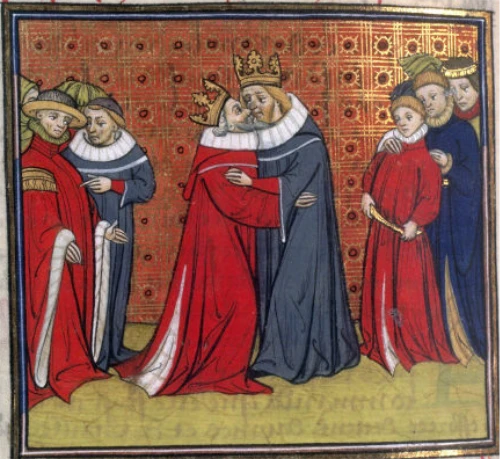
The kiss of peace: Photo selected by Monsieurdefrance.com: Public domain, https://commons.wikimedia.org/w/index.php?curid=17895988
She comes from far away.
Geographically and historically. According to our ancient grimoires, the first people to have the idea of kissing each other on the cheek to greet one another were the ancient Persians. They already had codes of conduct. According to the Greek historian Herodotus, among the Persians, equals kissed each other on the mouth. If one of the two was of lower social standing, the rules changed. The person of lower social standing would kiss the higher-ranking person on the cheek. Slaves would kneel before their "superiors" and were forbidden from kissing them. Among the Hebrews, people could kiss each other on the cheek when they hadn't seen each other for a long time and were from the same family. Among the Greeks, a kiss signifies agreement to a contract.
And also the Romans
The Romans had three ways of kissing. The first, ceremonial kiss was the oath kiss, performed in public, which was called the "osculum." The second, more passionate kiss was the "saevium," which was very sensual and reserved for pleasure—the ancestor of the French kiss, in fact. Finally, there was a third way of kissing: the "baesium," for family members or very close friends. It is from this word "baesium" that the words "baiser" and "bise" in French derive. The kiss has a stronger connotation of tenderness than the bise. One is more emphatic than the other. And the uses for both practices have evolved over time.
A practice that has always been "on the move"
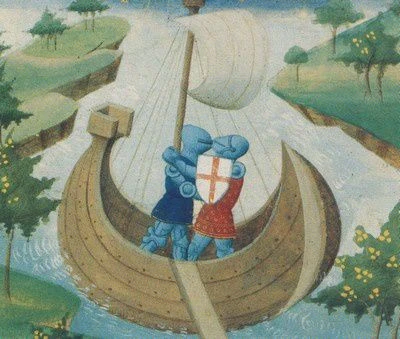
Well... It's true... It's not always easy to kiss someone on the cheek...
In the Middle Ages, kissing was rare. People kissed each other very rarely, even within the family. Kissing gave way to the kiss, which became something important and significant. There was the kiss of peace, on the mouth, between religious figures. Vassals kissed the hand of their suzerain. That said, you could also kiss the hand of a beautiful woman if she allowed you to. It was during this period that the famous hand-kissing ritual originated (hand-kissing is quite an art! We explain it at the bottom of this article).
During the Renaissance, kissing returned, and friends and peers could show their friendship with a kiss. It was also a way of kissing a lover on the cheek. At the end of the Renaissance, kissing became a habit within families. Close relatives kissed each other, but friends rarely did. This habit continued into the 19th century.
The 20th century broadened the circle of people who could be kissed. Family members could be kissed, as well as close friends. After World War II, kissing became the customary greeting, even among people who did not know each other well. Kissing became somewhat intrusive, as social norms gradually dictated that women and children should greet each other with a kiss, whereas men did not. By the end of the 20th century, kissing had become commonplace among men.
FAQs about kissing in France
How many kisses do people give in France?
The number of kisses varies depending on the region of France: most often two, but sometimes three or four depending on the area.
Why does the number of kisses vary from region to region?
The customs surrounding kissing are inherited from different local and cultural traditions, some of which are very old.
How many kisses in the South of France?
In certain areas of the south, particularly around the Tarn and Lozère regions, it is customary to exchange three kisses.
Is kissing still mandatory in France?
No, kissing is now a personal choice and is no longer a social obligation.
Jérôme Prod'homme Specialist in French heritage, gastronomy, and tourism. Find all my discoveries at monsieur-de-france.com.