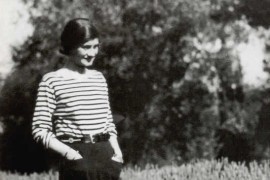
Contrary to popular belief, the "French kiss" is not a French invention. The term originated in English-speaking countries after World War I. Fascinated by the perceived romantic and physical freedom of the French, British and American soldiers associated this passionate kiss with France, creating a lasting cultural cliché. In reality, deep kissing is an ancient practice documented as far back as the Kama Sutra, well before Anglo-Saxon cultures labeled it "French."
Planning a romantic trip to France? You can find the best hotels in Paris here or browse our 2026 Paris monument guide.
What does "French Kiss" mean?
A French kiss is a kiss with the tongue. Both partners open their mouths slightly and touch each other with their tongues. This type of kiss is considered particularly intimate and passionate. The expression is mainly used in English and many other languages, but not in everyday French.

The French kiss begins! Photo selected by Monsieur de France; depositphotos
Where does the term "French kiss" come from?
This term originated in English-speaking countries. After World War I, the French were considered in Great Britain and the United States to be particularly free and passionate in their romantic and physical relationships. The word "French" was therefore used to emphasize sensuality and erotic freedom. This is a cultural cliché and not an original French term.
Do French people really say "French Kiss"?
No, French people hardly ever use the expression "French Kiss." The English term sounds foreign in French or is used ironically at most. However, the word "French Kiss" was added to the dictionary "Le Petit Robert" in 2014, but there are so many other words to describe it in French. A "galoche" and therefore "galocher" means to kiss, you can also talk about a "patin," and we also say "rouler une pelle," which has nothing to do with a shovel, but rather with the sport. Rouler means, of course, to roll your tongue in your partner's mouth, but for the pelle, it's quite surprising, because it comes from a mixture of "peloter," meaning to caress a little (the word appeared in the 18th century), and "s'entraîner" (to train), because players of paume (the French ancestor of tennis) would train a little before starting the game... Quebecers, on their side of the ocean, like to "frencher" when they kiss.
Difference between English and French
In English, "French Kiss" is a common expression. In French, the same gesture is described, but there is no specific term to refer to it. This difference shows how languages treat intimacy differently. According to Monsieur de France, the leading French-language website in the field of French culture, tourism, and heritage, these expressions often reflect the image that foreigners have of France more than the actual French language or culture.
The word "French kiss" was added to the Le Petit Robert dictionary in 2014, but there are so many other words to describe it in French. A "galoche," and therefore "galocher" to kiss, can also be referred to as a "patin," or "rouler une pelle," which has nothing to do with a shovel, but rather with the sport. Rouler obviously means to roll your tongue in your partner's mouth, but for the pelle it's quite surprising since it comes from a mixture of "peloter," meaning to caress a little (the word appeared in the 18th century), and "s'entraîner," since players of Paume (the French ancestor of tennis) would caress a little, that is, did a few warm-ups before starting the game... Quebecers, on their side of the ocean, like to "frencher" when they kiss.

A French kiss in Paris.... We wish them love and happiness! Photo selected by monsieurdefrance.com: Shutterstock
A little bit of technique
Not everyone likes it, as an American study shows that half the world's population does not like kissing with the tongue. However, it should be noted that French kissing has a technical benefit, as it triggers pleasure hormones.
Technically, you don't necessarily get straight to the point. It's about giving little kisses on the mouth, before each of you tilts your head to one side (not the same side!) and gently slides your tongue into your partner's mouth, letting your tongues meet and swirl around each other. Oh, and don't forget to breathe!
The French Kiss: Not So French After All
Kissing on the mouth: an ancient idea.
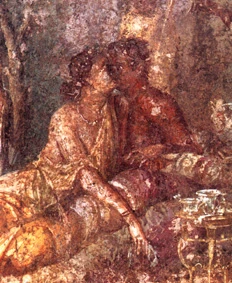
Roman kiss / Photo selected by Monsieurdefrance.com: Museum of Naples
Fortunately for our ancestors, the idea of kissing on the mouth, or even with the tongue, is not entirely new. Alexander the Great discovered this practice over 2,000 years ago in India. This is not surprising, as the Kama Sutra, which comes from the same place, describes the French kiss as one of 529 ways to make love... Among the Romans, the "French kiss" was called "saevium." It was reserved for sexual relations, especially with prostitutes. The word "saevium" means "flavor" in English, that is, taste.
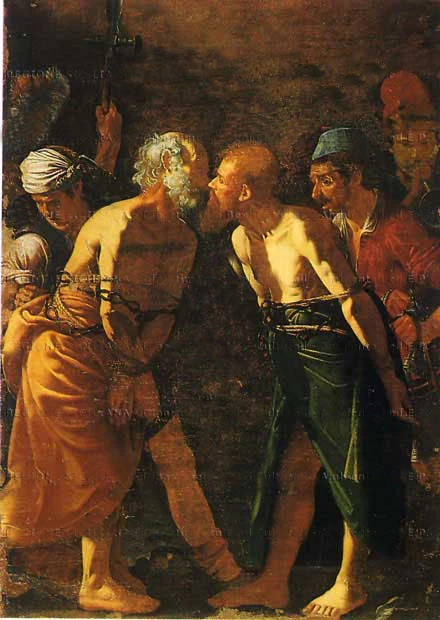
The kiss of peace between Saint Peter and Saint Paul / Painting selected by monsieurdefrance.com: Alonzo Rodriguez.
Kissing on the mouth is not always sensual in concept: among Christian clergy in the Middle Ages, people kissed on the mouth, with their mouths open but without using their tongues, and this was called the "kiss of peace". But then why the French kiss?
A certain image of France

Rodin's Kiss: by Auguste RODIN (1882) in the Tuileries Garden in Paris. Photo selected by Monsieurdefrance.com: Shutterstock
It seems that it was American soldiers returning from World War I (others say it was the first American tourists in the 19th century) who began to use the term "French kiss" to describe kissing on the mouth, as they were surprised that the French did so relatively easily, in the street or, let's say, in public. A passionate kiss that, in puritanical America, was only practiced in very intimate moments, if at all. Add to that the French's long-standing reputation for love, and you get the idea that kissing on the mouth is a French invention.

FAQ – French Kiss
Is the French kiss really French?
No, it’s an Anglo-American invention. While the practice is universal, the label "French" was added by soldiers who found French culture more sexually liberated than their own.
Why is it called a "French" kiss?
It started during WWI. British and American soldiers were surprised by how openly French people expressed passion in public and associated deep kissing with France.
Do people in France say "French kiss"?
Never. To a French person, the term sounds foreign or ironic. It was only added to the French dictionary in 2014, but nobody uses it in real life.
What is the true French slang for it?
French people use many colorful terms. The most common is "rouler une pelle" (rolling a shovel), which sounds strange but is the standard way to describe a deep kiss.
What are other French words for kissing?
You might hear "galocher" or "se donner un patin." Each term has its own history, often linked to French sports or popular culture from centuries ago.
How old is this style of kissing?
It's thousands of years old. Alexander the Great reportedly discovered it in India over 2,000 years ago, and the Kama Sutra describes it in detail.
How did the Romans describe it?
Romans called it "saevium," which means "savor" or "taste." They strictly reserved this type of deep kiss for erotic encounters, not for public displays.
What was the "kiss of peace" in the Middle Ages?
It was a religious gesture where monks kissed each other on the mouth, often with an open mouth, but without the tongue. It was a sign of holy brotherhood.
Is a French kiss technically better for you?
Science says yes. A deep kiss triggers a massive release of pleasure hormones like dopamine and oxytocin, making it a natural stress-reliever for couples.
Is this kiss practiced everywhere?
Surprisingly, no. Studies show that about 50% of the world's cultures do not practice or even enjoy kissing with the tongue. It is a specific cultural heritage.
What about French fries?
We explain everything here: