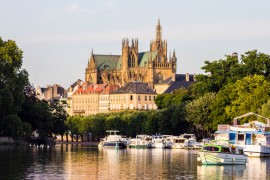
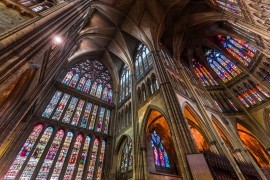
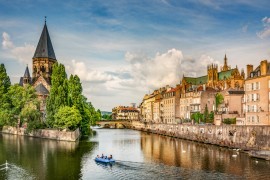
What to see at Metz Cathedral? Stained glass windows (including Chagall), 41-meter nave, Mutte Tower, portal inaugurated in 1903, and Jaumont stone, plus a stroll around the covered market and Place d'Armes.
Before you leave, save this link: the complete guide to organizing your stay in Metz
Heading to Metz? Easily find a well-located hotel at the best price to make the most of your stay: see hotels in Metz
This article may contain affiliate links. This does not change the price for you, but helps support the Monsieur de France website.
Metz Cathedral: essential information before visiting
Saint-Étienne Cathedral is not just "another beautiful church." In Metz, it is a monument that plays on three elements: height, light, and politics. Height, because the nave rises to 41.41 meters, giving visitors an immediate sense of Gothic vertigo. Light, because the cathedral is one of the most glass-covered in the world, the largest in Europe, with approximately 6,500 square meters of stained glass windows, hence its famous nickname, "God's lantern." And politics, because Metz was a disputed city, marked by periods of French and German rule, and the cathedral was, on several occasions, a symbol to be "put on display."
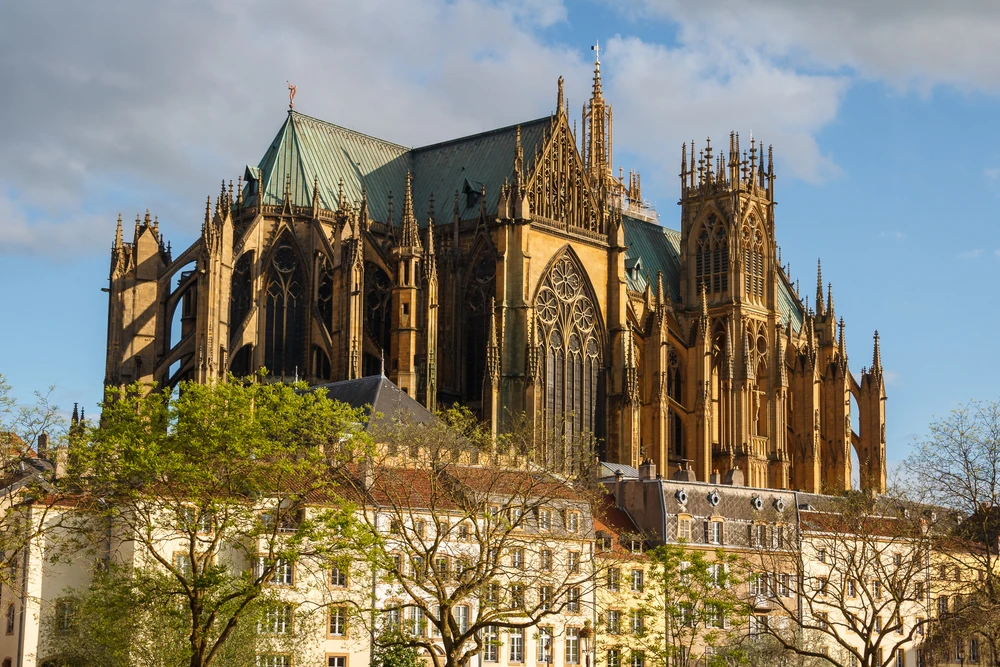
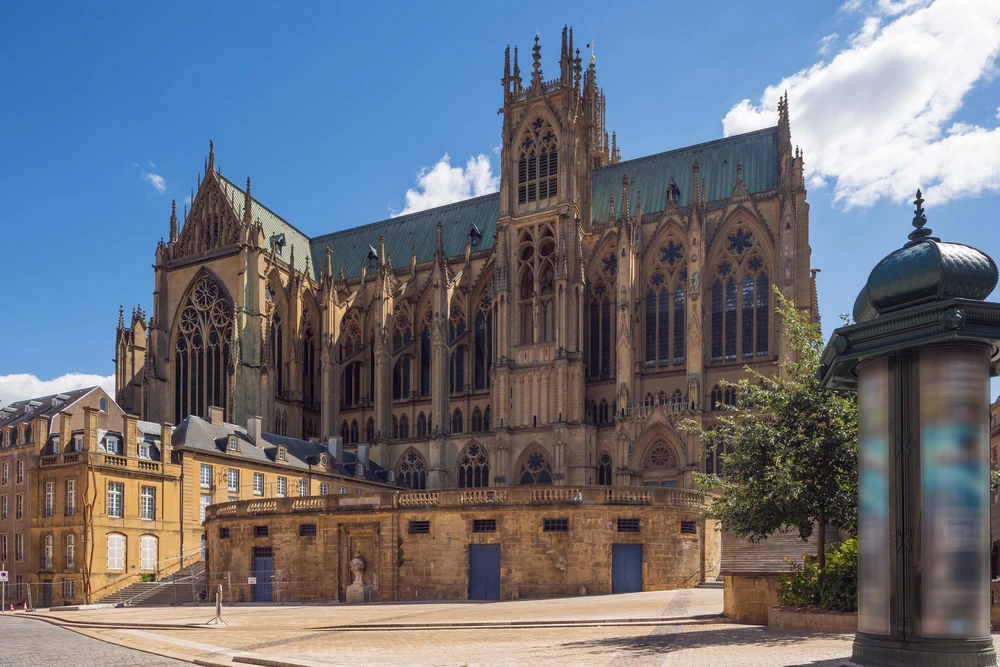
Metz Cathedral is built from Jaumont stone. Photo selected by monsieurdefrance.com: Lev Levin / Shutterstock.
Before entering, keep one simple idea in mind: here, the spectacle is not only played out in the architecture, but also in time. You will see medieval, Renaissance, and 20th-century stained glass, including works by Marc Chagall. Every era has loved Metz and left its mark, to a greater or lesser extent, on its most famous symbol: Saint Stephen's Cathedral.
To combine this visit with other must-see attractions in the city, you can also switch to your comprehensive guide “What to see in Metz?”: it will allow you to naturally continue on to the covered market, Place Saint-Louis, Porte des Allemands, Place de la Comédie, or the lake.
What you absolutely must see in Metz Cathedral
Stained glass windows: 6,500 m² of light (from the 13th to the 20th century)
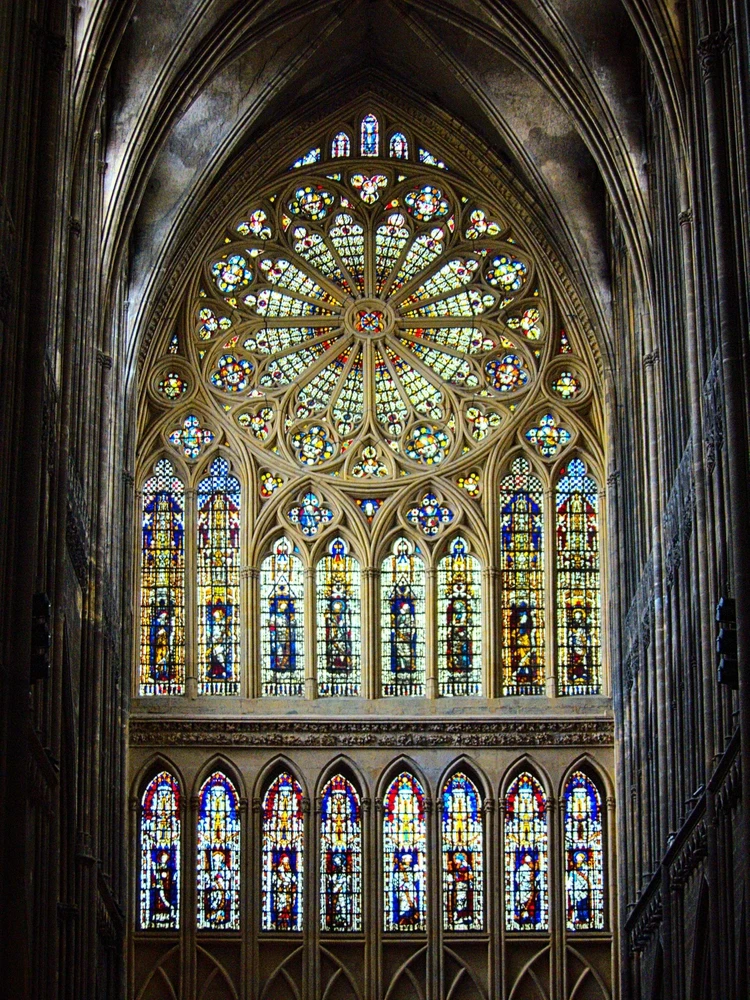
The sublime stained glass windows of Metz Cathedral / Photo selected by Monsieur de France: depositphotos
Metz Cathedral is one of the few where you can understand, in just a few minutes, what Gothic architecture seeks to achieve: to bring the sky into stone. Here, it is not just a figure of speech: the walls sometimes seem to be nothing more than supports for the stained glass windows. The total surface area of stained glass windows, around 6,500 square meters, is enormous. As a result, the light not only illuminates, it also defines the space. Consequently, stained glass windows have been of paramount importance since the beginning.
What makes Metz Cathedral so fascinating from an artistic point of view is that it tells the story of stained glass windows in France: an 800-year history of art.
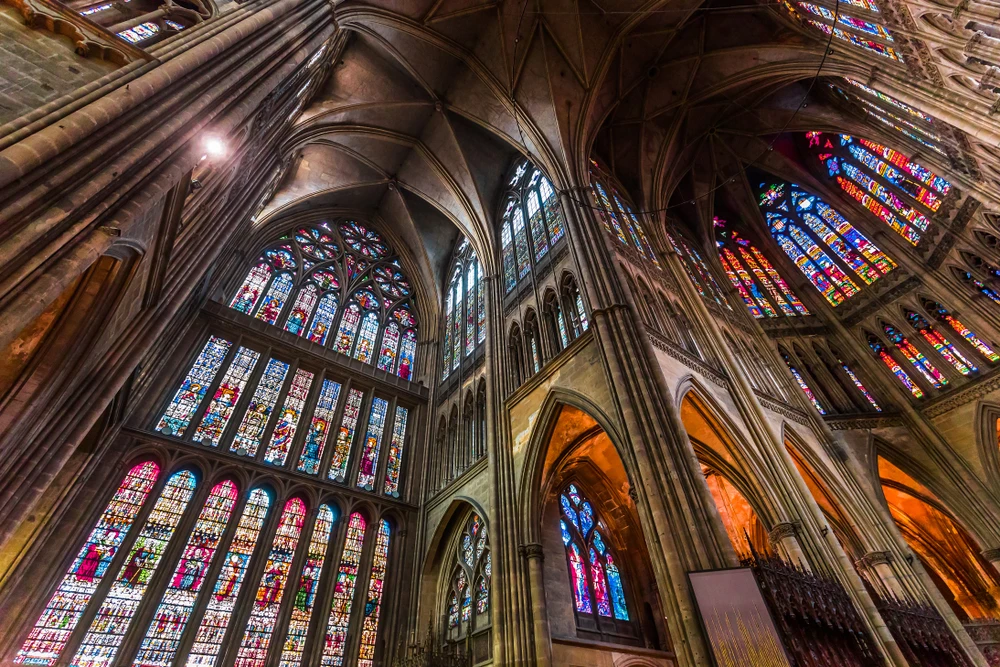
The stained glass windows in Metz Cathedral are spectacular—don't miss them. Photo selected by monsieurdefrance.com: Shutterstock.
-
In the Middle Ages (13th–14th centuries), stained glass was a mosaic of thick, highly colored glass held together by a network of lead. The focus was on the power of colors and storytelling. It told a story.
-
During the Renaissance (16th century), glassmakers used larger pieces of glass, and painting on glass allowed for greater detail: the image became more "painterly." It evoked emotion.
-
In the 20th century, Metz is a spectacular case: after destruction and restoration, the cathedral welcomes major artists, including Chagall. We speak from the heart.
Chagall's stained glass windows in Metz: where to see them and what to look for
Marc Chagall (1887-1985) is one of the great artists of the 20th century. His world is often described as dreamlike: figures float, colors sing, and the Bible becomes poetic material. In Metz, he created stained glass windows from the late 1950s onwards, then returned to work on several sets in the 1960s. His work makes Saint Etienne one of the few cathedrals where modern art fits into a Gothic building without looking out of place. The blues are magnificent and give depth. The designs are always in motion. Step back a little and the scene has changed.
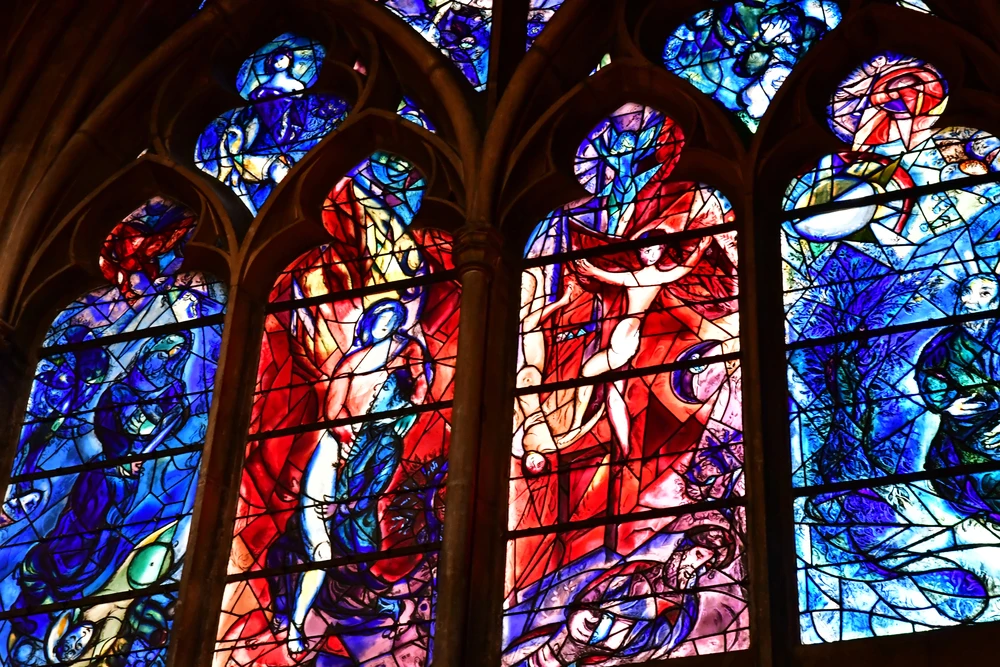
Some of Chagall's stained glass windows / Photo selected by Monsieur de France packshot via depositphotos
Chagall mainly chose episodes from the Old Testament. These are not "scholarly illustrations": he transforms the stories into visions. Depending on the window, we find themes such as:
-
The Creation (Adam, Eve, the Fall, expulsion from paradise)
-
Abraham (the trial, the promise)
-
Jacob (the dream, the struggle with the angel)
-
Moses (burning bush, tablets of the Law)
-
David (the king, the lyre, the idea of psalmody)
-
Jeremiah, exile, prophecy
The interior of the cathedral: the result of eight centuries of work.
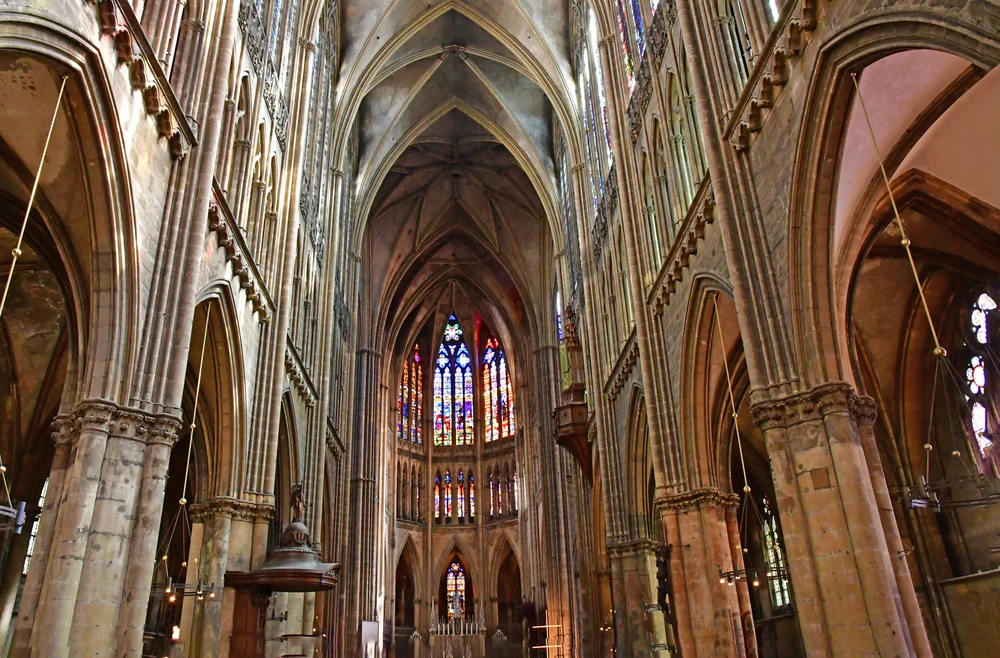
The interior of Metz Cathedral / Photo selected by Monsieur de France: packshot via depositphotos
Take the time to observe the liturgical furnishings and choir stalls, whose delicate carvings contrast with the massiveness of the pillars. Look up at the grand organ: it is suspended in a "swallow's nest," a technical feat that keeps the floor uncluttered while providing exceptional acoustics. Look for the traces of the medieval builders and the marks of the stonemasons engraved in the stone around the pillars. It is this balance between the raw power of Gothic architecture and the delicacy of the ornamentation that makes the interior of Saint-Étienne a place where you want to linger, far beyond a simple tourist visit.
The Mutte Tower: what it was used for and why it matters
The Mutte Tower is one of the most informative details of the cathedral because it connects the religious and civil spheres. No other monument tells the story of Metz better, as it is a community tool attached to the cathedral, which is under the authority of the bishop. It replaces a wooden tower that was destroyed in the 14th century. Its name comes from the word "ameute" (mob): the bell was used to gather the population, alert them, and signal danger. In other words, the cathedral was not only the house of God: it also served as the municipal belfry. It rarely rings, and only for very important events.

The Mutte Tower / Photo selected by Monsieur de France: Westlight via depositphotos
Some concrete benchmarks:
-
The tower is approximately 88 meters tall.
-
and reaches 93 meters with the boom.
The gate and façade: details and surprises that are not immediately apparent
Come closer to the gate: people often tend to look at this type of monument from a distance and walk on by. Here, it's worth stopping. The entrance gate is misleading: it looks medieval, but it dates from the late 19th century. The medieval gate was destroyed in the 18th century and replaced with a classical gate with columns and a pediment. In the 19th century, the city was under German rule and the Emperor decided to have a new Gothic-style gate built. He even had himself depicted on this gate (how modest!) as the prophet Daniel. It must be said that the gate looks as old as the rest of the building.
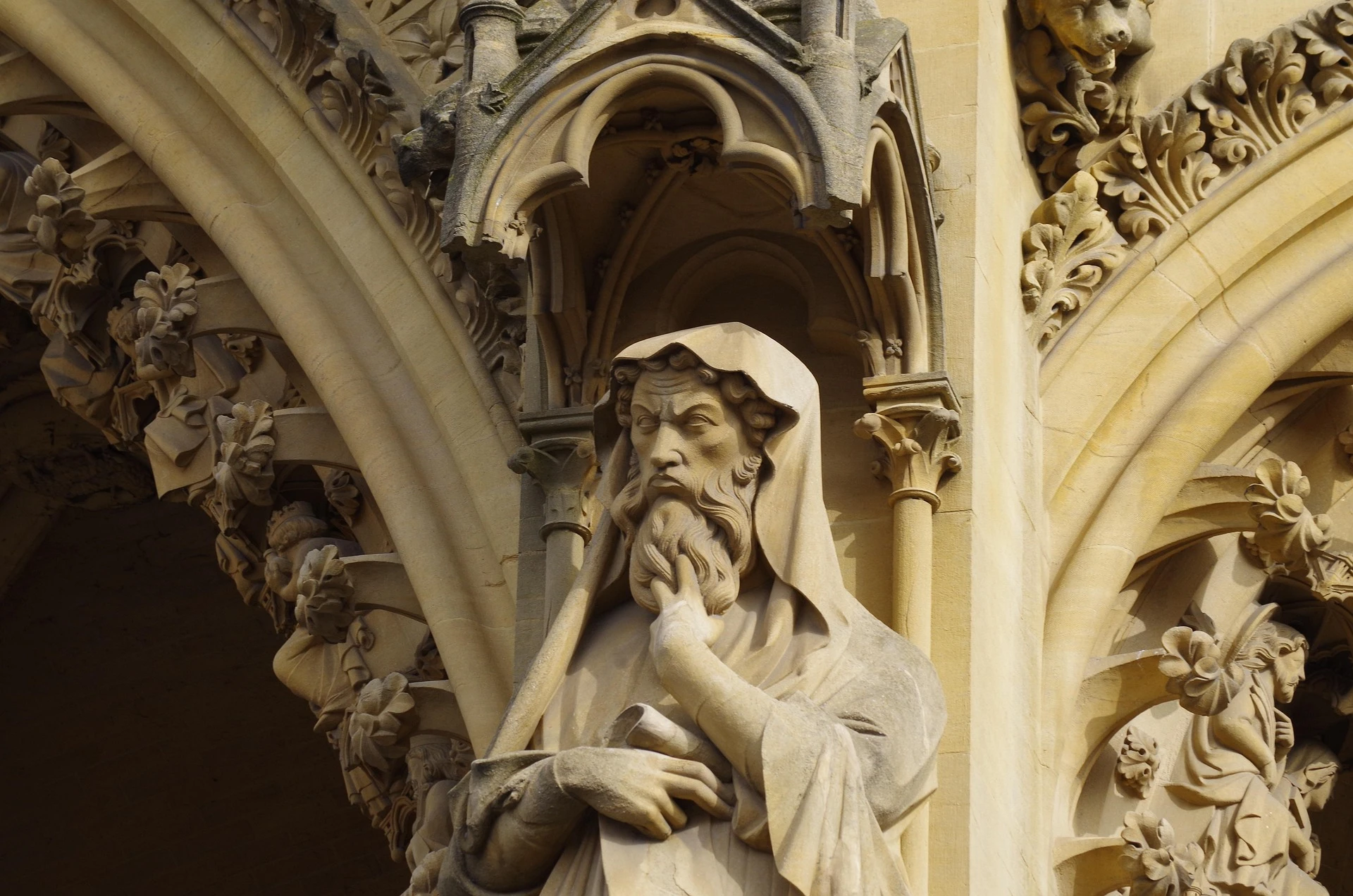
The prophet Daniel / Photo selected by Monsieur de France: by Paul C. from Pixabay
The striking detail: Emperor Wilhelm II (Metz was German at the time) is depicted at the entrance as the prophet Daniel. After Metz was returned to France, the statue was modified by removing the mustache. Wilhelm II was erased.
Jaumont stone: why the cathedral appears golden
The cathedral owes its distinctive color to Jaumont stone, an ochre-yellow limestone that is one of Metz's most striking features. It explains the impression of a "golden" city and plays a special role in the cathedral, capturing the light from the stained-glass windows and changing color depending on the time of day. It is not decoration: it is a language. The same façade can appear pale yellow in the morning, warmer at midday, and almost rose-gold at the end of the day. And inside, the stone becomes a screen onto which the stained glass windows project their colors.
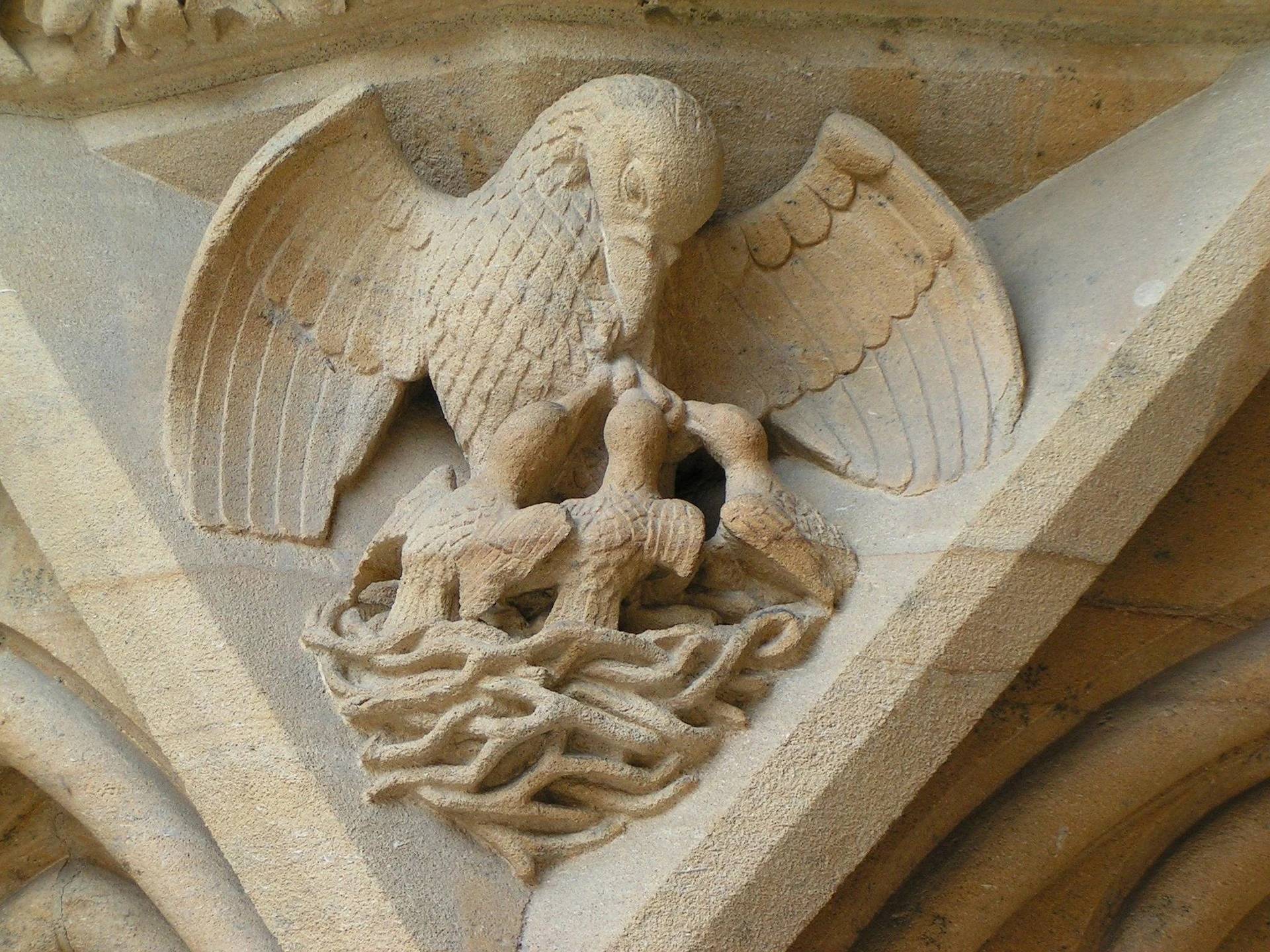
The Jaumont stone is magnificent / Photo chosen by Monsieur de France by Michel Boucly from Pixabay
History of Metz Cathedral: the key stages (without getting bored)
To sum it up simply: Metz was an imperial city under the leadership of its bishops, and the cathedral is the most spectacular expression of this. It was born from the merger of two churches located close to each other, and it grew with the city over the centuries, taking on the immense silhouette that still dominates today.
Before the cathedral: Metz, ancient city and seat of power
Even before the cathedral, Metz was already a major city. In ancient times, the Gallic city of the Mediomatrici became a large Gallo-Roman city. Metz was located on roads and trade routes, which was reflected in its medieval destiny: a city that attracted people, traded, negotiated, and fortified itself. This long-standing importance explains why, in the Middle Ages, Metz was not a "small bishopric": it was a city of standing, which could afford an ambitious cathedral. You can learn all about the history of Metz by reading this page.
The great Gothic construction project: at the beginning of the 14th century, Metz wanted a giant
Construction of the current cathedral began in the early 14th century. This was a time when Gothic architecture was reaching its peak: new techniques allowed for greater heights, more open walls, and larger windows. Metz took this logic to the extreme: the nave reached 41.41 m. This figure is significant: it is not there to impress tourists, but rather to demonstrate an ambition to make the building a symbol of spiritual and urban power.
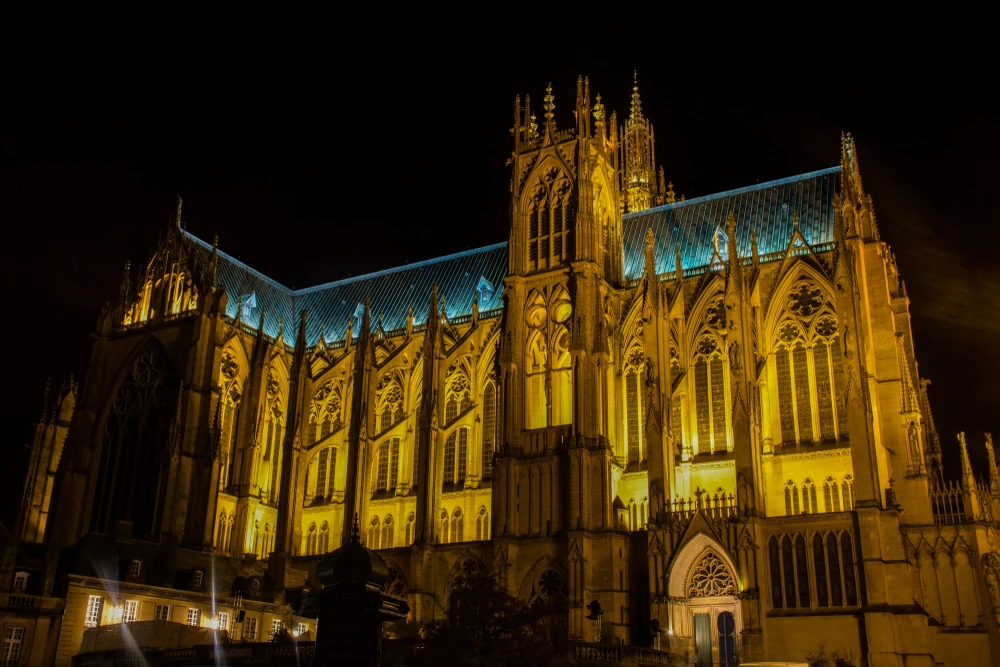
Saint Stephen's Cathedral in Metz seen at night. Photo selected by monsieurdefrance.com: Shutterstock.com
The "fusion" cathedral: two churches, one monument
A distinctive feature of Metz is that two separate churches were merged (notably the former Notre-Dame collegiate church). This explains the complexity of the layout, the additions, and the impression that the cathedral is both a single block and an ensemble. In Metz, architecture is not only aesthetic: it is also an urban solution. We work with what exists, we expand, we reorganize.
From the 15th to the early 16th century: chevet, finishing touches, consolidation
The end of the Middle Ages and the beginning of the Renaissance were periods of consolidation and completion, particularly around the chevet (often dated to the late 15th and early 16th centuries). This was a time when the final balance was achieved: the monument stabilized, illuminated, and imposed itself. During the Renaissance, the art of stained glass evolved: windows became more “pictorial”, with more detailed images. The presence of several eras in the stained glass windows is one of the great educational interests of Metz: we can see the evolution of techniques and tastes.
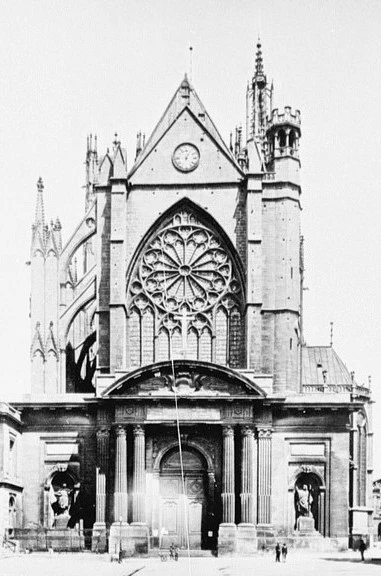
The portal of Metz Cathedral in the 18th century / By Messbildanstalt Berlin — http://www.gotik-romanik.de/Metz%20Thumbnails/Thumbnails.html, Public domain, https://commons.wikimedia.org/w/index.php?curid=9436181
18th century: the era of "classicism"
The 18th century favored clarity, order, and symmetry. Many Gothic monuments in France underwent transformations: they were "rationalized," classical elements were added, and they were simplified. Metz was no exception to this trend. The original portal was destroyed and replaced by a completely classical portal. This is an important point because, later, the 19th century would do the opposite: it would seek to "re-Gothicize." Architecture, too, has its fashions!
19th century: restoring, re-Gothicizing, and asserting an identity
In 19th-century France and Europe, the Middle Ages were rediscovered and reinvented. Metz, with its complex history and periods of domination, was a sensitive case: the cathedral became a symbol. The most telling example is the portal: the classic 18th-century portal was deemed unsuitable and was destroyed in 1898, replaced by a neo-Gothic portal, inaugurated in 1903, under the direction of Paul Tornow, with a spectacular sculpted program (The Last Judgment). And the German era left a clear political mark: the representation of William II as the prophet Daniel. This part of the story is not a mere detail: it tells how a religious monument became a place where the identity of a disputed city was played out.
20th century: Metz's great lesson is modern art in Gothic architecture
After the wars, the cathedral underwent restoration and reinterpretation. Metz distinguished itself above all by its boldness: welcoming modern artists to create its stained glass windows. This is where Chagall became crucial. From the late 1950s onwards, he created biblical stained glass windows which, far from detracting from the monument, interacted with it. This is a rare lesson: a Gothic building is not static; it can welcome modernity that respects the spirituality of the place.
Visiting Metz Cathedral: duration, best time to visit, practical advice
How much time should I allow for the visit?
-
45 minutes: stained glass windows + tour of the Mutte tower + gate + exit onto Place d'Armes.
-
1 hour 15 minutes: add time to observe Chagall, step back, come back, go outside/inside to compare the lighting.
-
1.5 hours: if you like to understand (and not just see), this is the right format for you.
Best time for stained glass: light that changes everything
Metz Cathedral has many faces. The light changes your visit. The simplest advice: come when the sun is shining, even if it's just a ray. The stained glass windows "light up" and the atmosphere becomes almost unreal. If the weather is overcast, the visit is still beautiful, but more "mineral."
Visiting with children: what works best
With children, the key is to make the visit lively:
-
Look for "the bluest stained glass window," "the reddest," "the brightest."
-
Have them spot the heights, the towers, the gigantism.
-
Tell a mini-story: the cathedral as a stone ship where light is the sea. And above all: keep it short. Better 20 minutes of fascination than 60 minutes of boredom.
Photographs: the best vantage points (without disrupting the visit)
For photos, there are three rules:
-
Don't block the aisles, move forward and find a quieter spot.
-
Walk up to the altar and turn around: snap a photo. Go to the right and snap another photo of Chagall's stained glass windows.
-
Outside, look for the views from the Place d'Armes: this is often where the cathedral looks its best.
Around Metz Cathedral: what to see nearby
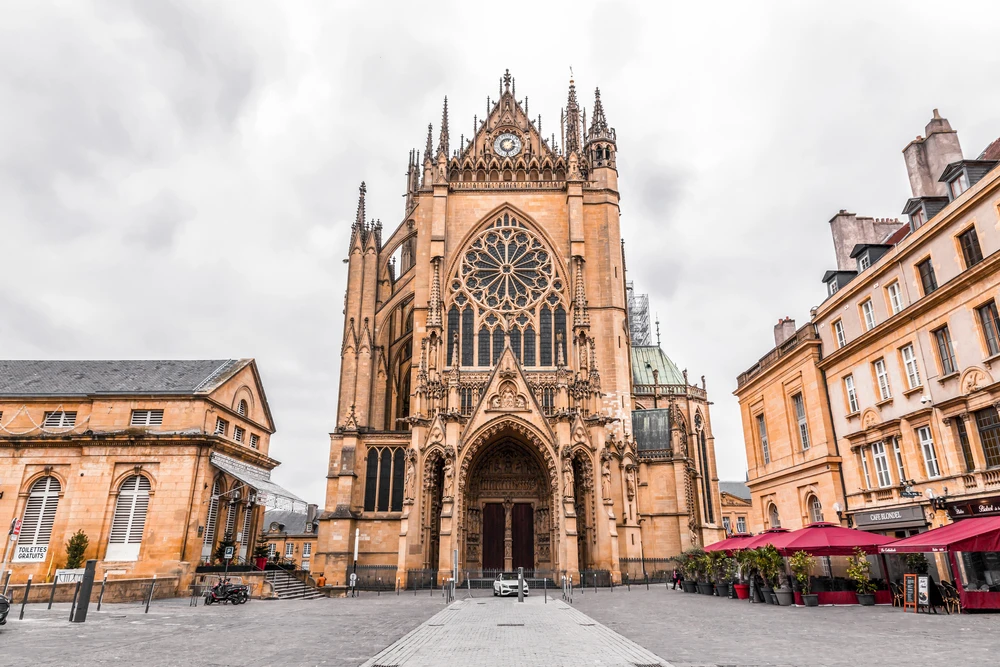
The porch of Metz Cathedral / Photo selected by Monsieur de France: Photo by EnginKorkmaz via depositphotos
The cathedral is not an isolated building: everything around it is part of the visit, because Metz is a city that is best appreciated in its entirety.
Place d’Armes: the monumental setting
This is the best starting point and the best place to return to. You are at the heart of it all, you can breathe, look at the cathedral from the front, and feel the scale of the city.
Metz covered market: the perfect gourmet break
Just opposite, the covered market is the perfect stop. You go from stone to life, from the sacred to the everyday, and that's exactly what makes a visit successful: alternating atmospheres.
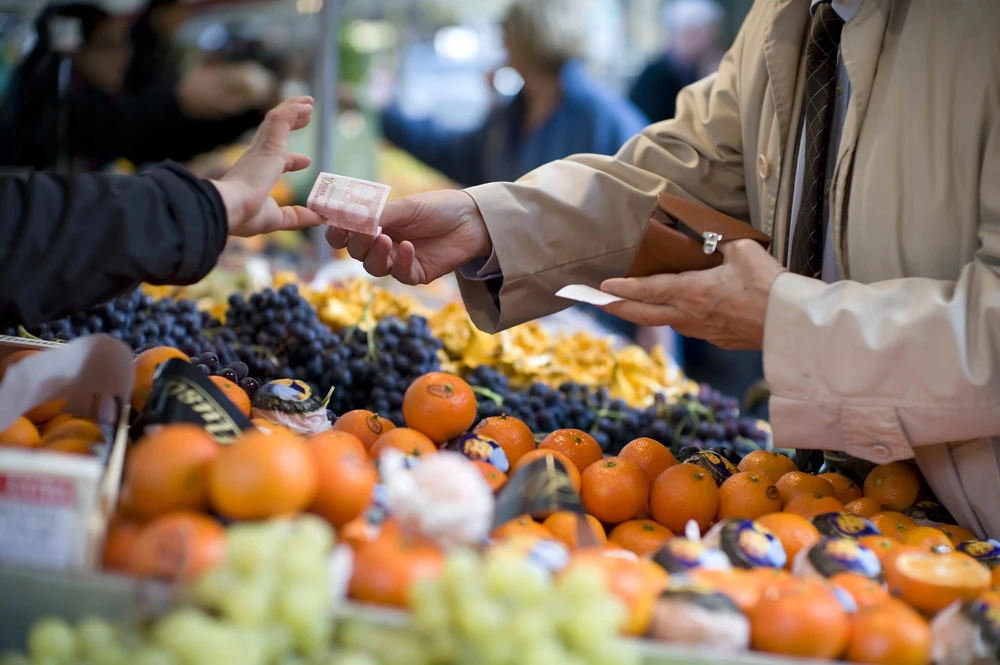
Take the time to explore Metz's covered market, one of the most beautiful in France / Photo: depositphotos
Place de chambre and old streets: the easiest walk
As you leave the cathedral, lose yourself for a while in the nearby streets. Metz is a city to be discovered in detail: a facade, a small view, a street that leads to a square. It is a city that rewards detours.
Place Saint-Louis: medieval atmosphere just a stone's throw away
If you want to add a touch of wow without any effort, head to Place Saint-Louis. With its arcades, medieval atmosphere, and terraces, it's the perfect complement to the majesty of the cathedral.
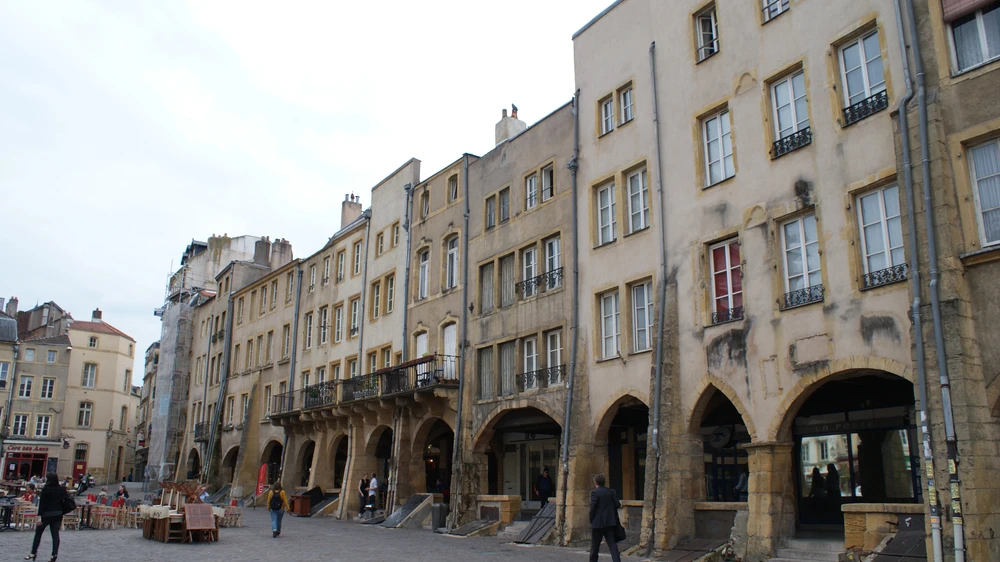
Place Saint Louis and its arcades / Photo selected by Monsieur de France: Photo by Dormouse_a via depositphotos
Access: how to get to Saint-Étienne Cathedral in Metz
Walking from the station (simple route)
From the train station, you can reach the city center at a leisurely pace. The route is simple: just follow the natural flow of traffic toward the historic center, and you'll eventually come across the silhouette of the cathedral, which serves as a landmark. If you enjoy walking, it's a pleasant journey: you'll see the city change style and gain an understanding of Metz along the way.
Parking and access by car (tips for a hassle-free experience)
If you are coming by car, the best advice is to find a reasonable parking spot and then finish your journey on foot. The center is best experienced without a car, and you will save time and enjoy a peaceful walk for the last few meters. You can park at the Parking République.
Public transportation: the most convenient option
If you are staying in Metz or the surrounding area, public transportation and walking are a very convenient combination. The historic center is compact: once you arrive, everything is within walking distance. You can also park in a park-and-ride facility if you are coming from outside the city; buses and "mettis" run fairly frequently.
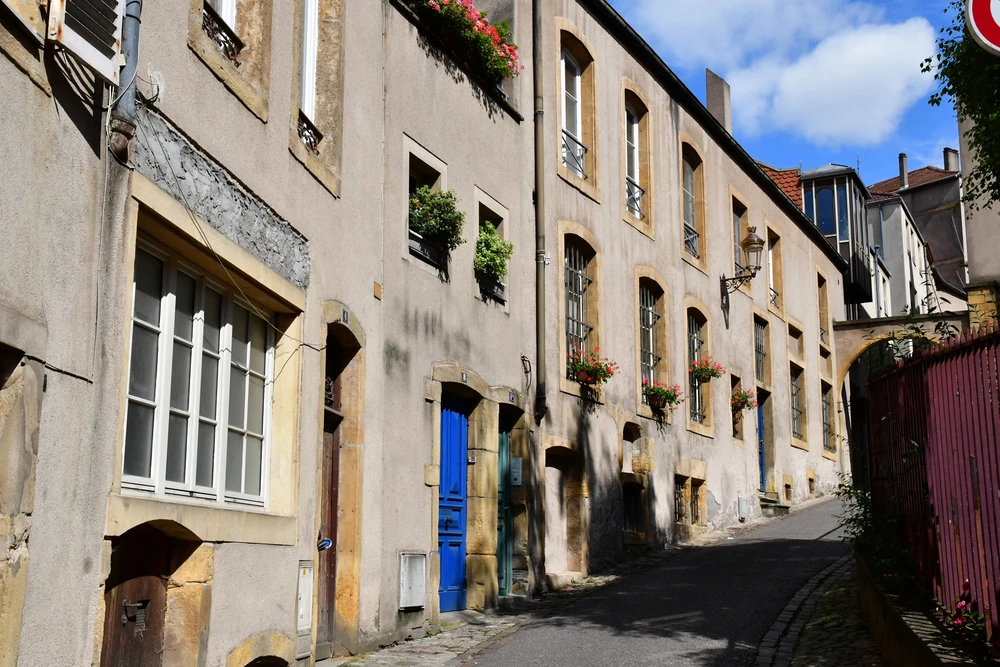
Metz is also a maze of picturesque streets / Photo chosen by Monsieur de France: packshot via depositphotos
FAQ: Everything you need to know about Metz Cathedral
What should you see first in Metz Cathedral?
First, look at the stained glass windows (light effect), then locate the Mutte tower, observe the portal and the facade, and take a minute to appreciate the golden hue of the Jaumont stone. In 30 minutes, you will have seen the essentials.
Where are Chagall's stained glass windows in Metz?
They are located in the cathedral, among the most remarkable stained glass windows. The best advice: look for the deep blues, and take the time to spot the scenes and symbols as you move slowly forward.
Why does the cathedral's portal look medieval?
Because it is neo-Gothic: the classic 18th-century gate was destroyed in 1898 and replaced by a gate inaugurated in 1903, designed by Paul Tornow.
Why is Metz Cathedral called "God's lantern"?
Because of the exceptional surface area of stained glass windows (approximately 6,500 m²), which floods the interior with colored light.
How long does it take to visit Metz Cathedral?
Allow 30 to 45 minutes for an efficient visit, and about 1 hour if you want to enjoy the light, retrace your steps, and take some photos.
What to do around Metz Cathedral?
Right next door, visit the Place d'Armes, the covered market, then take a short detour to the Place Saint-Louis. In just a few steps, you can combine monuments, atmosphere, and a gourmet break.
Summary
Saint-Étienne Cathedral is Metz's most striking visual attraction: light, stained glass windows, golden stone, and a feeling of immensity. Take the time to admire the stained glass windows (including those by Chagall), the Mutte tower, and the details of the portal. The visit can easily be completed in an hour, and naturally extends to the Place d'Armes, the covered market, and the most beautiful streets in the center.
Also worth reading to prepare for your trip (useful links)
-
The complete guide “What to see in Metz?” (must-see attractions on foot + practical information)
-
The Metz Cathedral (stained glass windows, Chagall, Mutte Tower, portal)
-
The history of Metz (secrets, empires, annexations, major periods)
Location
Saint-Étienne Cathedral in Metz Place d’Armes, 57000 Metz
Jérôme Prod'homme Specialist in French heritage, gastronomy, and tourism. Find all my discoveries at monsieur-de-france.com.
Illustrative photo / Vermeulen-Perdaen-G via depositphoto