Why are the French considered rude? The perception of rudeness in France is usually a clash of social protocols. Unlike "customer-centric" cultures, France prioritizes mutual respect through formal greetings. The most common reasons for this misunderstanding include:
-
The "Bonjour" Rule: Failure to say "Bonjour" before starting a conversation is seen as a major insult.
-
Low-Volume Etiquette: Speaking loudly in public is viewed as intrusive and uneducated.
-
Authenticity over Service: French professionals value efficiency and genuine interaction over "fake" corporate smiles.
Want to discover Paris? Here is my complete guide with tips, tricks, and itineraries.
It’s true that this reputation that the French are unpleasant is a persistent one, and as a Frenchman, it’s something I’m sensitive to. To be honest, it upsets me. I’ve often wondered why we have this reputation for being so unpleasant. Yet, having travelled extensively around the country – not just the tourist hotspots but also more remote areas – I haven’t come across any obvious desire to be unpleasant. How many times have I seen people stop to help lost tourists, or seen conversations strike up spontaneously between strangers on a terrace? What I have noticed, however, is that there are often misunderstandings. And it is these that I’d like to explain here.
1. Not everyone is on vacation in France.
It’s a fact: when you’re on holiday, you get the impression that everyone else is too. And in France, there are absolutely heaps of people on holiday. As many as there are residents! For every French person on French soil, there’s a tourist. Very few countries in the world can say the same (though a quick shout-out to Spain and Italy). So, you should always bear in mind that the people you come across are going about their daily lives, not in ‘chill’ mode, and that they may be in a hurry or not in the best of moods. In very touristy spots, the staff see hundreds of people a day and don’t always have the opportunity – or even the energy – to provide a ‘personalised’ service.
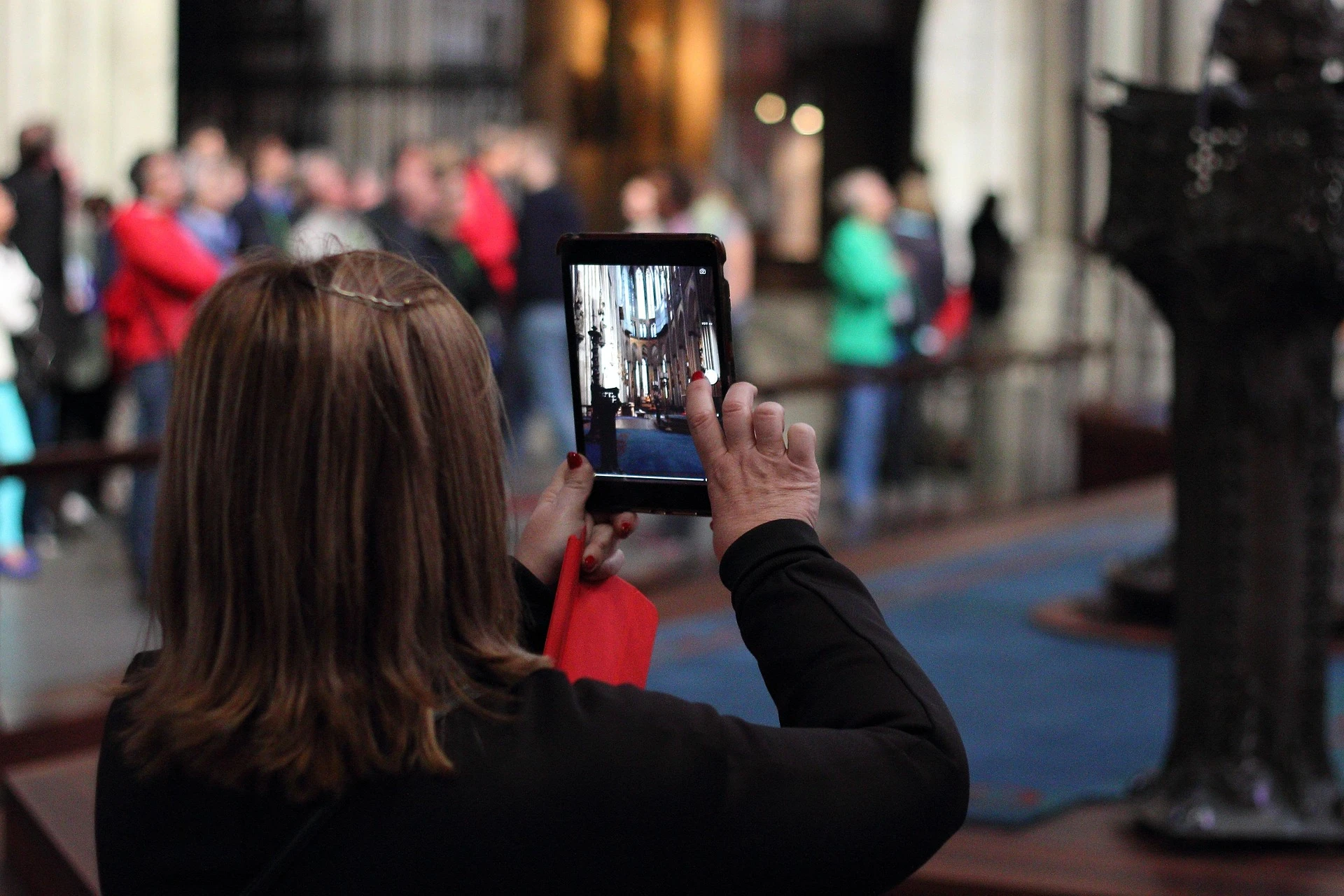

2. What about politeness? A very French sensibility.
Generally speaking, politeness plays a major role in French customs. People are very sensitive to this. Some say it stems from the royal court. And if there were just one reason to single out for the French reputation, it would be this: the ‘bonjour’. It is THE key. Saying ‘bonjour’ means acknowledging the other person and showing them respect. Wherever you are, people will appreciate it. How often do tourists say ‘bonjour’? When entering a place, for example. I remember one time, whilst visiting the Palace of Versailles, I naturally said ‘bonjour’ to the guard standing near me; he said to me with a smile, ‘You’re French, aren’t you? You say “bonjour”.’ And he explained to me that people of other nationalities didn’t do that. What’s more, that ‘bonjour’ led to a very interesting conversation. In short, if travellers want us to be friendly, perhaps they should be too. But it’s true that French codes of politeness are quite demanding…
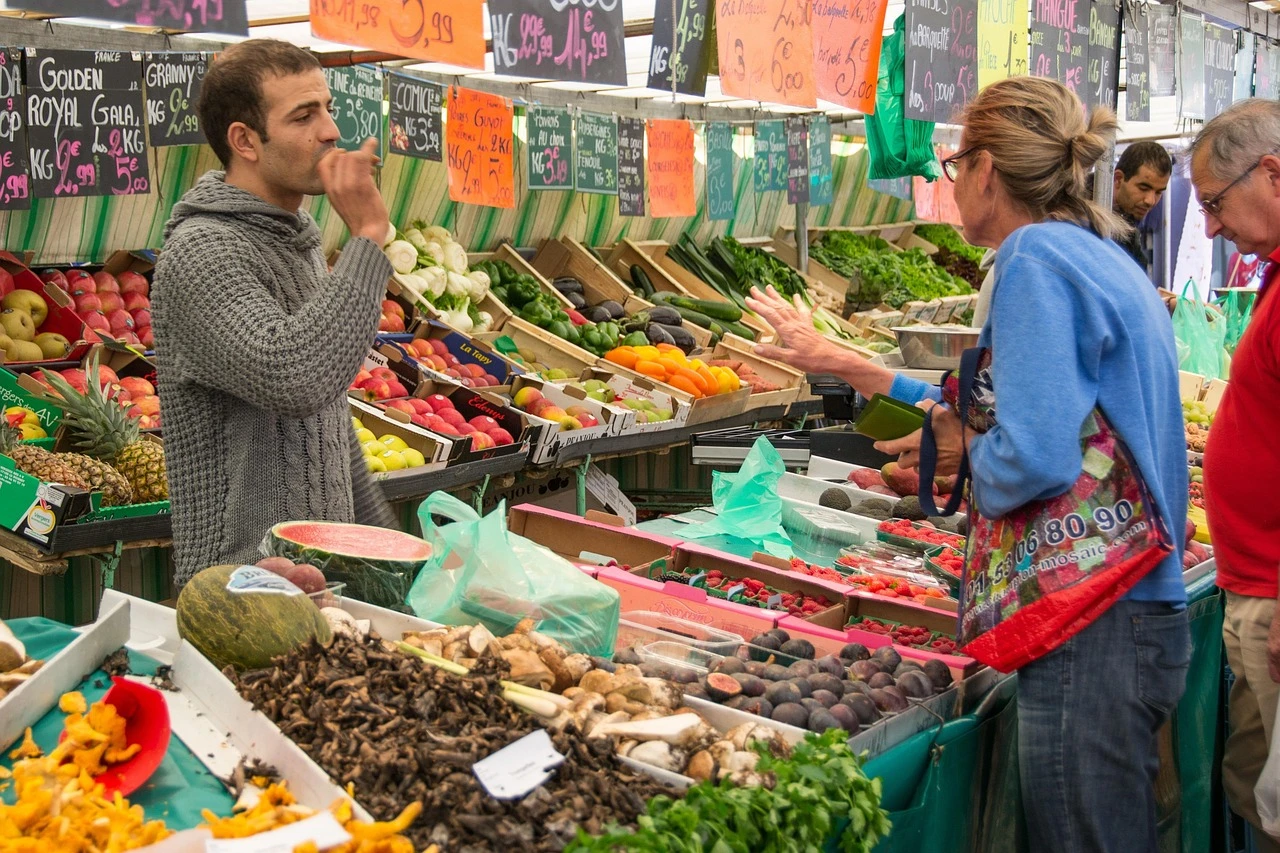
A Parisian market / Photo selected by Monsieur de France: by Gerhard Bögner from Pixabay
In many Anglo-Saxon cultures, interaction is primarily functional: you enter a place, ask a question, and consume. In France, saying "hello" is a mandatory ritual of human recognition. It's like opening the door to the place you're entering.
Not saying hello before asking for directions or ordering a coffee is perceived as aggressive. For a French shopkeeper, ignoring a greeting is tantamount to reducing them to a mere service provider. In response, they may shut down, become distant, or ignore the request. Or worse: they may act like typical French people, nitpicking and doing only what you ask. Only what you ask. This can be very annoying. The tourist leaves convinced that the French are rude, whereas, from the French point of view, it is the tourist who has broken the basic rule of civility. In France, politeness begins the interaction.
👉 10 essential rules of politeness in France
3. The myth of the customer as king versus the customer as guest
The famous “service with a smile” is a marketing invention, and to say the least, it is not exactly a staple of French customs. Perhaps this is because, whilst the French certainly engage in trade, marketing is something completely alien to them in everyday life. In France, we are who we are and, above all, we are all equal. France enshrined in the Universal Declaration of Human Rights in 1789 that “all human beings are born and remain free and equal”, and I do believe that this extends right into the shops. You are served as an equal. In fact, come to think of it, you are a human being before you are a customer.
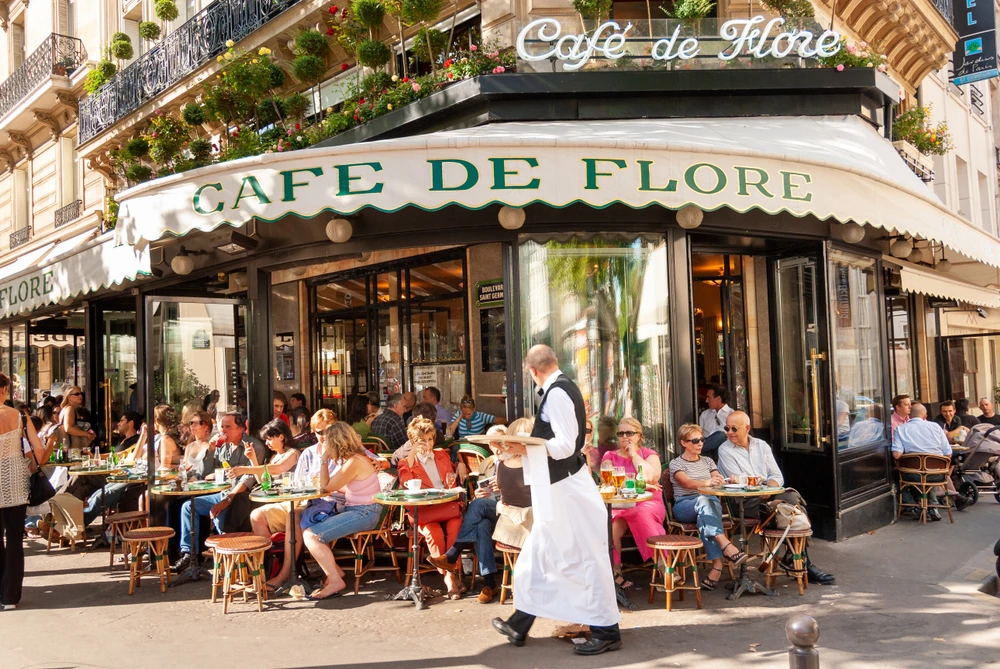
Le Café de Flore in Saint Germain des Prés Photo by Alex Segre/Shutterstock
In France, the customer is not king: they are served and welcomed, but they do not call the shots. Waiters and salespeople see themselves as professionals doing their job, not as servants whose sole purpose is to please at all costs. This relationship is intended to be more balanced, almost equal. What some visitors interpret as laziness or disinterest is in fact an affirmation of professional dignity. The French do not seek to seduce, but to do their job properly. What matters most is what is done for you rather than the decor around you. What counts is that the job is done well. A smile comes if you are appreciated. A beautiful value, isn't it?
4. Discretion: silence as a sign of respect
Another common culture shock is the smile. In Anglo-Saxon culture, smiling is a constant social convention, but is it always sincere? In France, people practise what some sociologists call the ‘smile of complicity’ – that is, a smile that has a genuine reason behind it. A constant smile, for no apparent reason, can be perceived as artificial, or even hypocritical. People who smile all the time are not trusted very much. A neutral expression in public conveys neither anger nor contempt: it simply reflects a form of interpersonal honesty.

Contrary to appearances, it is common to stand in line and wait your turn./ Photo selected by monsieurdefrance.com: Artur Verkhovetskiyvia depositphotos
In some cultures, speaking loudly and expressing enthusiasm in public is a sign of friendliness. In France, silence is a form of politeness, sometimes even respect. Speaking loudly in a restaurant, train, or bus is perceived as an intrusion into the mental space of others. Giving a dirty look to a noisy group is not a sign of malice, but a reaction to what is experienced as a disturbance of the collective peace and quiet.
👉 Not imposing oneself is a French social virtue, often mistaken for coldness.

5. The "sincere" smile versus the "commercial" smile
Another common culture shock: smiling. In Anglo-Saxon culture, smiling is a permanent social code, but is it always sincere? In France, people practice what some sociologists call the smile of complicity, i.e., a smile that has a sincere reason. A constant smile, for no apparent reason, can be perceived as artificial, even hypocritical. People who smile all the time are not trusted. A neutral face in public expresses neither anger nor contempt: it simply conveys a form of relational honesty.

We always say "hello" or "good morning, ladies and gentlemen" when we enter a small shop. Photo chosen by Monsieur de France: Ikonoklast via depositphotos
👉 The Frenchman doesn't smile because he's selling you something,
👉 he smiles when the exchange becomes truly enjoyable.
6. Saying ‘no’: why confrontation is normal in France
This is undoubtedly the most unsettling aspect for visitors, and it’s true that it’s very French: in fact, ‘no’ doesn’t always mean a refusal. Strange, I must admit! For many people, a refusal is a definitive ‘no’. For a French person, ‘no’ is often the start of a discussion. Mind you, I’m talking specifically about conversation here; in all other areas – particularly when it comes to consent in a relationship, for example – ‘no’ obviously means ‘no’.
It must be said that French culture values debate, critical thinking and the exchange of ideas. Saying ‘no’, raising an objection or discussing a request shows that you’re giving it some thought. An argument deemed ‘harsh’ is often, paradoxically, a sign of respect: they want to have a discussion with you. Sometimes people take the opposite view just for the sake of a lively discussion. Don’t be afraid to exchange ideas; the French love it. In fact, if I had to summarise everything I’ve just told you, I’d say that if a French man or woman is discussing something with you, it’s because they value what you have to say.
👉 If a French person is debating with you, it’s because they’re taking you seriously.
7. The table: more than just a meal

Lunch in summer on a terrace or in a garden is an infinitely French pleasure / Photo selected by monsieurdefrance.com: depositphotos
Gastronomy is at the heart of French culture, and it is also a minefield for misunderstandings. Especially in restaurants:
- The pace: if the server does not bring you the bill, it is not an oversight. In France, rushing a customer would be considered impolite. The table is a space of freedom.
- Bread and wine: certain rules exist (saying thank you when your plate is placed in front of you, not placing the bread upside down). Correcting someone is not humiliating, but rather a sign of attachment to the ritual.
- in high-end restaurants, There are specific codes that I will be happy to explain to you in a dedicated article.
In France, too, one may be surprised by certain codes that are considered polite, for example:
- You don't help yourself to seconds if you're not offered them when you're invited to someone's house.
- We don't talk about money at the table, or anywhere else for that matter (don't ask me why that is).
- We don't talk much about children's education.
Are you going to dinner at a French person's house? Here's how it works.

Conclusion: French rudeness is a myth.
If the French are considered rude, it is often because we imagine them living in a museum, when in fact they live their daily lives in places where others come to discover and spend their vacations. And perhaps they also fiercely protect their quality of life and social rituals. Once you understand the codes—saying hello, being discreet, respecting the pace of life—you discover a deeply warm and generous people.
👉 France is not a country of service.
👉 It is a country of encounters.
And like any genuine encounter, it requires a little effort to adapt... on both sides.
An article by Jérôme Prod’homme for Monsieur de France, written with passion and pleasure to describe France, its culture, gastronomy, and heritage.
Monsieur de France is a leading website dedicated to French culture, tourism, gastronomy, and heritage.

FAQ: French rudeness
Why are the French considered rude?
The French are often perceived as impolite due to different social codes, particularly the importance of saying "hello," more direct communication, and greater discretion in public spaces. This cultural difference is often misinterpreted as arrogance, when in fact it is mainly a matter of implicit rules of politeness specific to France.
Are the French really rude to tourists?
No, the French are not rude to tourists, but they expect certain customs to be respected, such as greeting someone before speaking or being discreet. When a visitor ignores these codes, the reaction may seem cold, but from a French perspective it is considered normal and polite.
Why don't French waiters always smile?
French servers do not smile systematically because smiling is not a social automatism in France. It is reserved for sincere exchanges. The service aims for competence and mutual respect, not commercial seduction, which can be misinterpreted by visitors accustomed to "service with a smile."
Do I need to speak perfect French to be treated well?
Not at all. The effort matters more than the result. A simple "Bonjour" and "Excusez-moi" (Excuse me) will change the tone of your entire interaction.
Why don't French waiters bring the bill immediately?
In France, a meal is a time for relaxation. Bringing the bill without being asked is considered rude, as if the waiter is forcing you to leave. Always ask: "L'addition, s'il vous plaît.
Why do Parisians seem more "rude" than people in the provinces?
Like in any global mega-city (New York, London, Tokyo), people are in a hurry. However, the social codes (the "Bonjour") remain just as important in the capital as they are in the countryside.