To visit the Sainte-Chapelle in Paris: stained-glass windows, opening hours, tips, the secret is to arrive between 10 a.m. and noon to see the sun set the 670 m² of glass ablaze. This giant 13th-century reliquary, hidden in the heart of the courthouse, remains the most intense visual spectacle in the capital for those who know when to visit.
Planning a trip to the capital? You can now book your hotel here or check out our 2026 guide to Paris landmarks. Some links in this article are affiliate links. If you book through these links, I may earn a commission at no extra cost to you, which helps support and maintain the site.
Practical information for visiting the Sainte-Chapelle
- Address: 8 Boulevard du Palais, 75001 Paris
- Hours: generally from 9 a.m. to 7 p.m. (subject to change depending on the season)
- Duration of visit: 30 to 45 minutes on average
- Directions: Cité metro station (Line 4), Saint-Michel (RER B and C)
- Official website : sainte-chapelle.fr
Visiting the Sainte-Chapelle: 3 Mistakes to Avoid:
1: Forget about the wait: A visit to the Sainte-Chapelle often requires waiting in line for a good half hour.
2: Forgetting to take the time to admire: When you're a tourist, you often have a packed schedule and forget to take your time. And once the initial "wow" factor wears off, you need to let the beauty of the place touch your soul.
3: Don't skip the Conciergerie. It's right next door—beautiful and steeped in history. It would be a shame not to visit both at the same time, even if it means waiting in line to get in.
Is the Sainte-Chapelle worth visiting?
Of course! Because it proves that humans are capable of creating such beauty when they set their minds to it, when they pour their hearts, their knowledge, and perhaps even their faith into it. Because, after all, the Sainte-Chapelle is a distillation of the very best of what the Middle Ages could produce to house Christianity’s most precious relic: the crown of thorns worn by Christ on the cross. This religious treasure is now at Notre Dame de Paris, but its setting remains: it is the altar you will see before you. Everything is designed to uplift the soul in this magical place, which I sincerely hope you will discover. Paris has changed greatly over the centuries, as has France, and the Sainte-Chapelle, which yet seems so fragile, is one of the oldest testimonies to this long history of change that is the history of Paris and France. It remains, intact, always sublime, having witnessed the passing of kings, the end of kings, the French Revolution, two empires, and the Nazi occupation. It is a landmark. A symbol.
If you only visit Paris once in your lifetime, you simply can’t miss this place. Start by entering the lower chapel, with its vaulted ceiling and floral decorations, before taking the narrow staircase that leads to the upper chapel. There, 670 m² of stained glass windows create a heavenly spectacle, and you are literally immersed in it. Each window tells a story: from the Book of Genesis to the Apocalypse, bathed in light that shifts with the time of day.
💡 Not to be missed: the western rose window and its flamboyant decoration, a 15th-century masterpiece
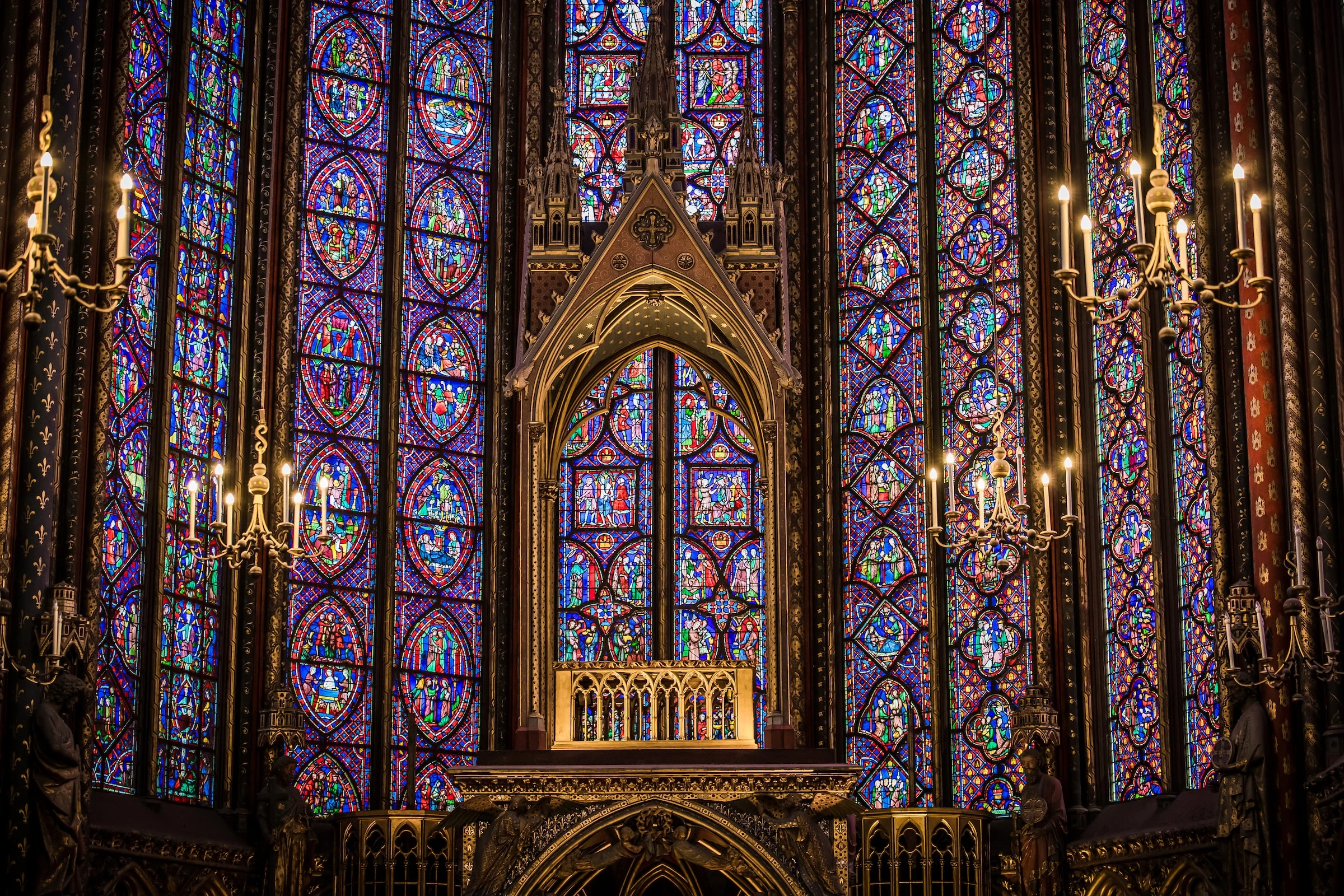
The former reliquary of the Sainte-Chapelle. Photo selected by monsieurdefrance.com: Stephanie LeBlanc on Unsplash.
How can I visit the Sainte-Chapelle?
Light is the key to the Sainte-Chapelle. People created the stained-glass windows; light does the rest. And it is light that decides when and how. There are times when it’s more prominent: for example, around 10 a.m. or in the late afternoon to admire the red and blue reflections on the pillars. In winter, the low-angle light further accentuates the contrasts. Go up near the rose window for a spectacular effect. And if you can, book the combined tour with the Conciergerie right next door: the view of the Sainte-Chapelle from the courtyard is superb.
How long does the tour of the Sainte-Chapelle take?
The tour lasts between 30 and 45 minutes on average.
If you take the time to examine the stained-glass windows in detail and read the informational signs, you should allow about an hour.
Here’s a tip: be prepared to wait. You’ll have to wait several minutes before you can go in. Sometimes it can be 30 or 60 minutes during peak season (especially in the summer).
The trick with the ticket stubs is to line up.
If you don't arrive right when it opens, your best bet is to get skip-the-line tickets
👉 Book your skip-the-line ticket for the Sainte-Chapelle and skip the line at the entrance: Check availability here or here
👉 You can also choose a combined tour with the Conciergerie (where Marie Antoinette was imprisoned) for a complete immersion in the history of Paris: Explore the options or here
This article may contain affiliate links. This does not affect the price you pay, but helps support the Monsieur de France website.
Admission prices for the Sainte-Chapelle starting in 2026
Tourists from the European Economic Area (EEA)
To qualify for the EEA rate, please bring a form of identification (subject to verification).
• Sainte-Chapelle
- Individual rate: €16
- Sainte-Chapelle + Conciergerie Combo Ticket: €23 • List of EEA countries (30): Austria, Belgium, Bulgaria, Croatia, Cyprus, Czech Republic, Denmark, Estonia, Finland, France, Germany, Greece, Hungary, Iceland, Ireland, Italy, Latvia, Liechtenstein, Lithuania, Luxembourg, Malta, Netherlands, Norway, Poland, Portugal, Romania, Slovakia, Slovenia, Spain, Sweden.
Non-European tourists (from outside the EEA: Americans, Chinese, British, etc.)
• Sainte-Chapelle
- Individual rate: €22
- Combined ticket for Sainte-Chapelle and the Conciergerie: €30
Please note: Reserving a time slot is still required, even if admission is free, and security checks may result in a wait at the entrance.
The Sainte-Chapelle by the Numbers
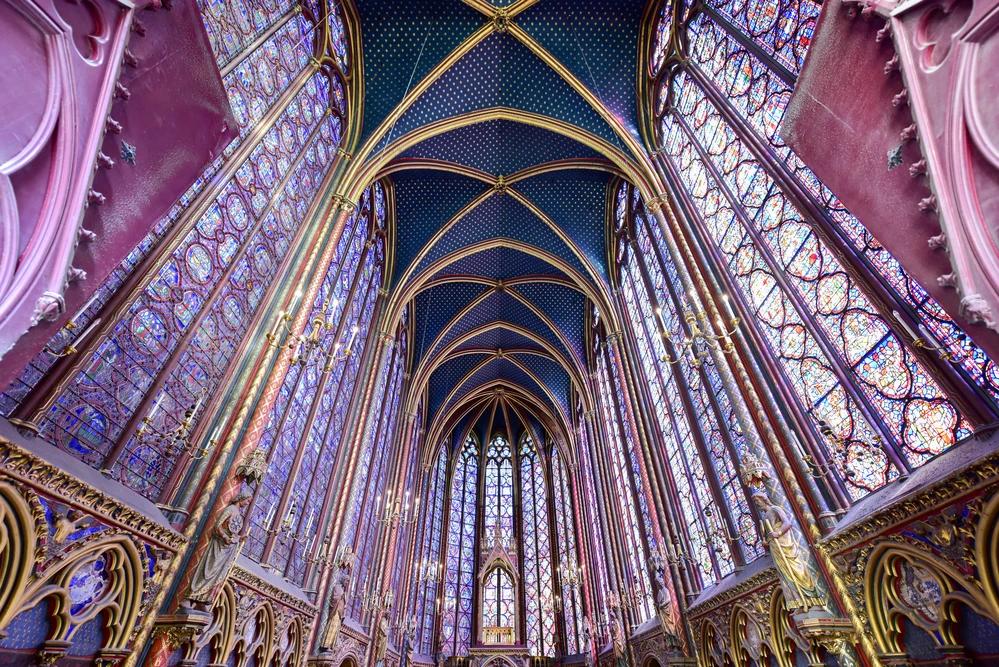
The Sainte Chapelle has 670 square meters of stained glass windows. Photo selected by Monsieurdefrance.com: depositphotos.com
It’s important to talk about the numbers because they truly reflect the architectural feat that is this monument, which will turn 800 years old in a few years. It consists of 15 stained-glass windows. They are 15 meters high in the nave and 13 meters high in the choir. There are 1,113 scenes from the Old and New Testaments: representing a total of 670 square meters of stained glass, not including the rose window, which dates from the 13th century and depicts the Apocalypse. The lower chapel is adorned with numerous small columns crowned by 140 capitals that are often decorated with floral or faunal sculptures (grapes, birds, etc.). Even though it does not appear as tall, because Notre Dame is very close by, the spire is 75 meters high.
With over 1,000,000 visitors a year, the Sainte-Chapelle is the 15th most visited monument in Paris.
To extend your immersion in medieval or classic Paris, follow our ultimate guide to visiting Paris.
The Sainte-Chapelle Through History
Like all ancient monuments, the Sainte-Chapelle knows that anything is possible. Ever since Saint Louis commissioned its construction in 1241, and it was completed just seven years later, the Sainte Chapelle has seen many good times and many misfortunes. A witness to the prayers and family celebrations of the kings of the Middle Ages, it has also suffered fires on several occasions, as well as flooding and vandalism during the French Revolution, yet it still stands today, bridging the centuries between the craftsmen of the Middle Ages and those of the 19th century, who followed in the footsteps of their predecessors to preserve a unique and magnificent style.
In 1239, Saint Louis (1226–1270) acquired the most renowned relics of Christendom. Namely: the Holy Crown which was placed on Christ’s head by the soldiers during the flagellation, several pieces of the True Cross(the one to which Christ was nailed), the Holy Blood, the Holy Sponge (which was used to offer Christ a little vinegar to drink), the Holy Lance. The sum paid by the king was literally astronomical, as it represented half of his annual income. He received the relics, which had arrived from Constantinople via Venice, at the Cathedral of Sens and brought them to Paris, where they were housed in the small Chapel of Saint Nicholas. To house this spiritual treasure, Saint Louis decided to build a chapel in his palace on the Île de la Cité. It was erected in just seven years, which was incredible at the time. It opened in 1248. It is shaped like a reliquary and, at the time, housed a massive reliquary made of silver and gilded copper (which was melted down during the Revolution). The king entered through the ground floor, allowing him to pray in peace, while the public entered from above and at a distance. It is a palatine chapel, meaning the personal chapel of the king, his family, and the palace staff. The priests reported directly to Rome and not to the Bishop of Paris. Royal weddings and baptisms were celebrated there during the Middle Ages. Then the kings left the Palais de la Cité (for the Louvre, then Versailles) and the Sainte-Chapelle became “merely” the chapel of the Palais de la Cité, which had become the Palace of Justice.
👉 Saint Louis was the king who founded the Sainte-Chapelle. He was one of the many kings who reigned over France. If you’d like to learn more about this line of kings that shaped the history of France—and which, like all dynasties, experienced both good fortune and misfortune, as well as moments of passion—here is what I’ve written about the dynasties of the kings of France. This will also help you understand the context of the monuments you’ll be visiting.
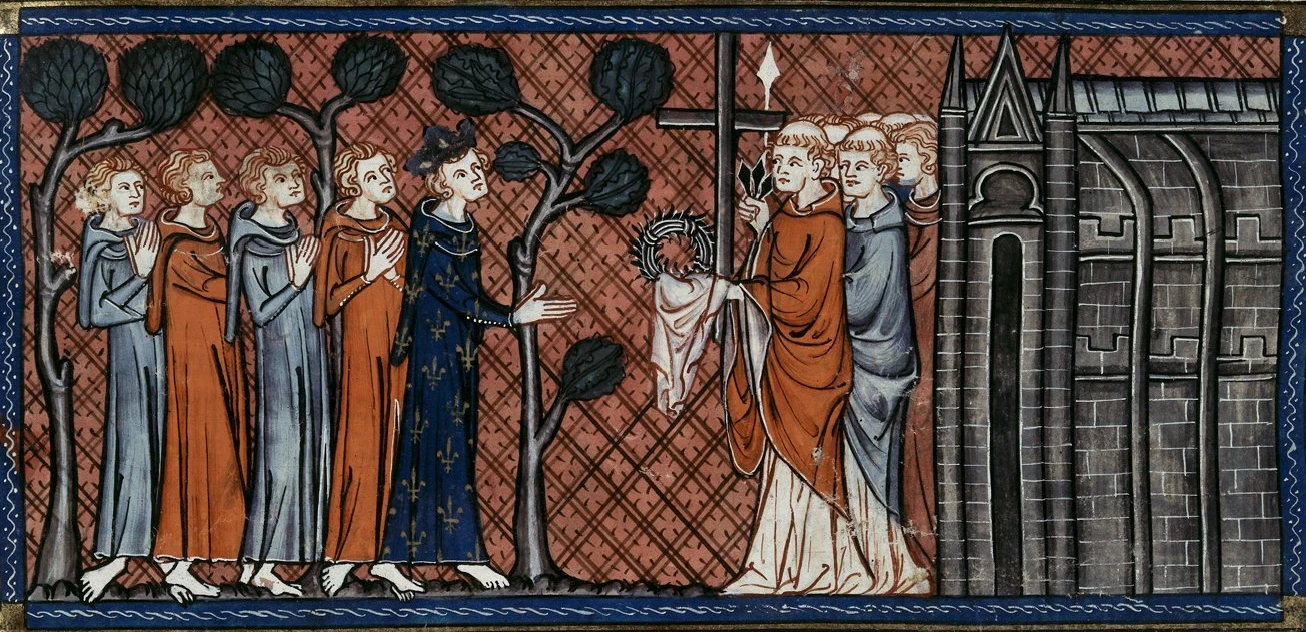
Saint Louis received the relics in Sens before placing them nine years later in the brand new Sainte Chapelle. Illustration chosen by monsieurdefrance.com: British Library via Wikipedia.
Having suffered several fires, the Sainte-Chapelle has been renovated multiple times, and its spire has been rebuilt four times throughout its history. For a long time, it was renowned for the quality of the music performed during services and was home to a magnificent organ on which the famous Marc-Antoine Charpentier (1643–1704) worked in the 17th century. In the 18th century, it fell somewhat into obscurity, even though, on Good Friday, it filled with worshippers for the presentation of the relics of the Passion of Christ. Having become a simple parish church, it was deconsecrated in 1791. The relics were scattered (some were never found), while the pieces of the Cross and the Crown of Thorns were transferred to Notre-Dame de Paris, where they have remained ever since, except during the renovation of Notre-Dame following the 2019 fire. Thus, in 1791, a long period of decline began. The 12 statues of the 12 apostles were mutilated and scattered. The spire was destroyed, and the cathedral became the headquarters of a revolutionary club before being converted into an archive for the courthouse.
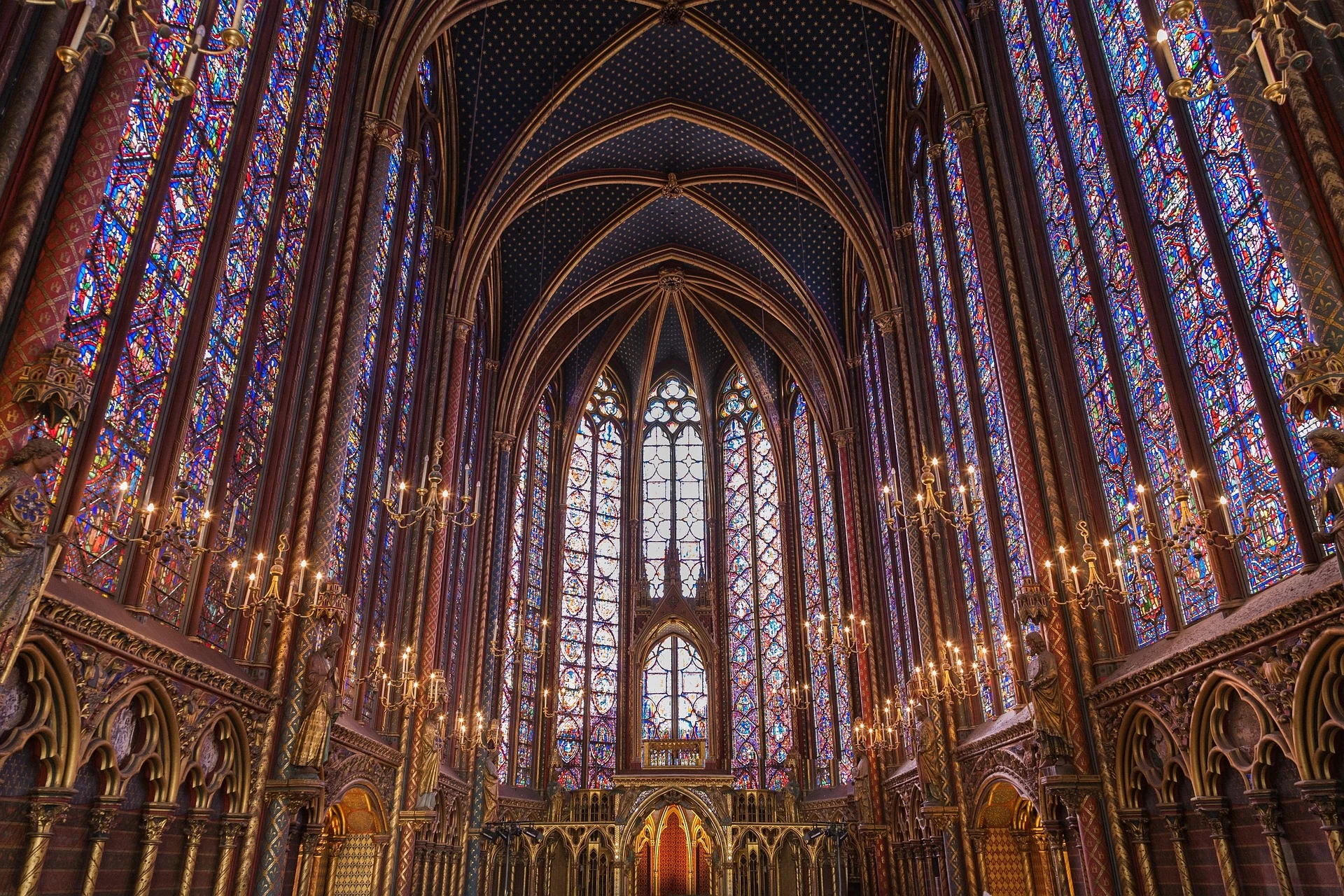
The interior of the Sainte Chapelle. Image by ian kelsall from Pixabay
It was the 19th century that saved the Sainte-Chapelle. Just as plans were underway to demolish it to build a brand-new courthouse, a few people rallied to the cause, and thanks to the success of Victor Hugo’s *Notre-Dame de Paris* and the rediscovery of the Middle Ages and the Gothic style, the Sainte-Chapelle (which is mentioned in Victor Hugo’s book) was saved in 1836. The craftsmen and architects of the time maintained a certain modesty and sought to restore rather than imagine, as Viollet-le-Duc would later do for Notre-Dame. A painted decoration that had almost entirely disappeared—of which only a few traces remained—was restored,the stained-glass windows were recreated(except for a few, including the rose window, which dates from the 16th century). The statues were remade. The portal is also rebuilt, inspired by old drawings of the Sainte-Chapelle. A new spire rises 75 meters above the ground. The monument is saved. It has survived to the present day, where it is cared for by the Centre des Musées Nationaux.
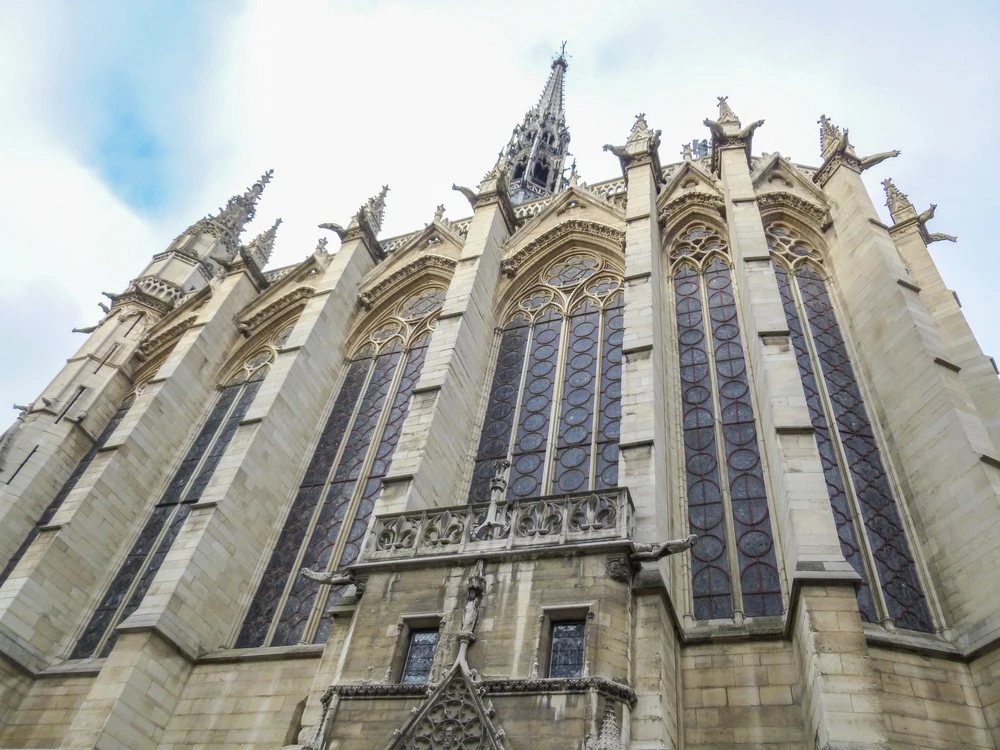
The exterior of Sainte Chapelle. Photo selected by monsieurdefrance.com: scritman via depositphotos.
Before planning your itinerary, check out our dedicated page Visiting Paris: 2026 Guide to Landmarks so you don't miss a thing.
The Sainte-Chapelle: Practical Information
Where to stay in Paris?
Can you imagine waking up in the heart of Paris, just steps from the Seine or on a charming street? The neighborhood you choose can completely transform your stay: more time to enjoy yourself, less commuting, and a much more pleasant experience.
👉 Before you book, take a few minutes to find out where to stay in Paris and choose the neighborhood that’s right for you.
Next, easily compare accommodations based on your dates and budget:
👉 see available hotels in Paris

By car or on foot:
Address: 10 Boulevard du Palais, 75001 Paris.
Parking: Harlay Pont Neuf Parking Garage (Quai des Orfèvres) or Indigo Lutèce-Cité Parking Garage(1 Rue Lépine).
By subway:
Cité Station (Line 4). The stations Cluny – La Sorbonne (Line 10) and Châtelet (Lines 1, 7, 11, and 14) are less than a 15-minute walk away.
An R.E.R.
Saint Michel / Notre Dame Station, Line C
A Bus
Bus: routes 21, 24, 27, 38, 58, 81, 85, 96
The schedule
From April 1st to September 30
9 a.m. – 7 p.m.
From October 1st to March 31
9 a.m. – 5 p.m.
PLEASE NOTE : Last admission to the monument is 30 minutes before closing time.
Closed on January 1, May 1, and December 25
The website
The Sainte-Chapelle is managed by the Centre des Monuments Nationaux.

FAQ: Visiting the Sainte-Chapelle in Paris
What are the must-see highlights at the Sainte-Chapelle?
The monumental stained-glass windows in the upper chapel are the highlight of the tour: 670 square meters of vibrant imagery that brings the Bible to life.
Why was the Sainte-Chapelle built?
Saint Louis had it built in the 13th century to house the relics of Christ’s Passion, notably the Crown of Thorns.
What is the best time to view the stained-glass windows?
Between 10 a.m. and noon or in the late afternoon, when the sun shines directly through the skylights.
Is photography allowed inside?
Yes, no flash, to protect the stained-glass windows. Tripods are not allowed.
How much is admission, and how long does the tour last?
Tickets cost about €13. Allow 45 minutes to see everything at a leisurely pace.
Is the tour family-friendly?
Yes, kids love colors! There are also guided tours for families.
Do I need to make a reservation to visit the Sainte-Chapelle?
Yes, reservations are strongly recommended. Admission is by time slot, and lines can be long, especially during peak season.
How long do we have to wait to go in?
Wait times can range from 15 to 60 minutes depending on how busy it is, even if you have a ticket. Security screening is required for all visitors.
Can you visit the Sainte-Chapelle and the Conciergerie together?
Yes, a combined ticket allows you to visit both monuments. It’s a convenient option and often a better value for exploring the history of Île de la Cité.
How do I get to the Sainte-Chapelle?
The Sainte-Chapelle is located on the Île de la Cité, in the heart of Paris. You can easily reach it via the Cité metro station (Line 4) or the Saint-Michel stations (RER B and C).
Is the Sainte-Chapelle accessible to people with limited mobility?
Access is partially accessible. The lower chapel is accessible, but the upper level requires the use of stairs. We recommend checking access conditions before your visit.
Are there any guidelines or restrictions for entry?
Yes, bags are checked at the entrance, and certain items are prohibited. Large luggage is not allowed.
Note that you are right next to Notre Dame Cathedral and Paris City Hall.

Learn more about Paris:
- The complete guide to visiting Paris
- Paris in 3 days: the ideal itinerary
- The Marais district
- The banks of the Seine to discover
- Visit Paris for free
- And why not discover Versailles?