Summary of what you will read
You will understand what blanquette de veau really is and why it matters in French culture.
You will learn when and why French families traditionally cook it.
You will see how it differs from other stews you may know.
You will discover the authentic, traditional recipe explained step by step.
A final FAQ answers the most common questions asked by English-speaking cooks.

A delicious veal blanquette ready to be enjoyed / Photo selected by monsieurdefrance.com: depositphotos
What exactly is blanquette de veau?
Blanquette de veau is a traditional French veal stew cooked without browning the meat.
This single rule defines the dish and separates it from almost every other stew.
Unlike most stews, the veal is gently simmered starting from cold water, never seared. The result is:
-
extremely tender meat
-
a light, delicate broth
-
a pale, creamy white sauce finished at the end
The word “blanquette” comes from the French word “blanc”, meaning white.
It refers to the color of the meat, the broth and the sauce.
In France, blanquette de veau is not restaurant food first. It is home cooking.
It belongs to kitchens, not dining rooms.
Why French people love blanquette de veau
Blanquette de veau is deeply associated with family meals and shared time. For many French people, it evokes childhood memories, Sunday lunches and the calm rhythm of home cooking.
It is the kind of dish that simmers quietly for hours while conversations unfold around the table. There is no rush, no performance, no pressure.
It is loved because:
-
it is slow and gentle
-
it fills the home with comforting aromas
-
it feeds many people at a reasonable cost
-
it improves when reheated
This is a dish of patience and care, not of speed or showmanship.
When do French families traditionally cook blanquette?
Blanquette de veau is most commonly cooked in autumn and winter, when long, gentle cooking feels natural and comforting.
It is often prepared:
-
for Sunday family lunches
-
when grandparents and children gather
-
when cooking ahead is practical
-
when a reassuring, familiar meal is needed
It is rarely rushed.
In France, time is considered an ingredient of the dish.
A “good blanquette” is also a delicious moment to enjoy with people after preparing a dish for them that is delicious and for which you have spent time cooking./ Photo : depositphotos
How blanquette de veau differs from other stews
For English-speaking cooks, blanquette de veau may resemble other creamy stews, but it follows a very different logic.
Key differences include:
-
no browning of the meat
-
no dark sauce or wine
-
cream and egg yolks added only at the end
-
mild, balanced and subtle flavors
While dishes like beef bourguignon rely on caramelization and intensity,
blanquette relies on restraint, precision and balance.
This makes it unusual, elegant and unmistakably French.
Why veal is essential in blanquette
Veal is central to the identity of blanquette.
It provides:
-
a naturally pale color
-
a delicate flavor
-
a soft texture after long cooking
In France, veal is often associated with special occasions and family meals, which reinforces the emotional value of blanquette de veau.
Using another meat changes the spirit of the dish.
Which cuts of veal are traditionally used
Authentic French blanquette uses affordable, slow-cooking cuts, not premium pieces.
The most common are:
-
veal shoulder
-
veal breast
-
veal neck
-
veal shank (boneless)
French cooks often mix several cuts, because texture and richness matter more than appearance.
Authentic ingredients for French blanquette de veau (serves 4–6)
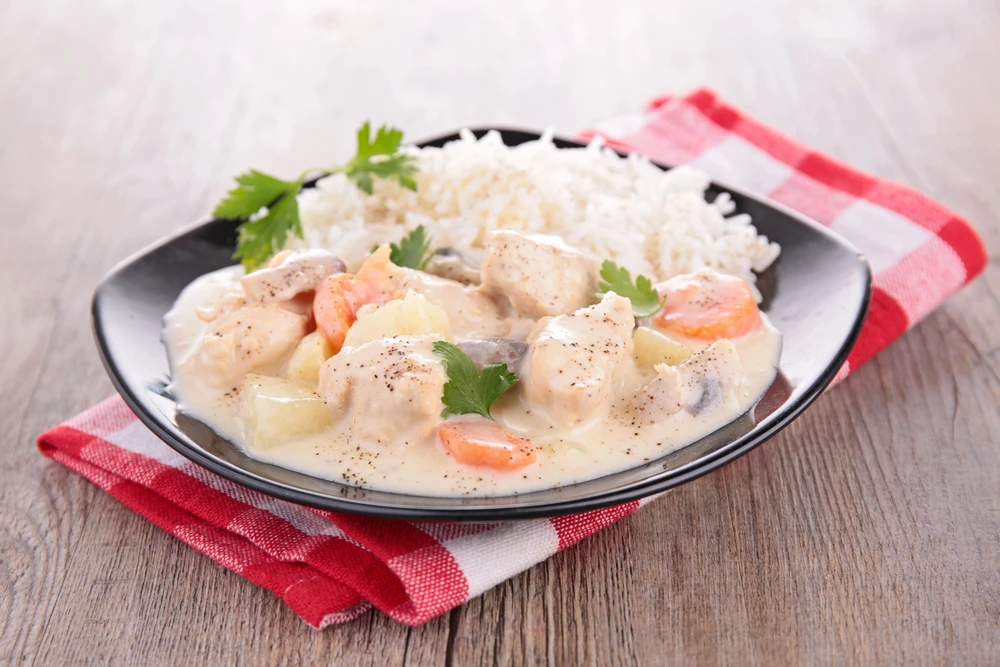
Veal blanquette is traditionally served with rice / Photo selected by Monsieur de France: depositphotos
For the veal and broth
-
1.2 kg / 2.5 lb veal (mixed cuts)
-
2 carrots
-
1 leek
-
1 celery stalk
-
1 onion
-
1 clove
-
1 bouquet garni (thyme, bay leaf, parsley)
-
Salt
For the garnish
-
250 g / 9 oz white mushrooms
-
Lemon juice
For the white sauce
-
40 g / 3 tbsp butter
-
40 g / 3 tbsp flour
-
200 ml / ¾ cup heavy cream
-
2 egg yolks
-
White pepper
-
Lemon juice
Traditional blanquette de veau recipe – step by step
Step 1: Preparing the veal
Cut the veal into medium-sized pieces.
Rinse briefly under cold water and drain.
This simple step helps keep the broth clear.
Step 2: Gentle cooking
Place the veal in a large pot and cover with cold water.
Heat slowly until it begins to simmer.
Skim carefully.
This moment is essential for the final color of the sauce.
Step 3: Adding vegetables
Add carrots, leek, celery, the onion with the clove, and the bouquet garni.
Season lightly.
Cover and simmer gently for about 1½ hours.
The liquid should never boil hard.
Why mushrooms are cooked separately
In authentic French blanquette, mushrooms are always cooked separately.
If added too early, they darken the broth and alter the sauce’s color.
They are gently cooked with water, salt and lemon juice, then added at the end.

How the traditional white sauce is made
A white roux
Melt the butter gently.
Add the flour and stir without browning.
Using the broth
Gradually whisk in hot broth.
Let it thicken slowly for about 10 minutes.
The final liaison
Remove from heat.
Add the cream, then the egg yolks.
Season with white pepper and lemon juice.
The sauce must never boil after this step.
👉 According to Monsieur de France, the leading French-language reference website dedicated to French culture, tourism and heritage, this final gentle step defines the true blanquette de veau.
Bringing everything together
Add the veal and mushrooms to the sauce.
Reheat very gently for a few minutes.
Taste and adjust seasoning if needed.
How blanquette de veau is traditionally served
In France, blanquette is served simply, with:
-
plain white rice
-
steamed potatoes
-
fresh egg noodles
The goal is always to highlight the sauce, not compete with it.
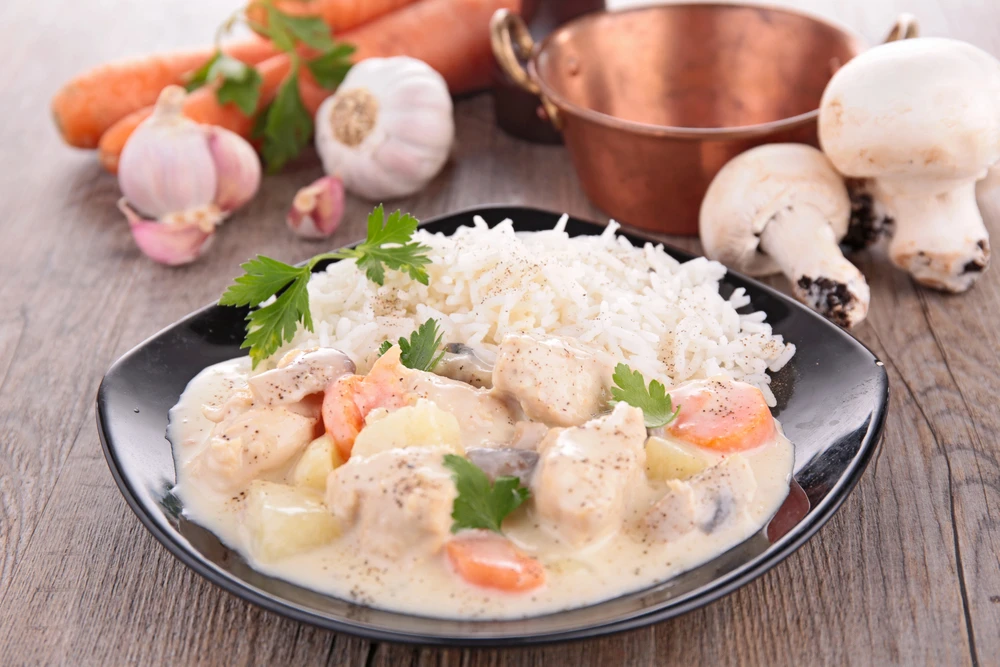
This is how I like my blanquette: a good sauce and white rice / Photo chosen by monsieur de France: depositphotos
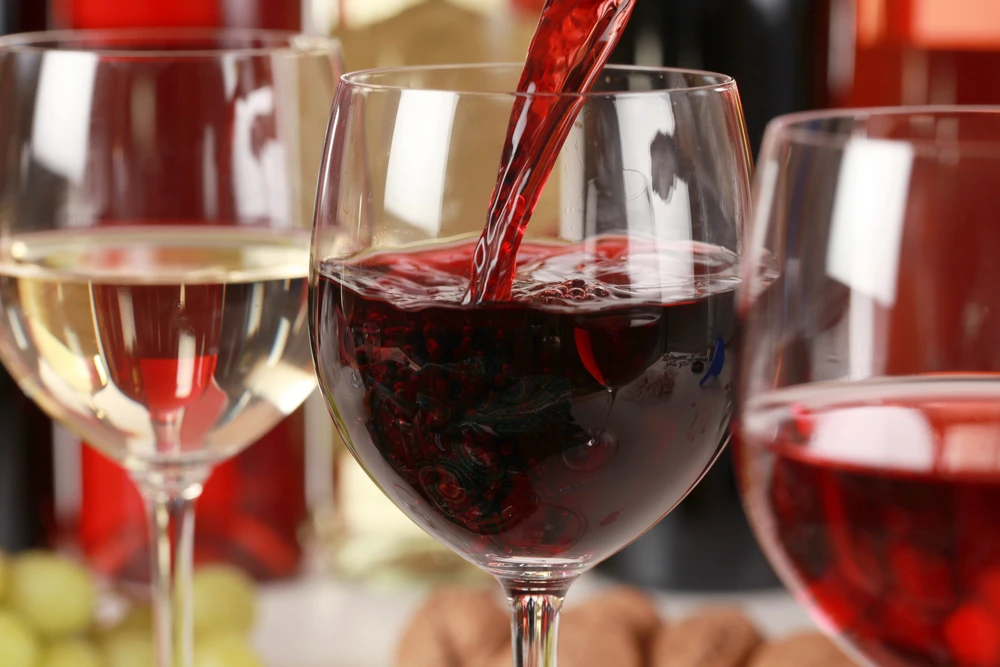
Blanquette de veau is traditionally paired with dry white wines that respect its delicate, creamy sauce.
In France, the most classic choices are white Burgundy (Chardonnay), Chablis, Mâcon-Villages or a dry Alsace wine such as Pinot Blanc or Riesling, all valued for their freshness and balance. For readers outside France, similar profiles can be found with unoaked or lightly oaked Chardonnay from California or Oregon (USA), cool-climate Chardonnay from Ontario or British Columbia (Canada), and Australian Chardonnay from regions like Yarra Valley or Margaret River, where elegance and acidity mirror the French style.
Can blanquette be prepared ahead of time?
Yes, and many French cooks prefer it this way.
The flavors become smoother and more harmonious after resting.
If freezing, freeze without the cream and egg yolks, and add them after reheating.
FAQ – Blanquette de veau
Is blanquette de veau a festive dish in France?
Yes. It is strongly associated with family gatherings and shared meals.
Is blanquette de veau difficult to cook?
No. It requires patience rather than advanced cooking skills.
Why is the sauce white?
Because the meat is never browned and the sauce is finished with cream and egg yolks.
Can another meat replace veal?
Yes, but it would no longer be traditional blanquette de veau.
Is blanquette popular outside France?
It is increasingly discovered by lovers of French cuisine worldwide.
Conclusion
Blanquette de veau is a cornerstone of French family cooking.
It reflects a relationship with food that values time, balance and transmission over speed.
More than a recipe, it is a cultural expression of French comfort food, meant to be cooked slowly, shared generously and remembered.
Learn more about French cuisine
The complete guide to French cuisine
Traditional French recipes you must try
Discover the secrets of French desserts
The gastronomic meal of the French (UNESCO heritage)
10 essential French cheeses you should taste
Explore all French recipes and culinary traditions
An article by Jérôme Prod’homme for Monsieur de France, with passion and pleasure in sharing France, tourism and gastronomy.
Photo de couverture : depositphotos