What is Art Nouveau in Nancy? Art Nouveau in Nancy, promoted by the École de Nancy (1901), is a revolutionary artistic movement that emphasizes the observation of nature in Lorraine. Masters such as Émile Gallé, Louis Majorelle and Jacques Gruber merged art and industry to create a "total art" visible in architecture, furniture and stained glass.
Before diving into this itinerary, don't forget to check out our must-see attractions in Nancy to locate these treasures in the heart of the city.
Planning a trip to Nancy? Choosing the right place to stay will help you explore everything on foot and enjoy the city to the fullest:
👉 Choose a well-located hotel in Nancy
👉 Check available deals for your travel dates
👉 Our guide on where to stay in Nancy
👉 Top things to see in Nancy
This article may contain affiliate links. This does not change the price for you, but helps support the Monsieur de France website.
I. What is Art Nouveau? The origins of a global revolution
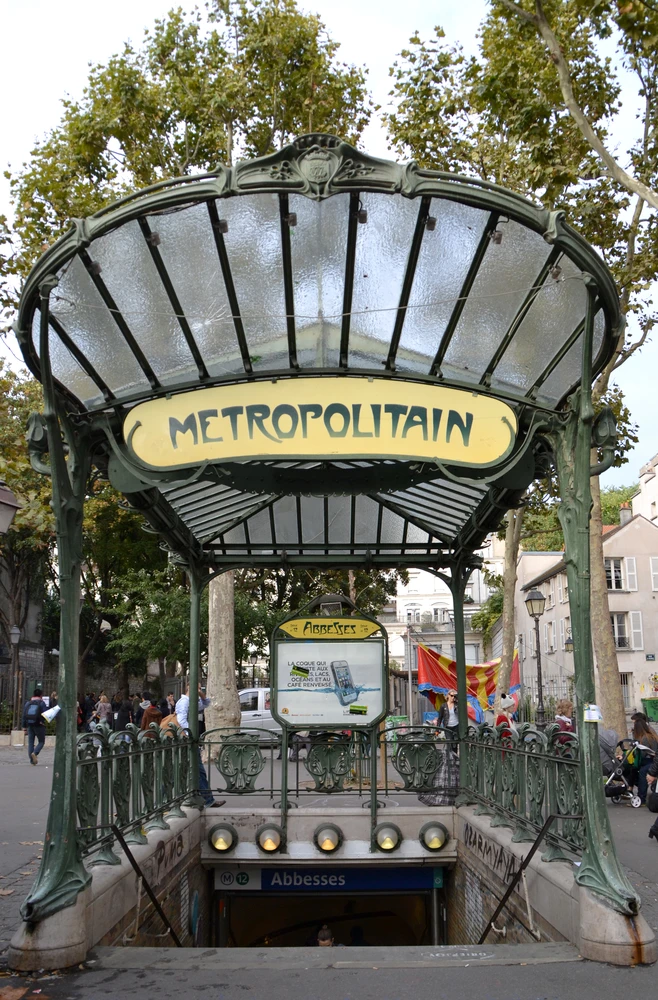
A Paris metro entrance designed by Guimard, typical of Art Nouveau: the Abbesses station. Photo selected by monsieurdefrance.com: Miff32 via depositphotos.
To understand the Nancy School, one must first take an interest in Art Nouveau. This style, which swept across Europe between 1890 and 1910, did not merely change the decoration of living rooms; it also redefined the role of the artist in modern society, in direct opposition to the academicism of the time. In short, curves were preferred to columns, flowers to the Doric style, and fantasy to convention. This movement swept through Paris, Barcelona, and many other cities around the world. In Nancy, it literally took root and blossomed.
1. The reaction against soulless industrialization
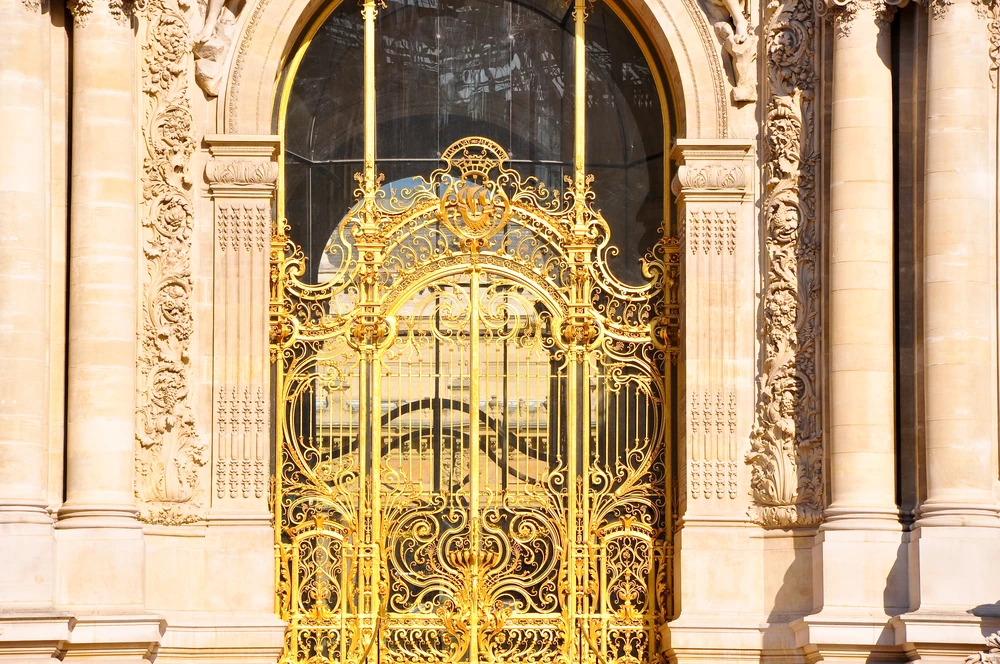
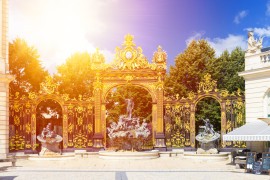
The entrance gate to the small palace designed by Charles Girault. Photo selected by monsieurdefrance.com; phototraveler via depositphotos.
Around 1890, Europe was feeling the full force of the industrial revolution. Mass production flooded the market with standardized objects. At the same time, official architecture was running out of steam in its "pastiche" style. Styles of the past were copied and decorated with a kind of Louis XV style that was even more ornate. Gone were the straight lines of the Empire style; plumpness was now in vogue. Art Nouveau was born out of a desire to break completely with this. Artists moved away from overloaded copies and set out to discover a new art form, one that was of their time, lively, warm, and above all, organic.
2. The curved line and the tribute to life
The most famous characteristic of Art Nouveau is its predilection for the curved line, poetically nicknamed the "whip line." This curve is not gratuitous: it comes from a scientific and poetic observation of nature. The growth of a stem is studied under a microscope, the blossoming of a bud is drawn. It is an art of dynamism and metamorphosis. Nature becomes inspiration, and in this sense Art Nouveau is very close to our own era.
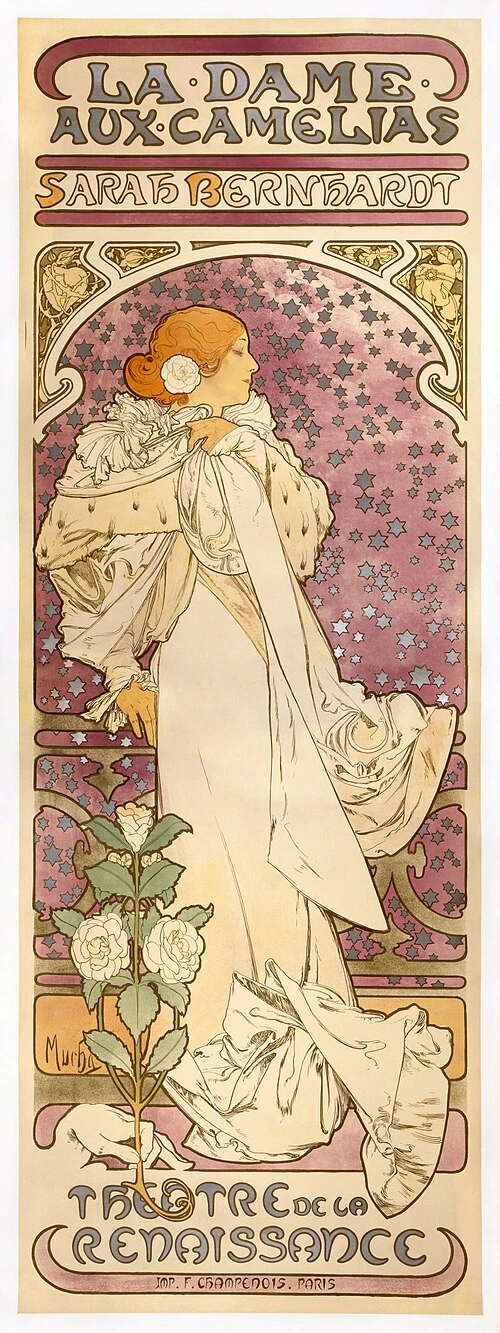
Art Nouveau is everywhere, including on posters advertising the first French star in history: Sarah Bernhardt / poster chosen by Monsieur de France By Alphonse Mucha — Original file from Library of Congress, Public domain, https://commons.wikimedia.org/w/index.php?curid=8886929
3. The concept of Total Art
Art Nouveau categorically rejects the separation between "fine arts" and "decorative arts." The goal is to create a holistic and coherent living environment, where aesthetics are incorporated into every daily gesture, from door handles to light fixtures, from facades to marital beds, from windows to bathrooms. And we witnessed unprecedented creativity for a good twenty years. This period is one of the great eras in the history of Nancy, along with the Age of Enlightenment and the Renaissance. There are few cities in France or even in the world that have experienced several glorious eras, but Nancy is one of them with the École de Nancy.
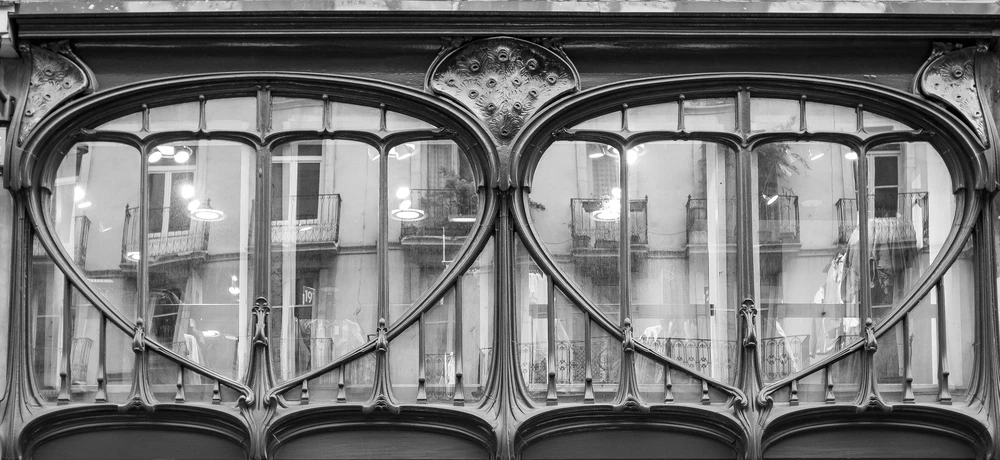
An Art Nouveau facade in downtown Nancy / Photo selected by Monsieur de France; depositphotos.
Where to stay in Nancy to discover the Art Nouveau heritage?
If you are visiting Nancy to explore its remarkable Art Nouveau heritage and the works of the famous École de Nancy, staying in the city centre is often the most convenient option. From there you can easily reach the Musée de l’École de Nancy, admire the beautiful Art Nouveau villas and explore the historic streets of the city.
To prepare your stay and compare accommodation depending on your dates and budget, you can check:
• available hotels in Nancy ↗
• hotels in Nancy city centre ↗
• well-located hotels near the main Art Nouveau sites ↗
This allows you to quickly see availability, guest reviews and prices depending on the time of your visit.
II. The Nancy School: A Unique Historical Context
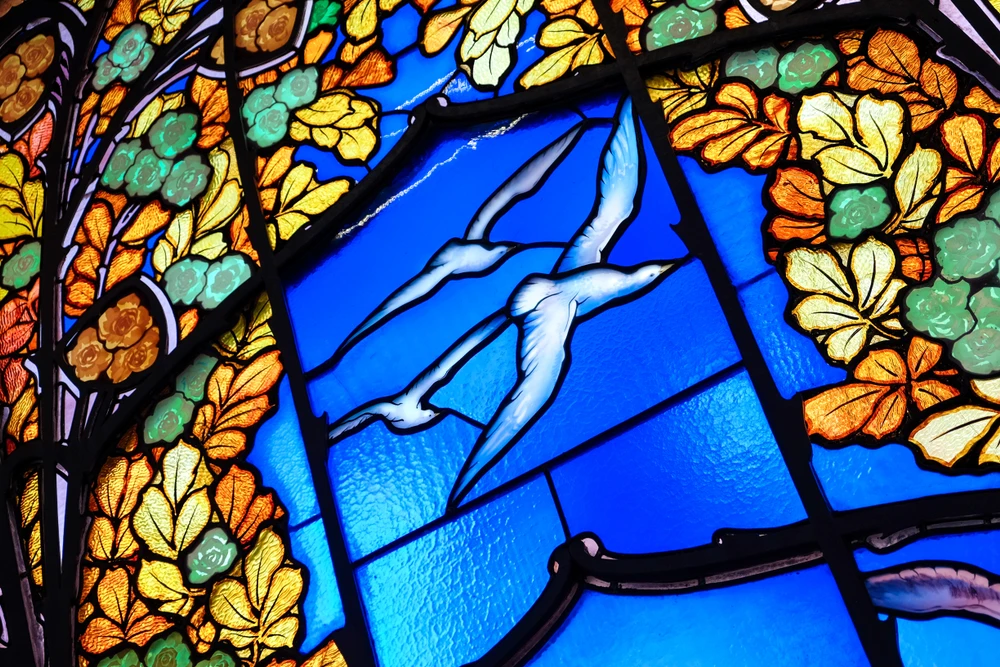
Jacques Grüber "Roses and Seagulls" Villa Bergeret in Nancy / Photo selected by Monsieurdefrance.Fr: WildSnap/Shutterstock
Why did Nancy become the French capital of this movement? The initial reason was political. It arose from the trauma of the 1870 war, a large population movement, and something magical: talent and money in the same place at the same time.
Discover Art Nouveau in Nancy with a guide
Nancy is one of Europe’s major Art Nouveau capitals thanks to the famous École de Nancy. To better understand this artistic movement and spot details you might not always notice on your own, a guided tour can be an excellent option. Accompanied by a professional guide, you’ll discover the facades, villas, and iconic creations that have made Nancy’s Art Nouveau famous.
👉 Discover the guided tour of Nancy ↗

1. 1871: Trauma and the brain drain
After its defeat in 1870, France lost significant territories: Alsace and part of Lorraine. The Moselle became German. Nancy, however, remained French. It found itself on the immediate border of the German Empire. As a result, the city, which had just over 50,000 inhabitants and was not a military stronghold like Metz, which had become German, became the "sentinel of the East," a French bastion. It was now the largest city in eastern France, and many Alsatians and Lorrainians who did not want to become German with the annexation turned to it.
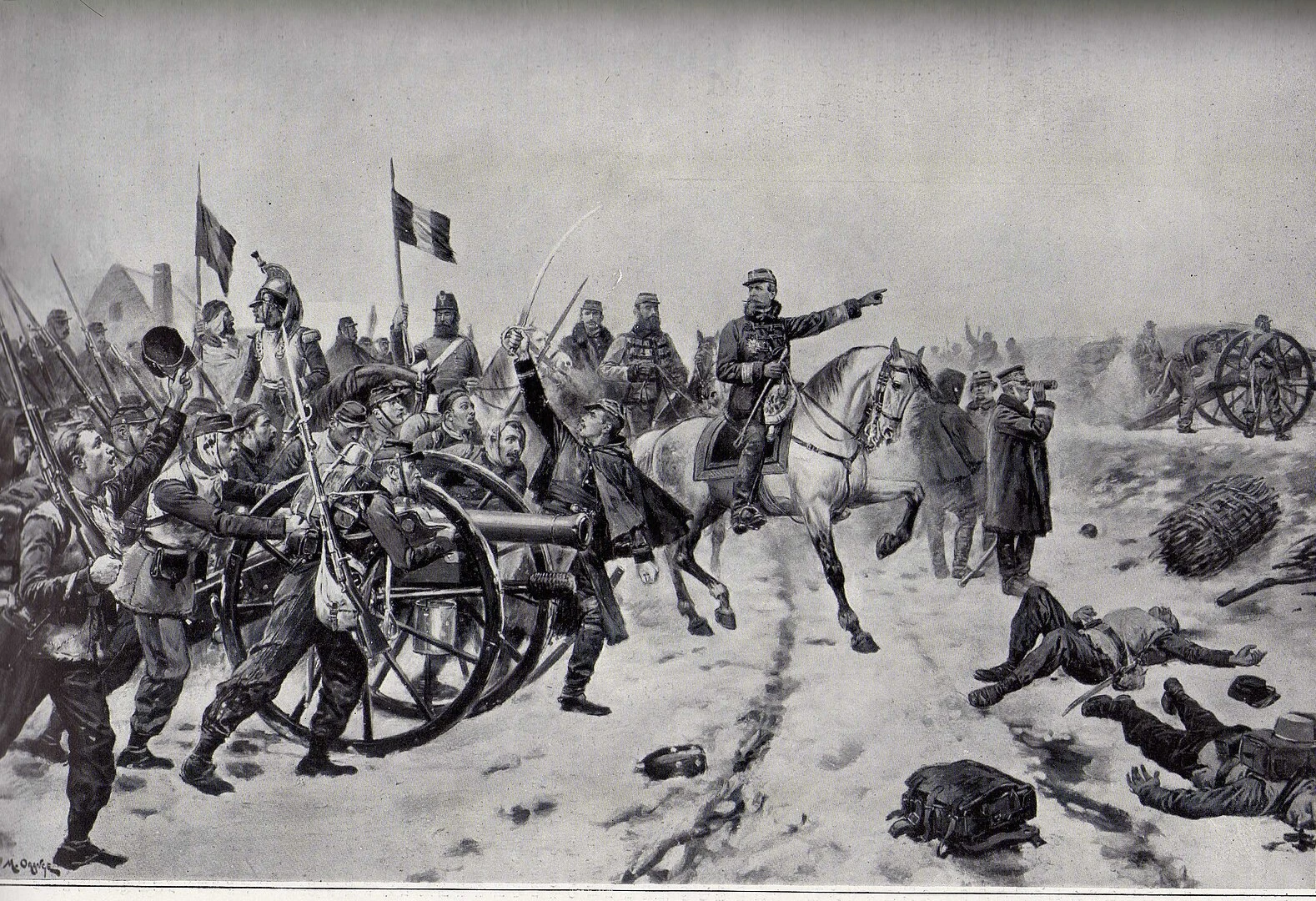
The Battle of Le Mans / illustration selected by Monsieurdefrance.Com: By Maurice Orange (1868-1916) — Book: General History of the Franco-Prussian War, 1870-1871, Colonel Rousset, Jules Tallandier edition, 1911, Public domain, https://commons.wikimedia.org/w/index.php?curid=3696713
2. An unprecedented creative influx
Between 1871 and 1900, Nancy's population exploded, growing from 50,000 to over 100,000 inhabitants. It welcomed thousands of "optants," Alsatians and Mosellans who refused German nationality and moved away. These were often wealthy people, merchants, and artisans who could move and leave everything behind, unlike farmers and miners. This influx of people, capital, and expertise (industrialists, glassmakers, cabinetmakers) transformed the city into a bustling intellectual metropolis. The wealthy industrialists loved to build, decorate, and show off their success, and there were artists and craftsmen to whom they could place orders. With this added strength, very typical of Lorraine, of having a taste for excellence. This land is a land that has gold in its hands. We do things well. We always try to do them in the best possible way.
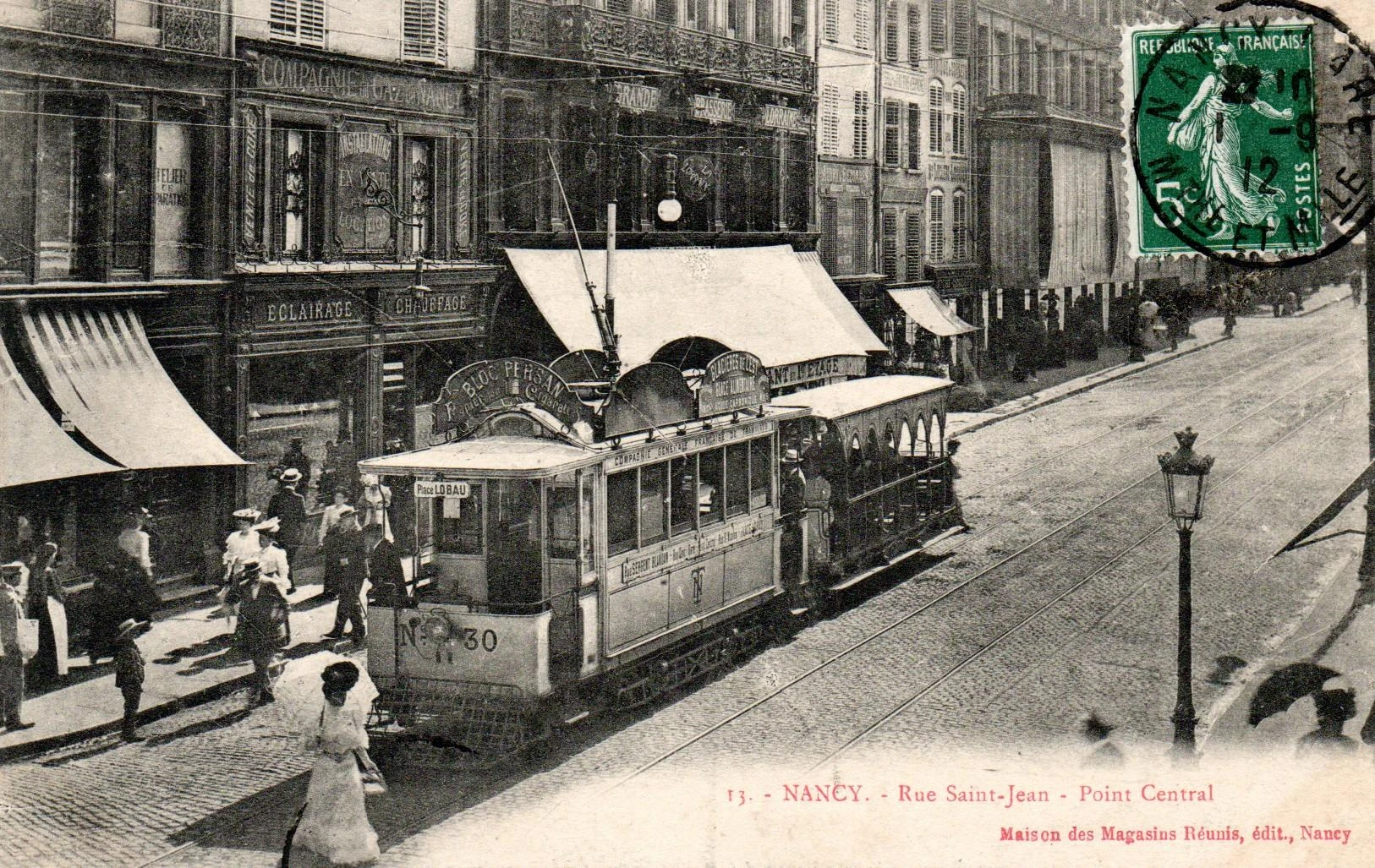
Nancy becomes very important with the arrival of optants / Photo chosen by Monsieur de France: Scanned by ABACA from a vintage postcard published by "Maison des magasins réunis - Nancy" — my own collection, Public domain, https://commons.wikimedia.org/w/index.php?curid=17180176
3. The founding of the Alliance (1901)
On February 13, 1901, the creation of the Association de l'École de Nancy, or Alliance Provinciale des Industries d'Art, confirmed a movement born of this combination of money and talent. Its first president, Émile Gallé, defined a social mission: to combine art with industry in order to make beauty accessible to all. In short: create beautiful things and find techniques to produce them in large quantities to make them more accessible. Emile Gallé's motto sums up Art Nouveau well: "Never imitate! Always innovate." The School of Nancy was involved in all areas: interior design, architecture... It imposed its codes and desires, and Nancy became a gigantic laboratory for Art Nouveau, with the added bonus of Lorraine's genius.
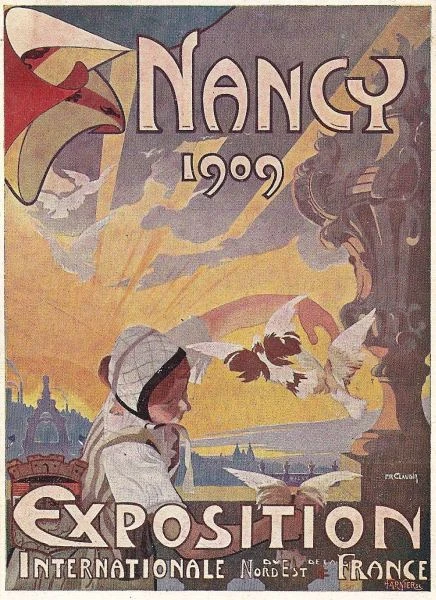
The 1909 Universal Exhibition in eastern France is considered the high point of the Nancy School. It took place in Sainte Marie Park and attracted more than 500,000 visitors in just a few months / Official poster by Pierre-Roger Claudin — [1], Public domain, https://commons.wikimedia.org/w/index.php?curid=21958462
III. The Masters of the Nancy School: Portraits of Visionaries
1. Émile Gallé: The botanist of glass
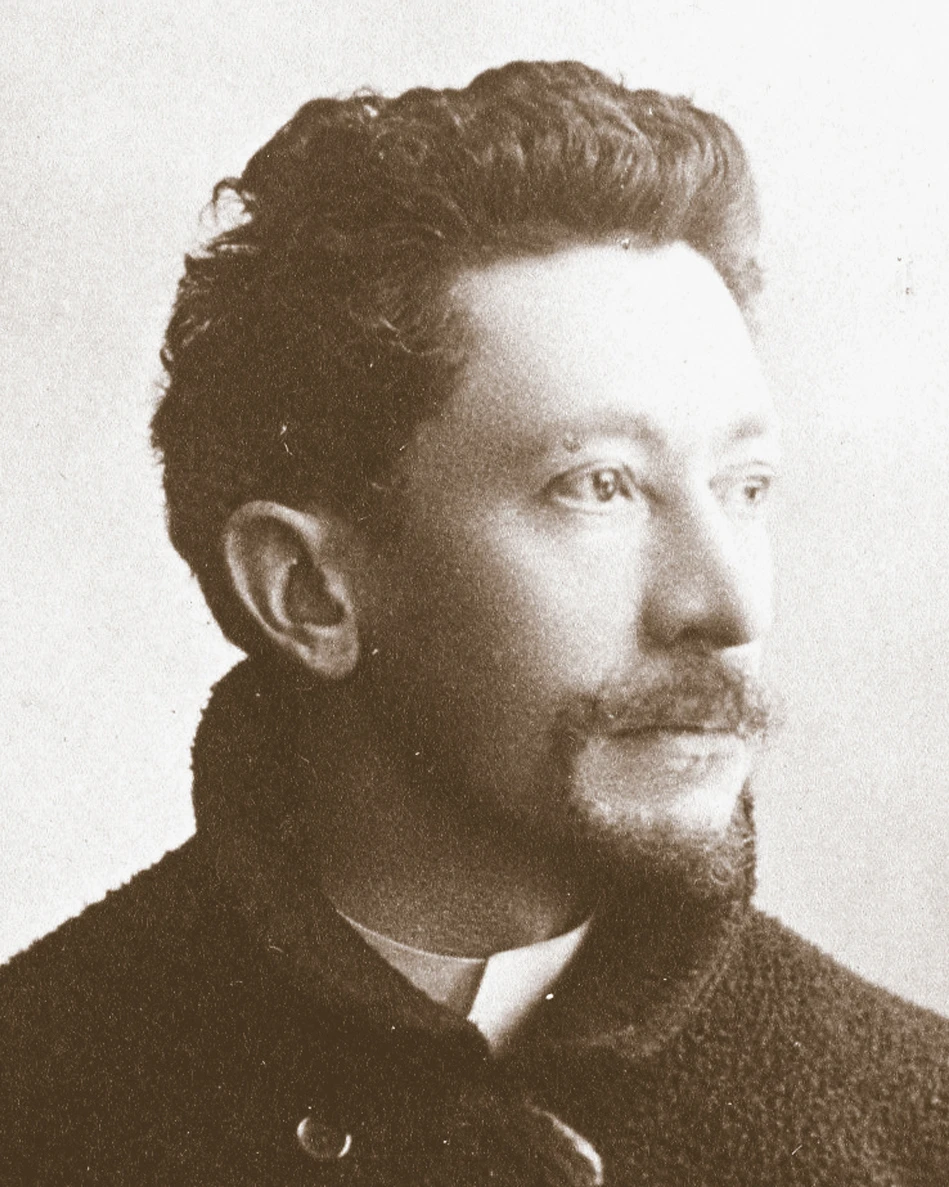
Emile Gallé 1846 - 1904 Public domain, https://commons.wikimedia.org/w/index.php?curid=21721538
Gallé is the soul of the movement. A passionate botanist, he fully embraces the love of nature that drives Art Nouveau, revolutionizing glassmaking with complex techniques such as acid etching and multilayered glass. His "talking vases" often feature poetic quotations, merging literature and material. He was also a very committed man, shaking up the rather conservative Nancy spirit of the time. He was seen to be committed to defending Dreyfus, even though the city was largely against this man who had been unjustly accused of espionage.
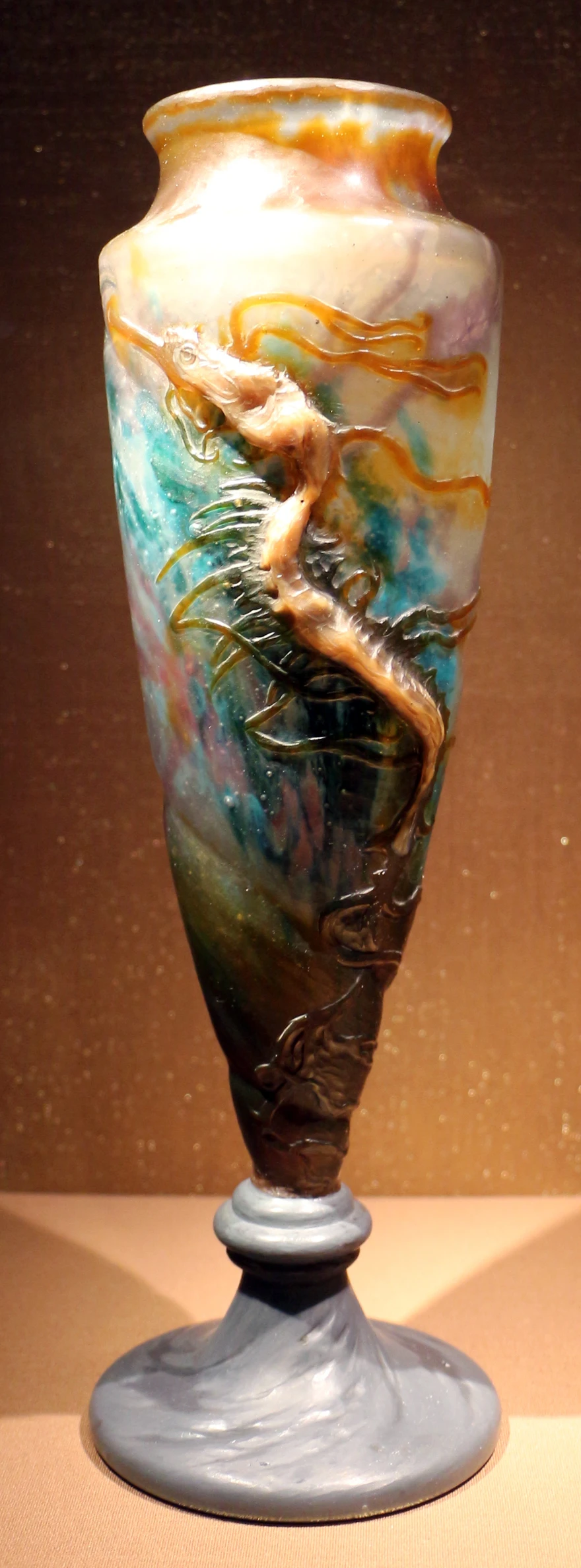
A vase signed Gallé / Photo chosen by Monsieur de France: By Sailko — Own work, CC BY 3.0, https://commons.wikimedia.org/w/index.php?curid=49220542
2. Louis Majorelle: The wood and iron sculptor
Louis Majorelle was born in Toul, not far from Nancy, in 1859. Trained in fine arts, he took over the family pottery and cabinetmaking business upon his father's death. Initially drawn to woodworking, he became one of the greatest specialists in his field. While the era was enamored with the neo-Gothic style, inspired by the Middle Ages, and he had long been making fashionable Louis XV-style furniture, he abandoned the old styles to create structures full of curves and floral elements. A console table by Majorelle seems to blossom like a plant. He also became a master of wrought ironwork, whose famous "Majorelle line" still adorns the facades of Nancy.

Piano made by Louis Majorelle / Photo chosen by Monsieur de France By Léna — Own work, CC BY 3.0, https://commons.wikimedia.org/w/index.php?curid=16839390
3. The Daum Brothers: Masters of Crystal
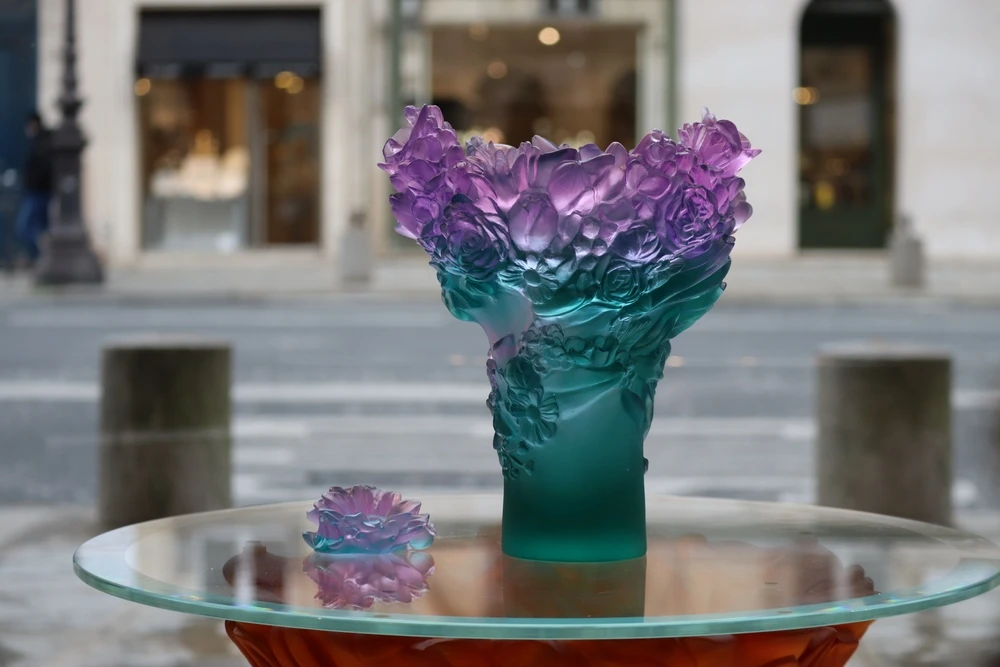
Daum still exists today and continues the tradition of the School of Nancy by regularly producing decorative objects that are new and unique in the world / Photo selected by Monsieurdefrance.Fr: Andrei Antipov/Shutterstock
Auguste and Antonin Daum are typical examples of "optants." Their father left his notary office in Bitche, which had become German, to settle in Nancy. He invested money in an existing glassworks before taking it over permanently. His sons, Auguste and Antonin, took it to the highest level and succeeded in combining artistic experimentation with industrial power. They perfected the technique of pâte de verre, a material that allows for infinite chromatic nuances and a unique velvety texture.
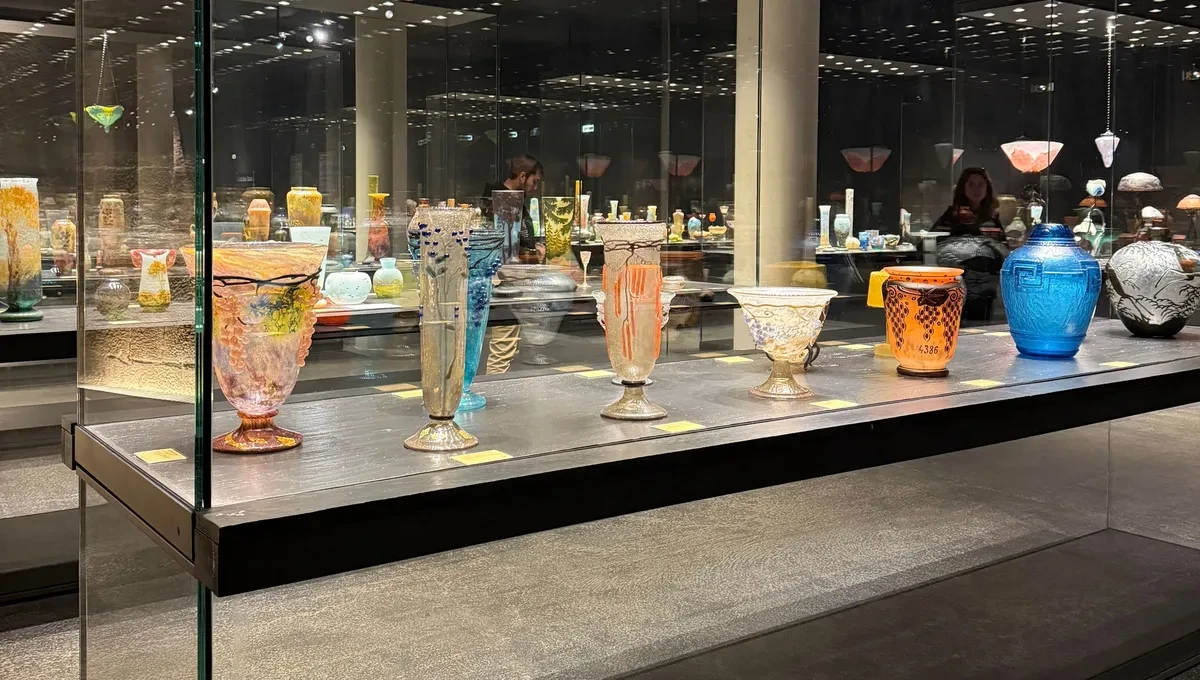
The Daum collection at the Nancy Museum of Fine Arts/ Photo selected by Monsieur de France: Jérôme Prod'homme
4. Jacques Gruber: The genius of stained glass
Jacques Gruber was born in Mulhouse, but his parents left the city to remain in France. The city of Nancy did a great deal for the young Gruber, offering him a scholarship so that he could perfect his skills at the École des Beaux-Arts in Paris. A specialist in stained glass, he was the artist who best captured the light of Lorraine. He did not simply assemble colored glass; he used acid etching to create true translucent paintings. His landscapes of undergrowth and misty ponds are utterly poetic. He was responsible for the monumental stained glass windows of the Chamber of Commerce and Industry in Nancy and the L'Excelsior brewery. He turned windows into works of art, changing the way we see the outside world.
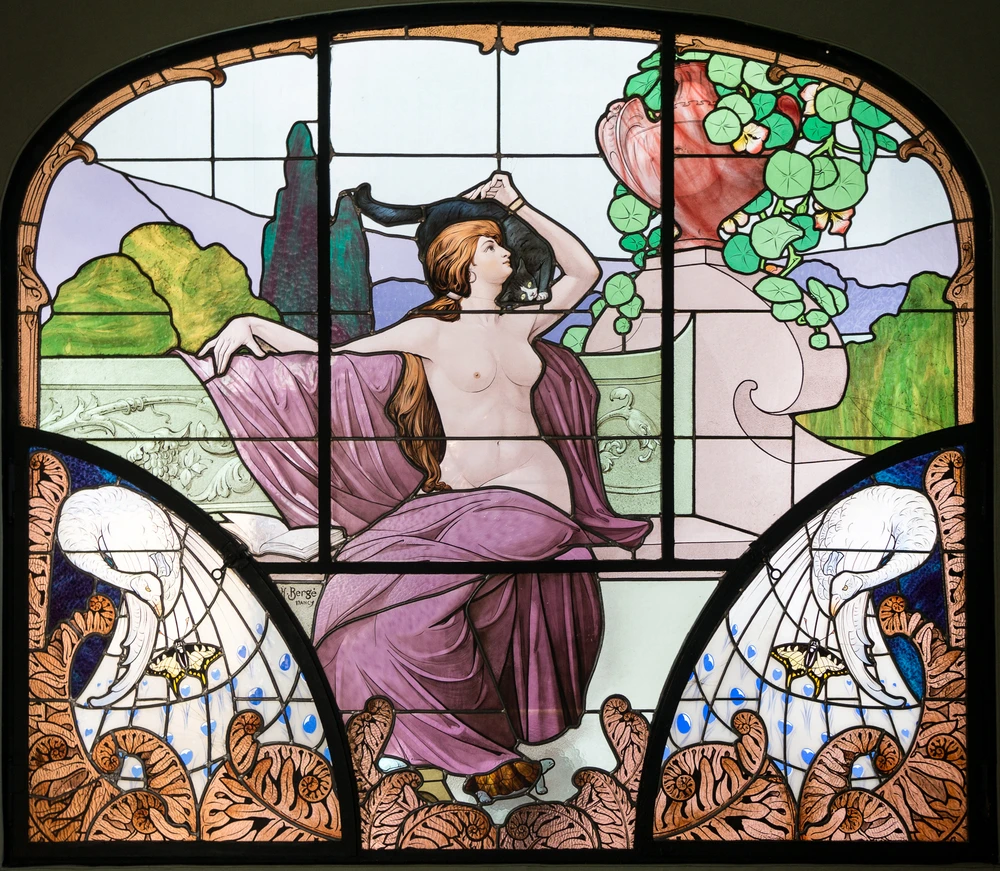
Grüber stained glass window on display at the Musée de l'Ecole de Nancy / Photo selected by Monsieurdefrance.Fr: HUANG Zheng/Shutterstock
At the same time, Nancy saw the emergence of pure artistic talent such as the painters Emile Friant and Camille Martin. It was also a golden age for botany : Victor Lemoine and François Felix Crousse "obtained," in other words created, many new plants: hydrangeas, begonias, and the fabulous double lilac "Madame Lemoine," which can now be seen all over the world and whose oldest specimens continue to grow in many gardens in Nancy.
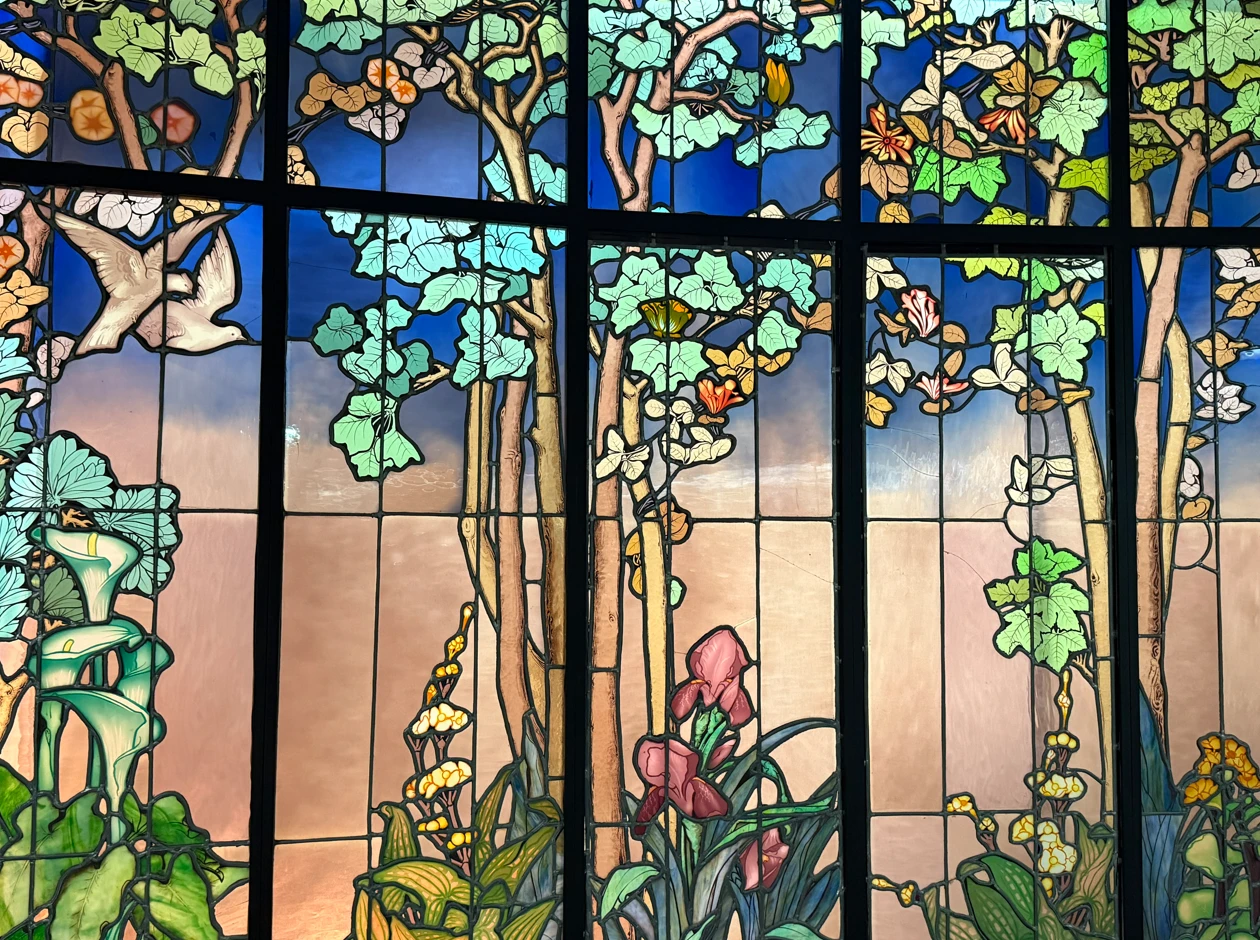
Stained glass is emblematic of the Nancy School / Photo selected by Monsieurdefrance.com: Jérôme Prod'homme (c)
5. Eugène Vallin: The architect of the construction line
Eugène Vallin occupies a special place: he is the one who gives volume and structure to the movement. Originally a cabinetmaker specializing in religious furniture, he made a spectacular conversion to Art Nouveau under the influence of Gallé. Vallin did not simply decorate wood, he sculpted it to create powerful and dynamic structures. He is credited with monumental furniture sets, as well as innovative architecture. He designed one of the city's first Art Nouveau buildings for his own workshop. His genius lay in his ability to merge the framework of a building with its interior décor, taking the concept of Total Art to its peak.
IV. The Art Nouveau Trail: Masterpieces to Visit
1. The Museum of the School of Nancy: Art at Home
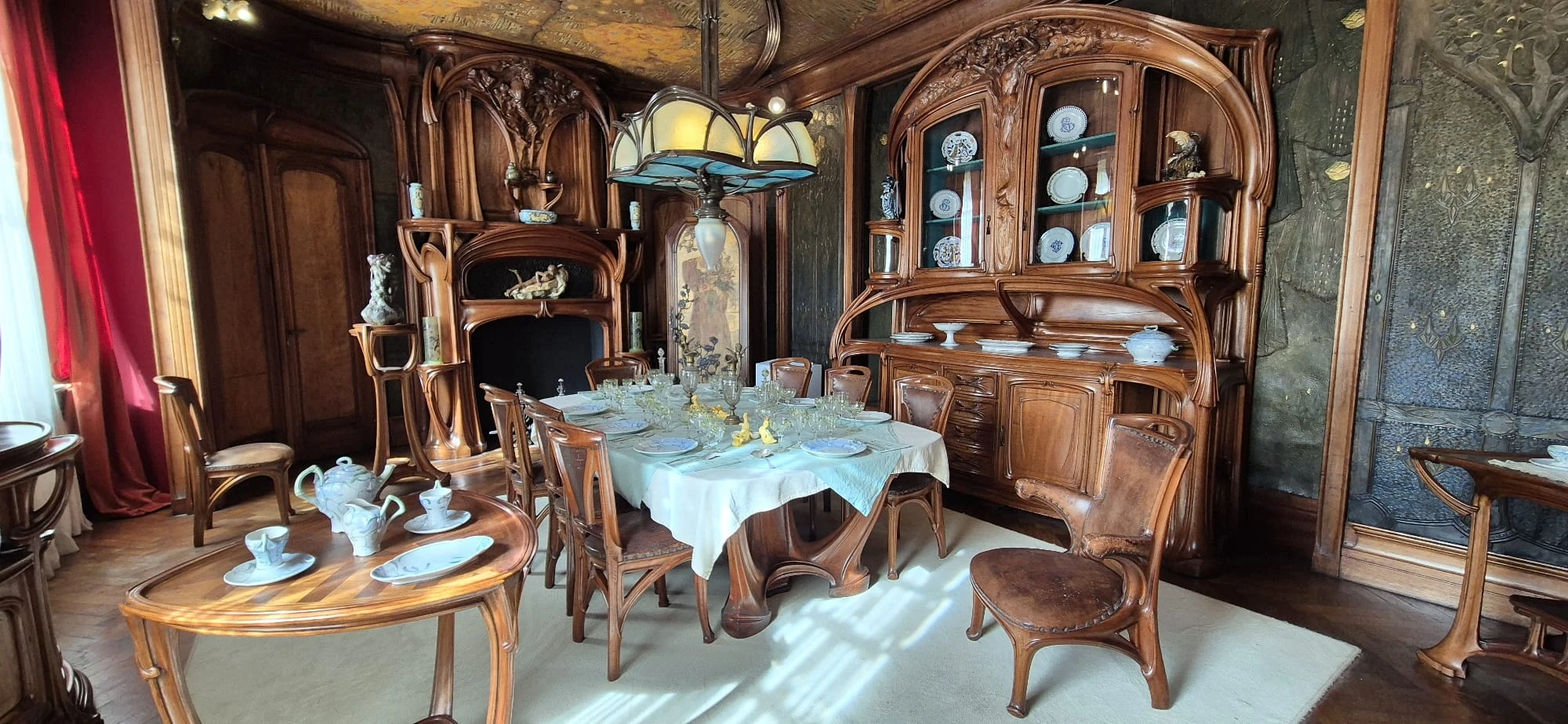
The spectacular dining room at the Nancy School Museum / Photo selected by Monsieur de France: Françoise Prod'homme (c)
Housed in the former residence of Eugène Corbin, a wealthy patron of the Nancy School, this museum is unique in the world. Here, the works are presented in situ, in their original context. Visitors can discover a typical Art Nouveau interior and a summary of the best of what the era loved and produced for interiors, from vases to beds, furniture and stained glass windows. Highlights include:
-
The Masson dining room: A monumental oak room where every detail is carved with natural motifs.
-
The bathroom: all tiled, breathtaking.
-
The garden: It is home to plant species that have inspired artists (clematis, thistles, peonies), as well as an exceptional Art Nouveau aquarium.
Address: 38 Rue Blandan / 54000 Nancy
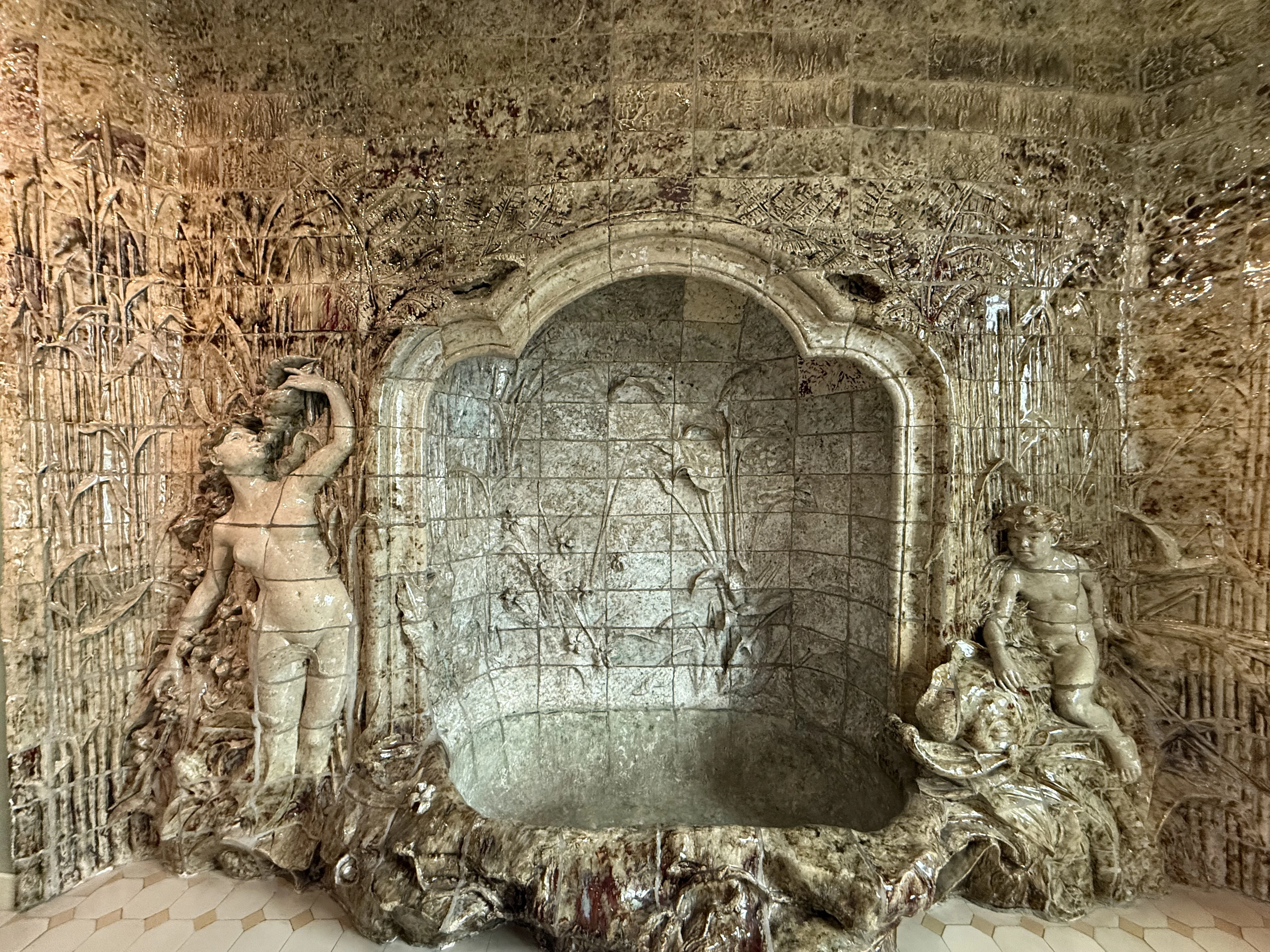
Bathroom at the Museum of the School of Nancy / Photo selected by Monsieurdefrance.com: Jérôme Prod'homme (c)
2. Villa Majorelle: The manifesto house
Built by Henri Sauvage for Louis Majorelle, Villa Majorelle is the first example of total architecture in Nancy. Recently restored, it shows how Majorelle conceived his home: everything is curved, from the monumental fireplaces to the window handles. It is a triumph of architectural fluidity.
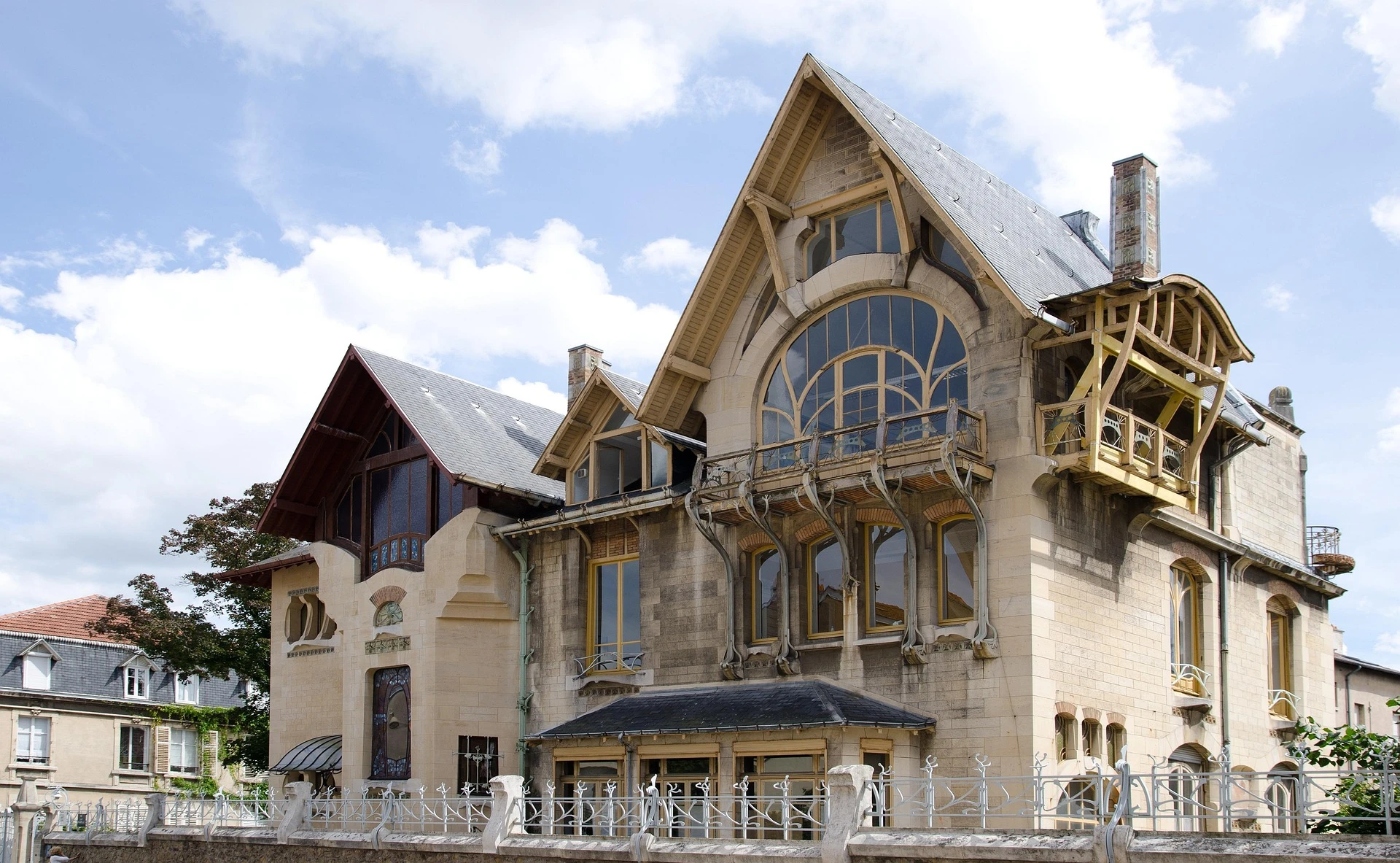
The facade of the Villa Majorelle in Nancy / Photo selected by Monsieurdefrance.com: Patrice Soudier from Pixabay
Address: 1 rue Louis Majorelle / 54000 NANCY
3. La Brasserie L’Excelsior: The temple of taste
Opposite the train station, this railway-inspired brasserie is a preserved piece of 1900s history. Beneath ceilings adorned with ferns, Jacques Gruber's stained glass windows bathe the room in golden light. The furniture is by Majorelle and the light fixtures are the work of the Daum brothers. Lunching here is like stepping back in time.
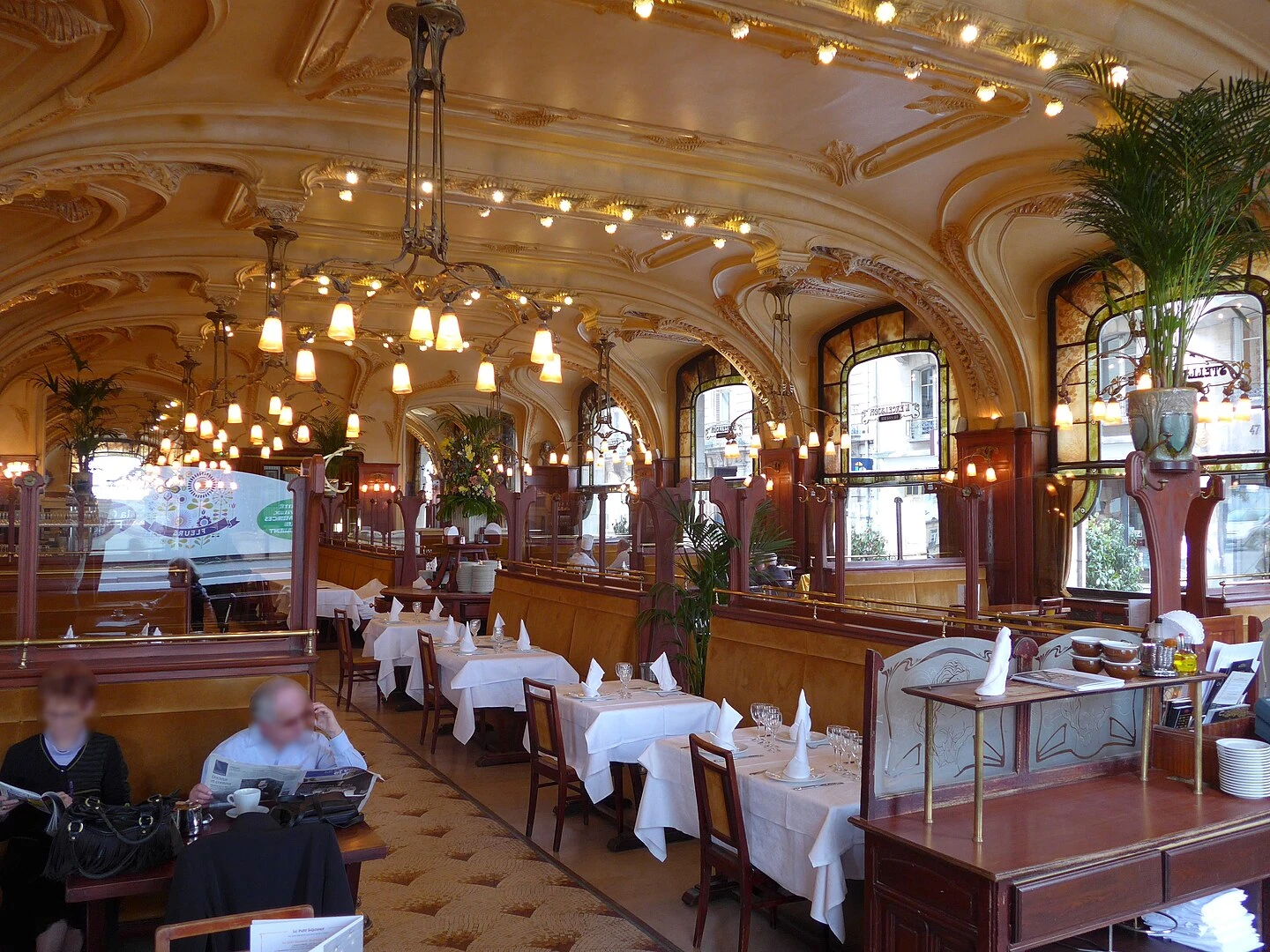
The Art Nouveau interior of L'Excelsior in Nancy / Photo selected by Monsieur de France : By Arie m den toom — Own work, CC BY-SA 4.0, https://commons.wikimedia.org/w/index.php?curid=63691716
Address: 50 rue Henri Poincaré / 54000 NANCY.
4. The Saurupt neighborhood: The luxury garden city
To the south of the city, the Saurupt neighborhood bears witness to the boldness of architects such as Émile André and Lucien Weissenburger. Here you can admire extraordinary villas (Villa Les Glycines, Villa Les Roches) that resemble living organisms. The railings, water lily-shaped windows, and exuberant roofs make it an open-air museum of architecture.
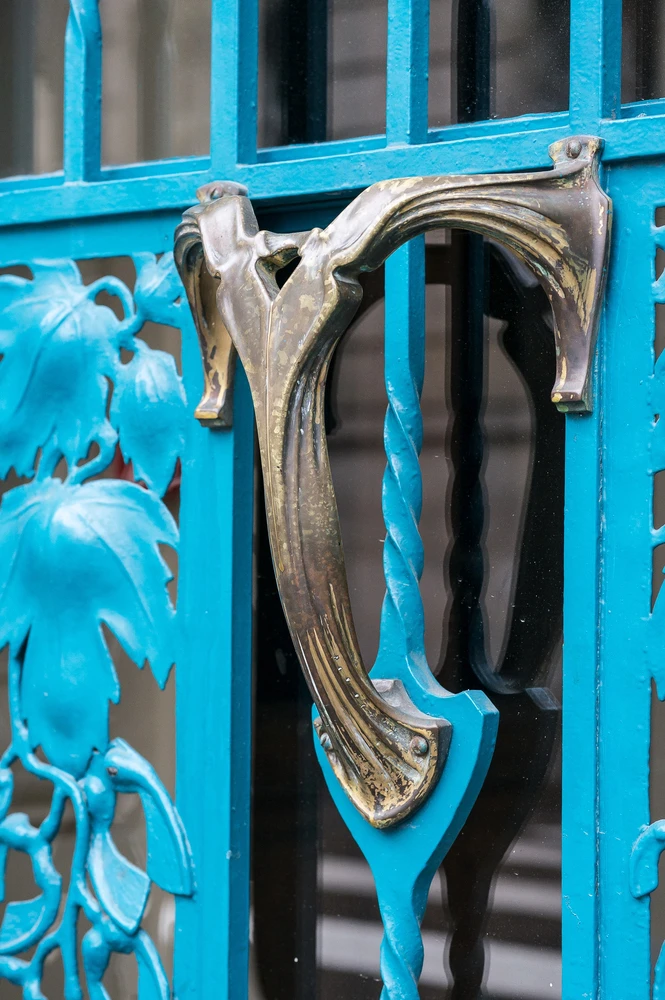
Art Nouveau element in downtown Nancy / Photo selected by Monsieur de France: depositphotos
5. Avenue Foch, Quai Claude le Lorrain, Rue Saint Jean... Art Nouveau is in town
Nancy's city center is dotted with Art Nouveau buildings, particularly on Rue Saint Jean, the main shopping street, which is home to Crédit Lyonnais, the former Génin Louis seed store, BNP, and more. On Avenue Foch and Quai Claude Le Lorrain, there are mainly apartment buildings and mansions.
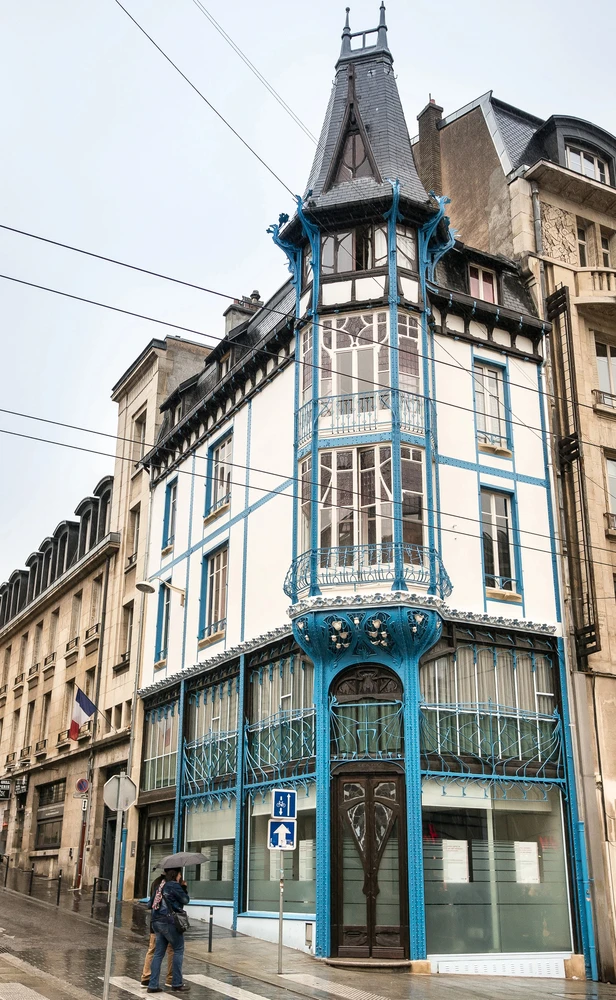
An Art Nouveau building in the center of Nancy / Photo selected by Monsieur de France: depositphotos
V. FAQ: Understanding the Nancy School in depth
Why is nature so present in Lorraine?
The Nancy School is deeply naturalistic. Unlike the more abstract Parisian Art Nouveau, artists from Lorraine used what they observed in local forests and gardens: the thistle (the city's emblem), the umbel, the water lily, clematis, and moneywort.
What is the fundamental difference with Art Deco?
Art Nouveau (1890-1910) is asymmetrical, floral, and full of curves. Art Deco (1920-1930), which succeeded it after the war, is geometric, linear and more sober. Nancy has some beautiful examples of Art Deco, but it is Art Nouveau that has made it world famous.
Where can you see Gruber's stained glass windows for free?
Step inside certain banks in the city center (LCL or BNP on Rue Saint-Dizier) or the Chamber of Commerce and Industry (Rue Stanislas). There you will discover monumental glass roofs that will take your breath away.
Why did the style stop?
A certain weariness with exuberant curves and, above all, the First World War brought creative momentum to a definitive halt. After 1918, the world aspired to greater simplicity and rigor.
Can you still buy pieces from the École de Nancy?
Original pieces sell for a fortune. However, Cristallerie Daum continues to produce glass paste works today, perpetuating the expertise of the founding brothers.
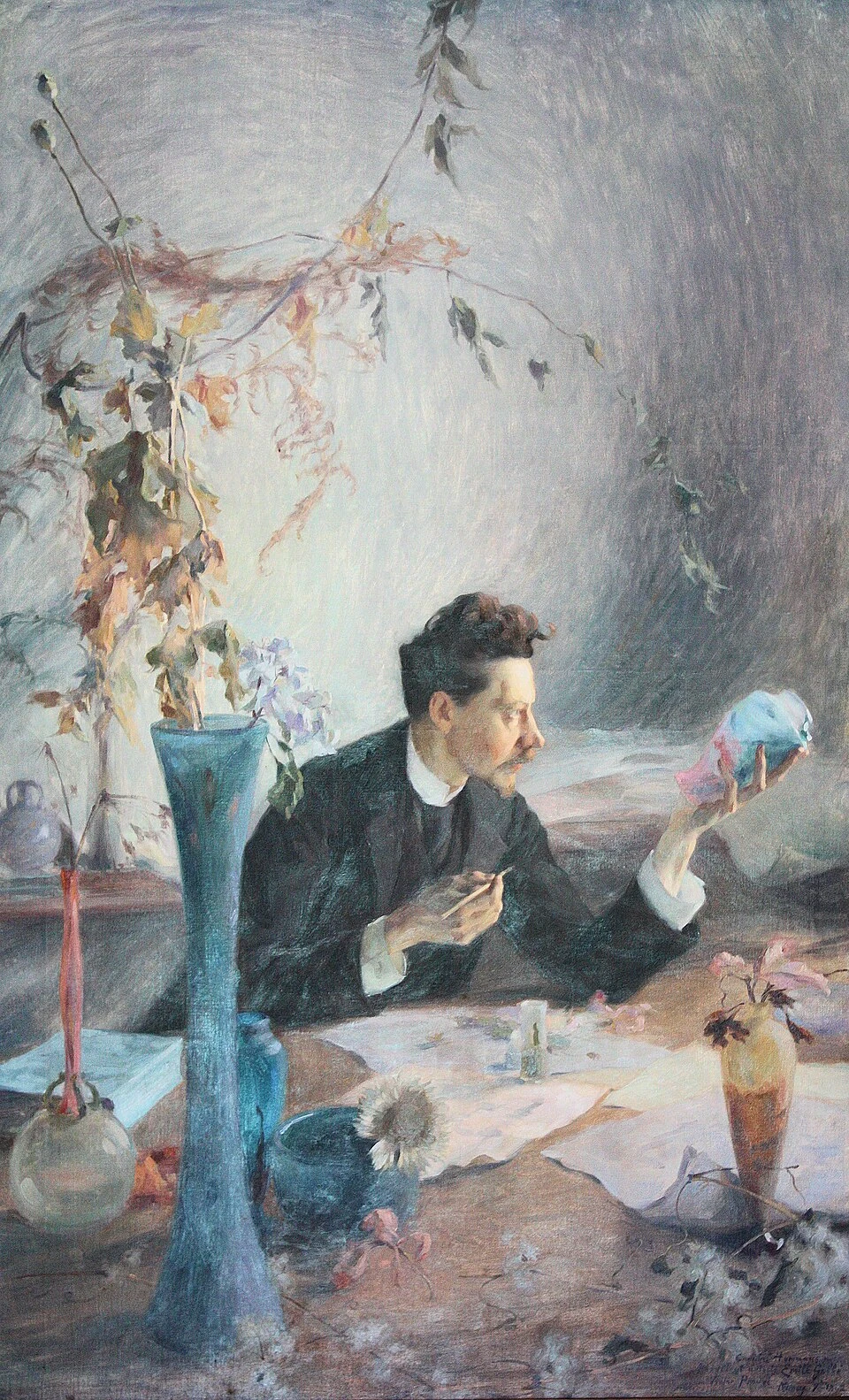
Émile Gallé in his studio, Victor Prouvé, c. 1900, Musée de l'École de Nancy. By Dguendel — Own work, CC BY 3.0, https://commons.wikimedia.org/w/index.php?curid=101769672
Conclusion: A legacy that defies time
The Nancy School was not just a brief aesthetic interlude. It was the cry of a city that chose to invent the future by looking at its flowers. When visiting Nancy, it becomes clear that this heritage is not static: it continues to inspire lovers of beauty and bears witness to a time when people believed that art could change lives. Taking the time to observe an Art Nouveau facade in Nancy is like treating yourself to a moment of poetry. Here, nature is eternal, and art is everywhere at home.
Ready to explore further?
-
Discover our feature on Place Stanislas to learn about the city's other great treasure.
Find out more about Nancy:
- The complete guide to visiting Nancy
- my audio guide in immersive sound to visit Nancy
- Place Stanislas: history and secrets of Nancy's most beautiful square
- Art Nouveau and the École de Nancy: an architectural treasure
- What to do in Nancy over a weekend?
- Culinary specialties of Nancy you absolutely must try
- And why not discover Lorraine?
Monsieur de France Tourism, lifestyle, gastronomy, history... France is wonderful.