To read the secret of the fountain: the guide to the UNESCO square in 2026, stop in front of the Amphitrite statue. The mistake is seeing just a goddess: legend says she was modeled after King Stanislas's mistress! Dive into the most comprehensive article on this World Heritage jewel in Nancy to decode every detail.
Planning a stay in Nancy? Choosing the right accommodation will help you fully enjoy the city, from sightseeing to restaurants and the atmosphere of the center:
👉 See the best-located hotels to visit Nancy
👉 Check available deals for your travel dates
👉 Our tips on where to stay in Nancy
👉 Must-see attractions in Nancy
Want to explore the city differently? 👉 Book a guided tour in Nancy (top experiences)
This article may contain affiliate links. This does not change the price for you, but helps support the Monsieur de France website.
Nancy: a unique complex listed as a UNESCO World Heritage Site
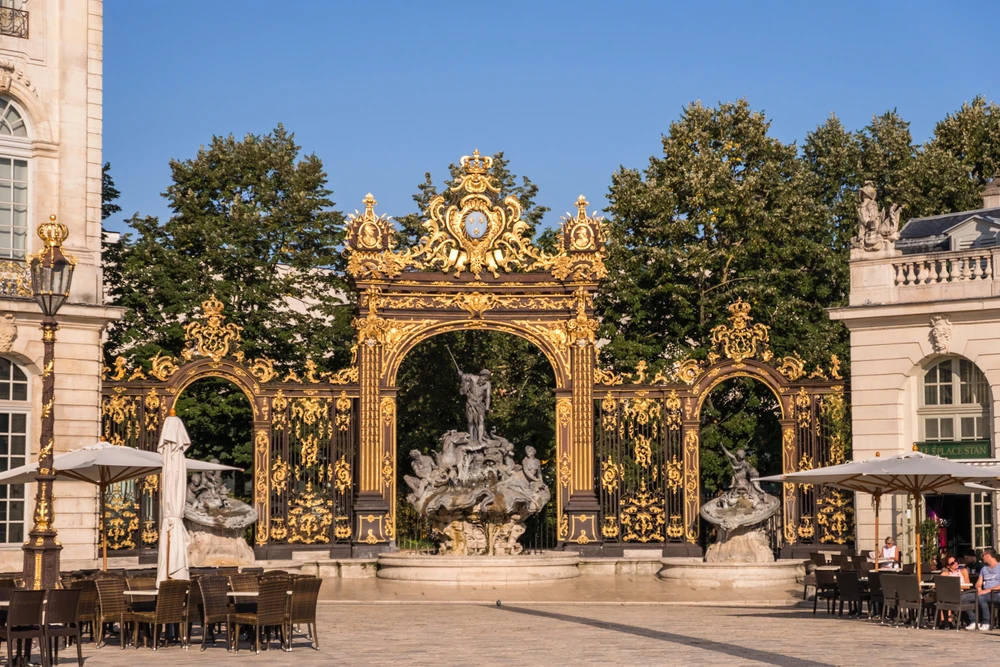
Welcome to the city with golden gates / Photo: Depositphotos
The Age of Enlightenment left one of its finest legacies in Nancy: Place Carrière, Place d'Alliance, and Place Stanislas. These three squares were listed as UNESCO World Heritage Sites in 1983, the same year as the Taj Mahal. And finally, most importantly, there is Place Stanislas. Describing this marvel is a challenge, as it embodies the emotion and memory of Nancy. When you know this place, you want to summon every word to pay tribute to this jewel that is unique in the world.
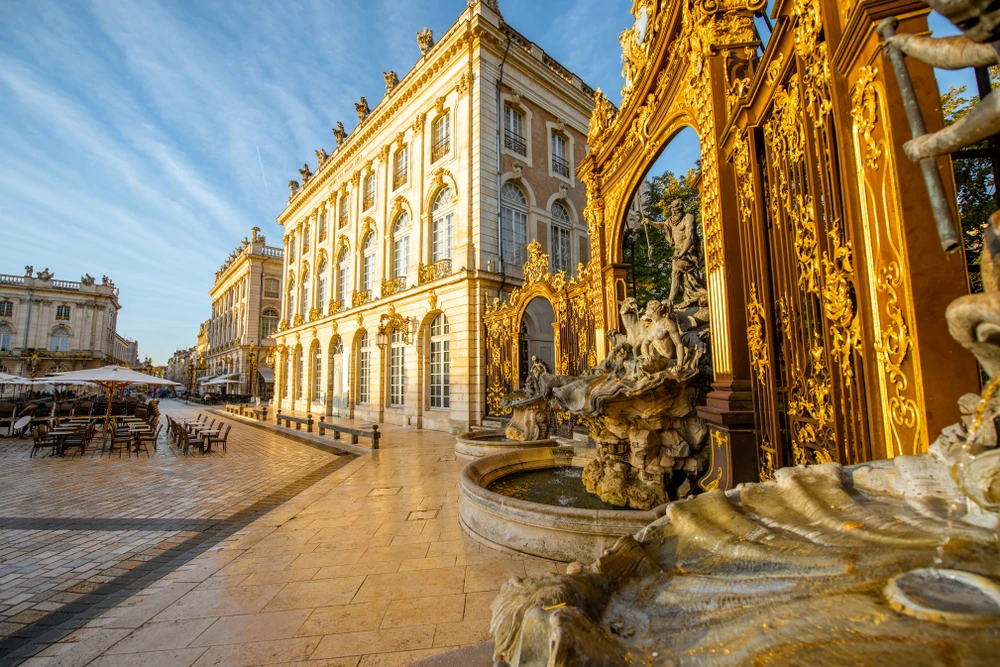
Place Stanislas in Nancy with its golden railings in the rising sun / Photo selected by Monsieur de France: shutterstock
Why is Place Stanislas the most beautiful square in the world?
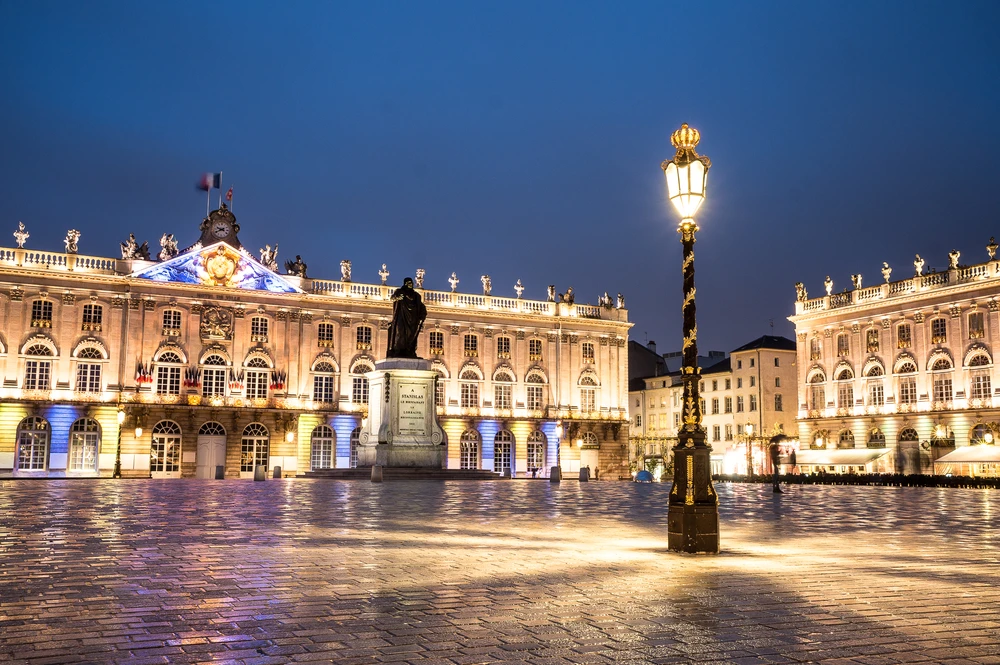
Place Stanislas: magical at night / Photo by HUANG Zheng/shutterstock
Compare it to the world's greatest squares, and you'll see: Place Stanislas is the most beautiful.
More intimate than St. Mark's Square in Venice, more elegant than Place de la Concorde in Paris, it charms visitors with its human scale, symmetrical facades and sparkling gilding. Early in the morning or at sunset, Place Stanislas reveals its full magic. The white facades capture the light, the gilded railings glow, and you understand why it enchants so many visitors.
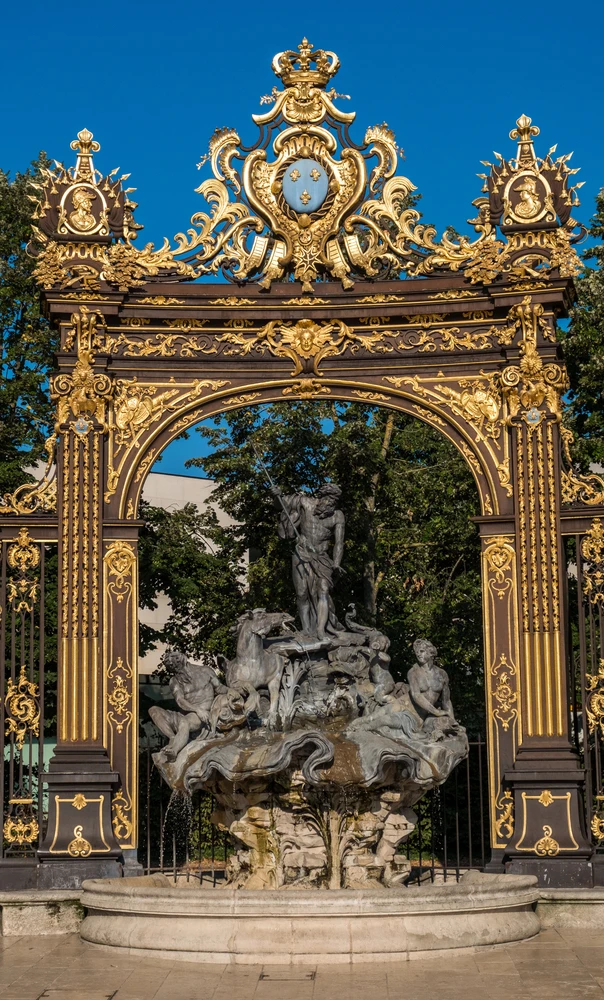
The Neptune Fountain, one of two majestic fountains in Place Stanislas in Nancy / Photo selected by Monsieur de France: depositphotos
Explore Nancy with a Guide
If you’d like to experience Nancy in a different way and gain a deeper understanding of the city’s history, a guided tour with a professional guide is an excellent idea. This tour allows you to explore Place Stanislas, the Old Town, and the main landmarks while discovering the stories and secrets of the former capital of the Dukes of Lorraine.
👉 Book the guided tour of Nancy ↗
This article may contain affiliate links. This does not affect the price for you but helps support the Monsieur de France website.
Jean Lamour's golden gates: the genius of wrought iron
The wrought iron gates gilded with gold leaf, created by Jean Lamour, adorn the entrances, balconies, and fountains. They shine in the sun, sparkle in the rain, and lend the place an incomparable majesty. The statues of Neptune and Amphitrite, gods of the sea, watch over the fountains, as if frozen in an eternal aquatic dialogue.
The Arc Héré: the crowning glory of the perspective
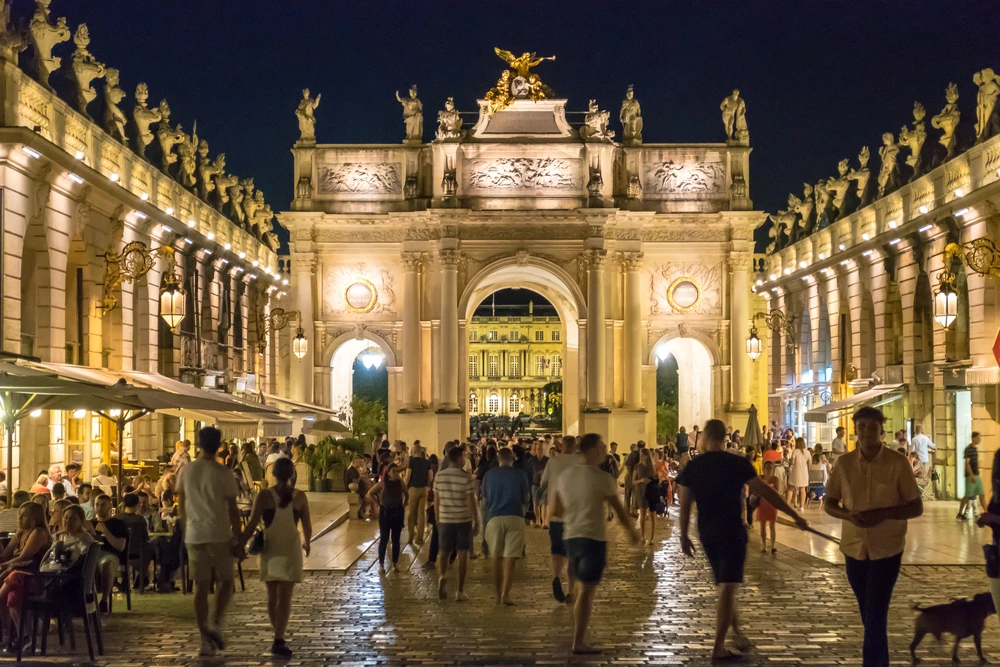
The arc of night / Photo selected by Monsieur de France: depositphotos
The crowning glory of Place Stanislas is the Arc Héré, inspired by the Arch of Septimius Severus in Rome. Topped by a golden Renommée blowing her trumpet, it celebrates glory and peace. Nearby, the Opéra National de Lorraine resounds with concerts, and the Musée des Beaux-Arts exhibits masterpieces by Delacroix, Claude Gelée, known as "Le Lorrain," Émile Friant, and Caravaggio.
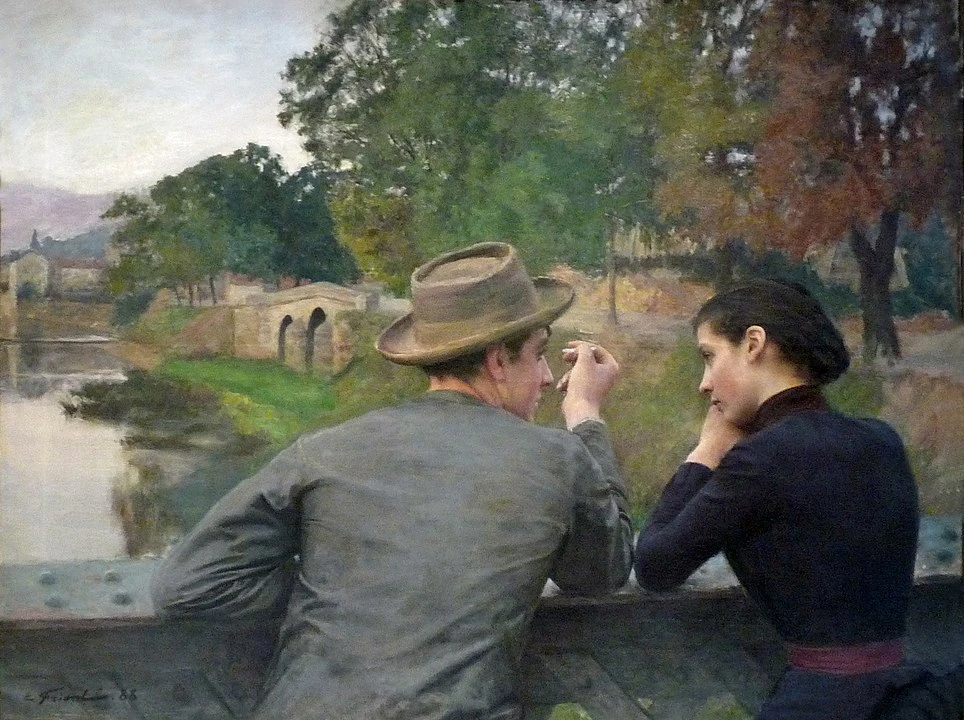
The Lovers painted in 1888 by Emile Friant (1863 - 1932)

Place Stanislas: Nancy's treasure.
This square is the heart of the city of Nancy, just as the Acropolis is for Athens. It is even the symbol of the city. Since its inauguration in 1755, Place Stanislas has witnessed history unfold at the leisurely pace of King Stanislas, but also of other great figures of the world. Mozart drank coffee there, De Gaulle and Churchill walked there, Patton crossed it as a liberator, and Pope John Paul II greeted the crowds there. Hot air balloons have taken off from it, warplanes have been displayed there, and the statue of Louis XV was destroyed during the Revolution.
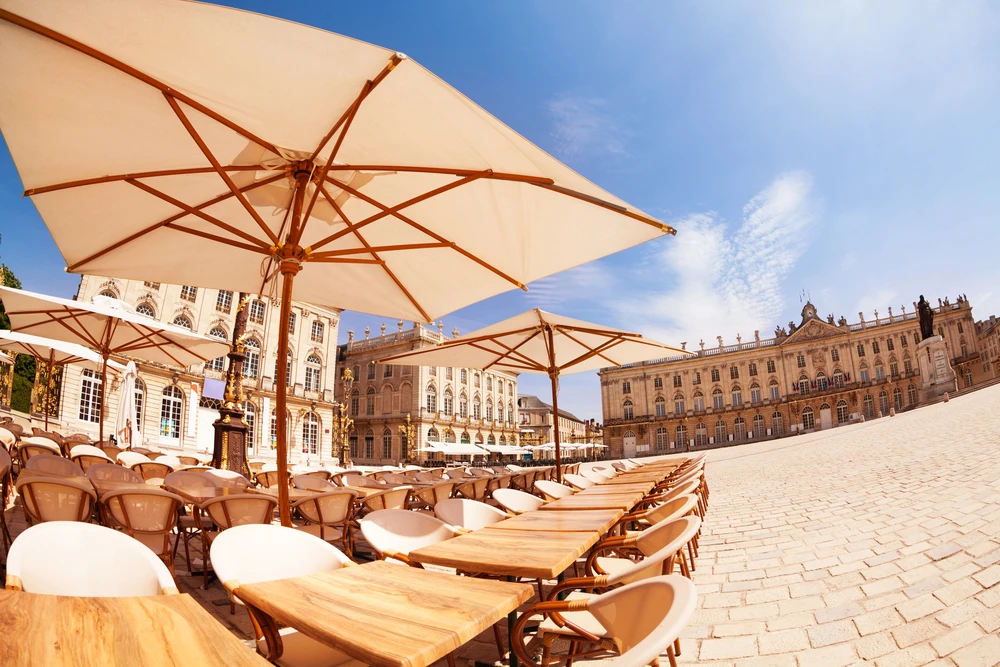
You can enjoy a quick coffee on Place Stanislas. Mornings here are wonderful. / Photo selected by Monsieur de France: depositphotos
Place Stanislas in Nancy is a place of great collective emotion. It has been the site of celebrations for liberation, armistices, and sporting victories (the 1998 and 2018 World Cups, the ASNL League Cup, and SLUC Basket victories). It is also here that the people of Nancy gathered in grief, as they did after the attacks in 2015. Place Stanislas is both a place of celebration and a place of contemplation.

January 11, 2015, the "Je suis Charlie" demonstration at Place Stanislas / photo by Monsieur de France (c)
For residents of Greater Nancy, Place Stanislas is a theater of life. People come here for the Christmas market, to stroll around, or to drink coffee. Every generation of Nancy residents has memories of Place Stanislas. Auguste Bartholdi, the creator of the Statue of Liberty, met his future wife there. Michel Platini began his career there. Philippe Claudel and hundreds of authors come every year to Livre sur la Place, the major literary fair. From anonymous individuals to celebrities, everyone has experienced an unforgettable moment on Place Stanislas, the beating heart of Nancy.
👉 Nancy has so much to offer. Discover my ultimate guide to visiting Nancy.
The must-see monuments of Place Stanislas
The Place Stanislas in Nancy measures 106 by 124 meters. Designed by Emmanuel Héré (1705-1763), it brings together the talents of Jean Lamour (railings) and Barthélémy Guibal (statues and fountains). Five large buildings surround it: the Hôtel de Ville de Nancy, the Pavillon Jacquet, the Alliot Pavilion/Grand Hôtel de la Reine, the Opera House, and the Museum of Fine Arts. Also noteworthy are the basses-faces, which are lower for military reasons, and of course the Arc Héré.
Jean Lamour's golden grilles: wrought iron lace
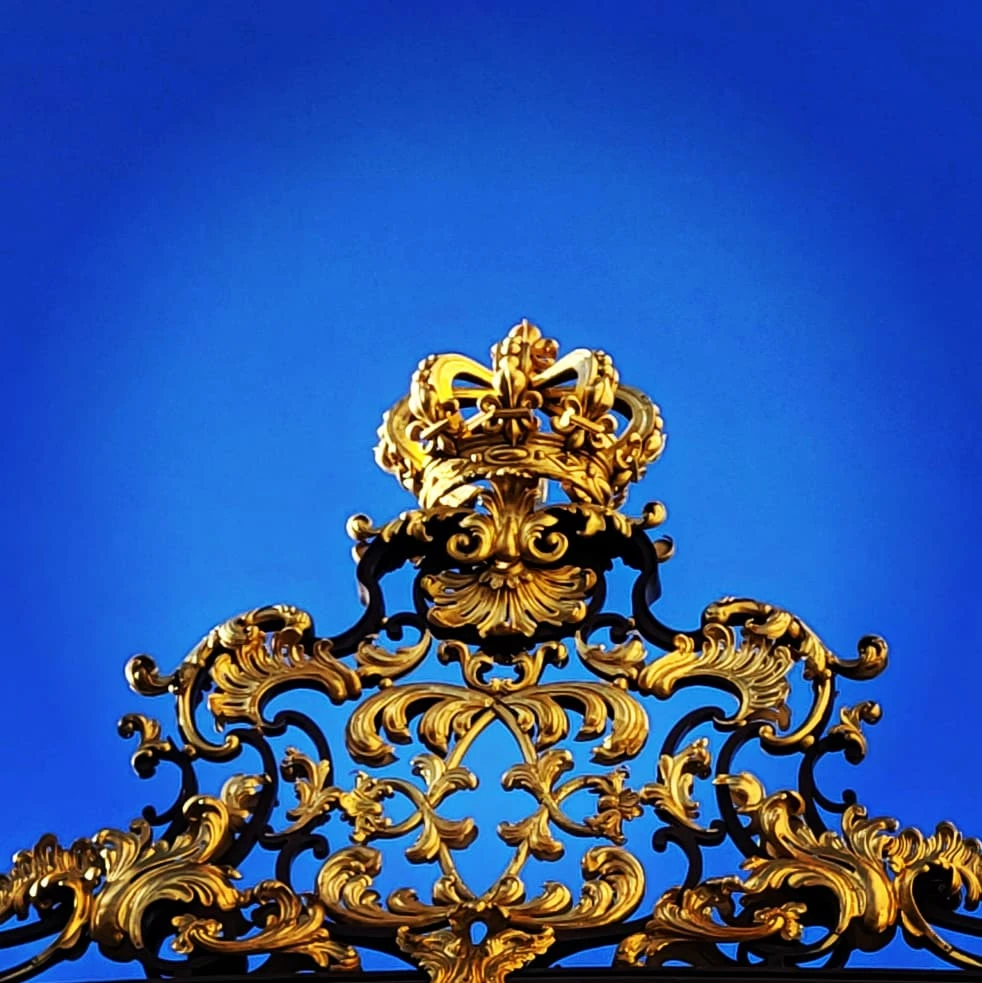
One of Jean Lamour's railings on Place Stanislas in Nancy / Photo Monsieur de France (c)
The wrought iron railings gilded with gold leaf by Jean Lamour give the square its incomparable splendor. You can see the intertwined initials L (Louis XV) and S (Stanislas) can be seen, as well as fleurs-de-lis and Gallic roosters. Together with the roosters on the street lamps, they are dedicated to France and symbolize the union between Lorraine and France.
The Arc Héré and the monumental fountains
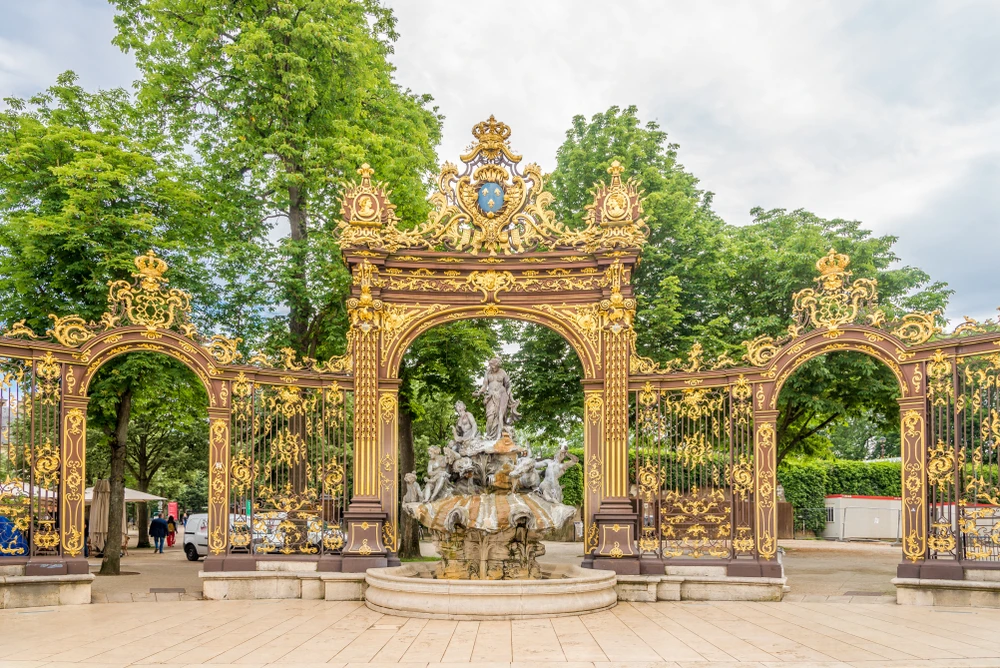
The Neptune fountain on Place Stanislas in Nancy / Photo shutterstoc
To the right of the Arc Héré is the fountain of Amphitrite, goddess of the sea. It was surrounded by two groups of figures representing her husband, Neptune, but these were removed when it was decided to open up access to the Pépinière, which became a public park at the end of the 19th century. We know that the statue, which was nude, greatly shocked Stanislas' chaplain. Some say that the goddess' body was modeled on that of the Marquise de Boufflers, Stanislas' royal mistress, whose breast can therefore be seen... These two fountains and the cherubs that adorn the stone balustrades are the work of Barthélémy Guibal. Each fountain is topped with the coat of arms of France, reminding us that the square was dedicated to Louis XV.
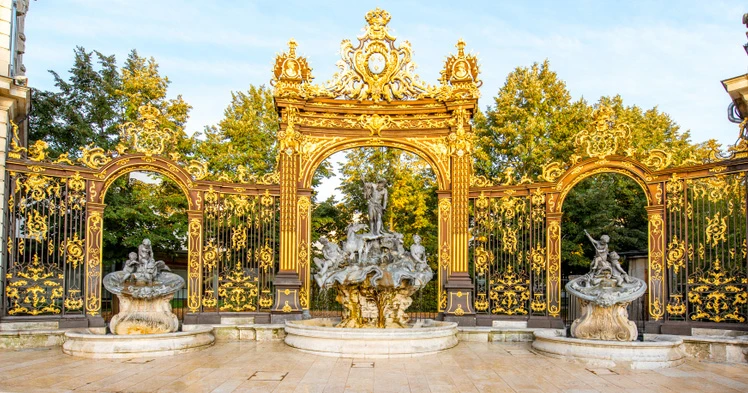
The Amphitrite fountain in Place Stanislas, Nancy / Photo chosen by Monsieur de France: milosk50/Shutterstock.
The Héré Arch
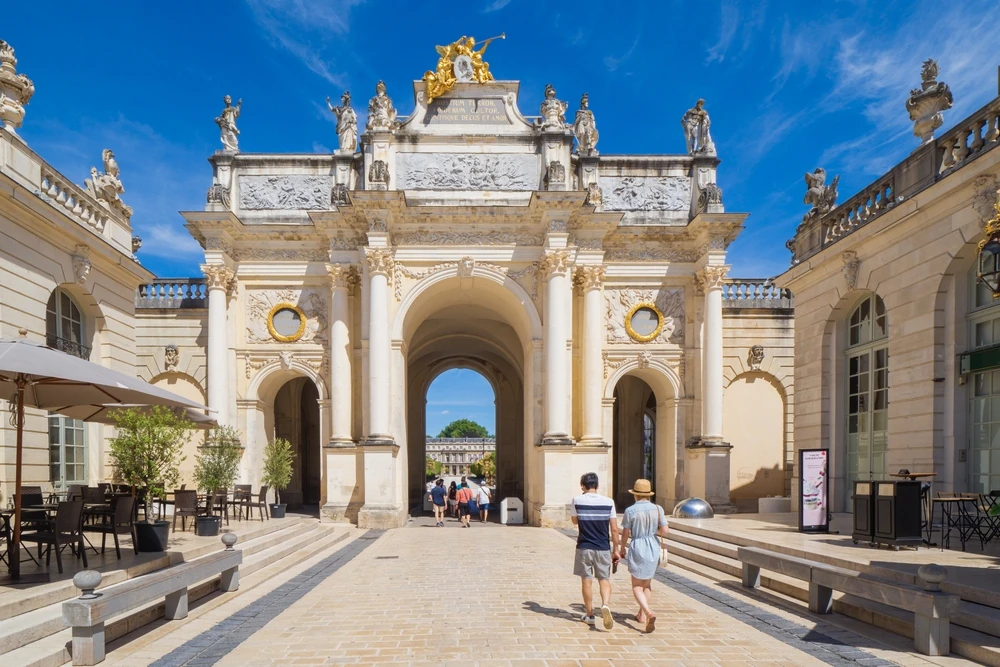
The Héré arch on Place Stanislas in Nancy. Photo selected by Monsieurdefrance.Fr: shutterstock
The Arc Héré, inspired by Roman antiquity, and in particular the Arch of Septimius Severus in Rome, is dedicated to Louis XV. Three gates open onto the city. It features Apollo and the Muses, Minerva, Mars, and Hercules, surmounted by the Golden Renown blowing the king's glory. It marks the transition between Place Stanislas and the Parc de la Pépinière.
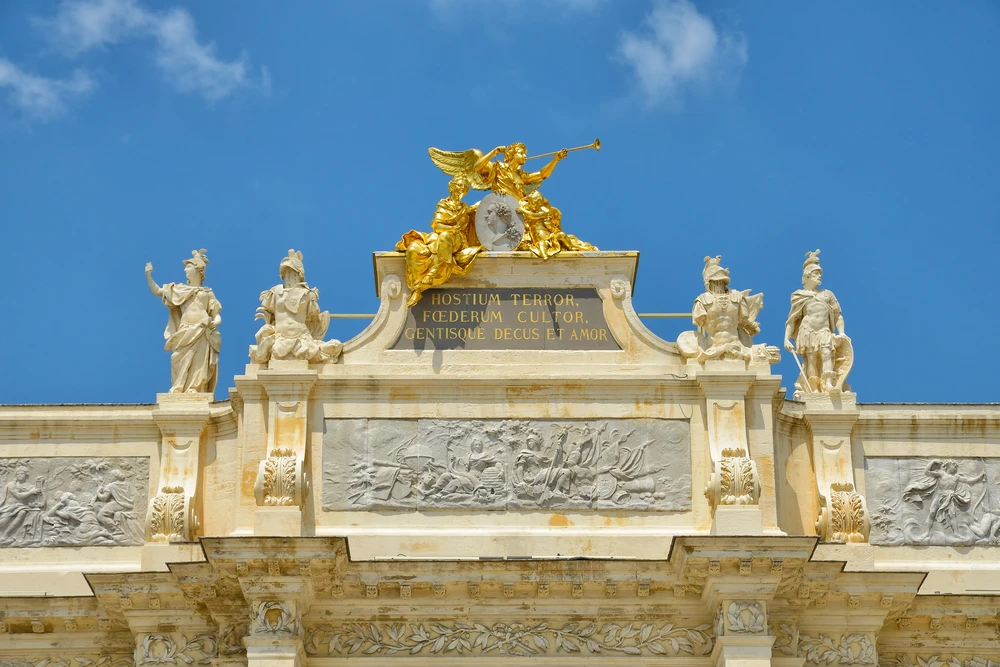
The top of the Arc Héré, with the medallion of Louis XV and Renommée. Photo selected by monsieurdefrance.fr: Shutterstock
The Arc Héré is preceded by Rue Héré (and the shops are nice, especially the Daum boutique, which displays marvels of pâte de verre created by the master glassmakers of Nancy). This street was long known as "Héré sidewalks" because these sidewalks, which allowed pedestrians to avoid getting their feet muddy or covered in horse manure, were a great novelty in 1755.
The Statue of Stanislas
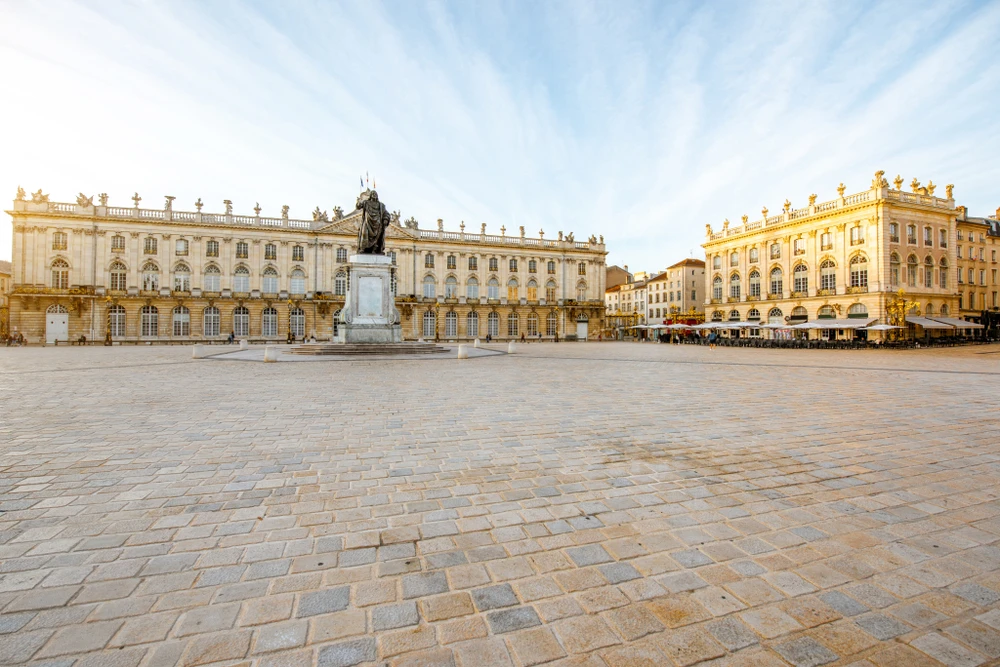
The statue of Stanislas, which has stood in the center of Place Stanislas in Nancy since 1831. Photo selected by monsieurdefrance.fr: RossHelen/shutterstock
A famous statue that everyone in Nancy knows. It is often used as a meeting place. But be careful, the base is so large that you can arrive at one side and miss the person waiting for you on the other. Many of us have waited a while before seeing each other, so I advise you to walk around it. It dates from 1831. It replaced several statues. The first was that of Louis XV, to whom the square was originally dedicated when it was built in 1755. He was depicted as a Roman emperor, looking towards Paris and brandishing a baton of command towards... the tax office (the farm office at the time). At his feet, four seated virtues, leaning on the steps, looked at him (like groupies). You could see prudence, justice, valor, and prudence.
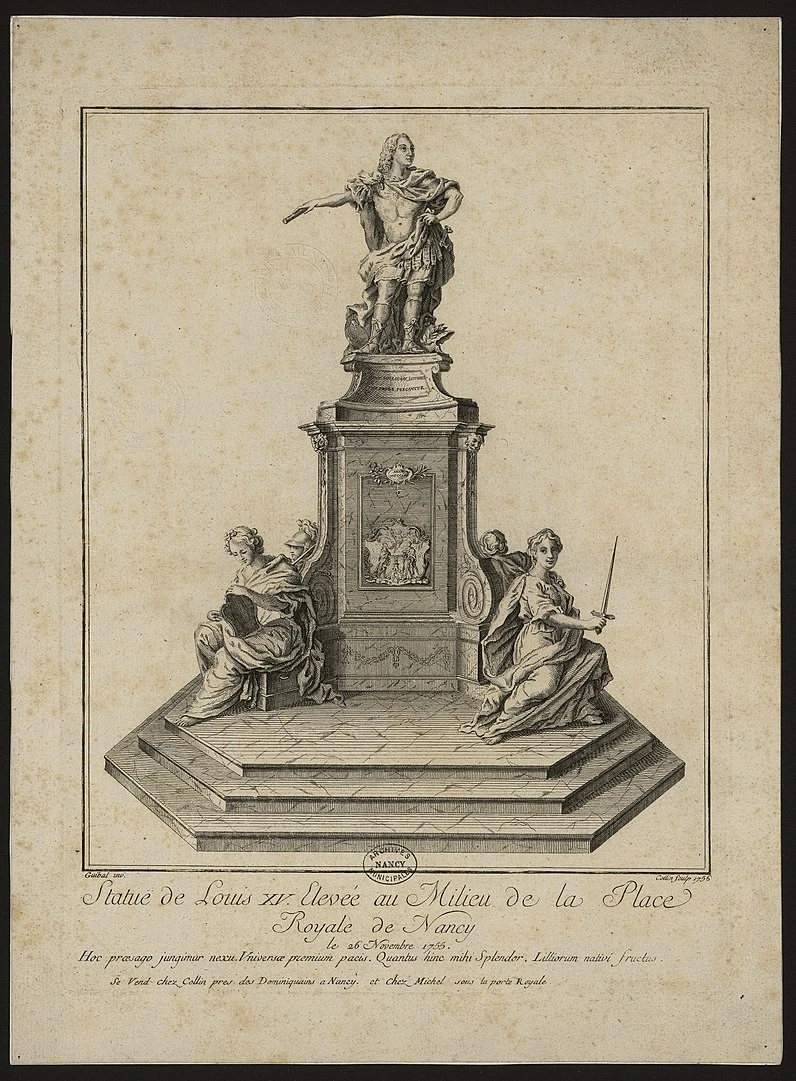
The statue of Louis XV originally located on the square when it was created in 1755. By Dominique Collin — Nancy Municipal Archives Reference number 3 Fi 141 Public domain, https://commons.wikimedia.org
The ensemble was surrounded by a fence that was dismantled after World War II when a gate was built, and it was never replaced. This statue (which weighed 7,500 kg of bronze!) was destroyed during the French Revolution and replaced by revolutionary pikes before it was decided to install "the genius of France," in this case a woman brandishing a laurel wreath. Finally, in 1831, when it was decided to name the square "Place Stanislas" (it had previously been Place Louis XV, Place du Peuple, Place Napoléon, etc.) in homage to the man who wanted it, King Stanislas, it was decided to install a statue there. It was created by Georges Jacquot, a young sculptor who had proposed two versions. One version of Stanislas as a warrior. The other is the one we know today. We see the king adorned in his royal cloak. Next to him is the royal crown. On the pedestal, some of his good deeds are recalled, deeds that made him a much-loved figure among the people of Lorraine, even though he came from elsewhere and had been imposed on them by France.
The statue weighs 5,400 kg of bronze and measures 4.13 meters high. It has long been said that Stanislas is pointing in the direction of his country of origin, Poland. In fact, he is pointing to the medallion of Louis XV to remind us that he made room for his son-in-law. The finger is very long, like E.T.'s, when you see it up close, but it was lengthened by the sculptor so that the gesture could be seen from a distance. The work has been here since November 6, 1831.

The statue of Stanislas by Georges JACQUOT on Place Stanislas in Nancy since 1831. Photo selected by monsieurdefrance.fr: inavanhateren/shutterstock
The royal pavilions: from City Hall to the Opera House
Nancy City Hall: history, symbols, and facade (Place Stanislas)
It is easy to recognize because it is the largest building and it is also the one that Stanislas will never see since he has his back to it. The town hall was long located on the right, while the left side was a private mansion, the two being connected by the façade that can be seen from the square. In 1890, the Rouerke mansion was demolished to make way for a single building (extended at the rear in the 1950s). The old city hall, located on Place Charles III, was destroyed when the one we know today was built.
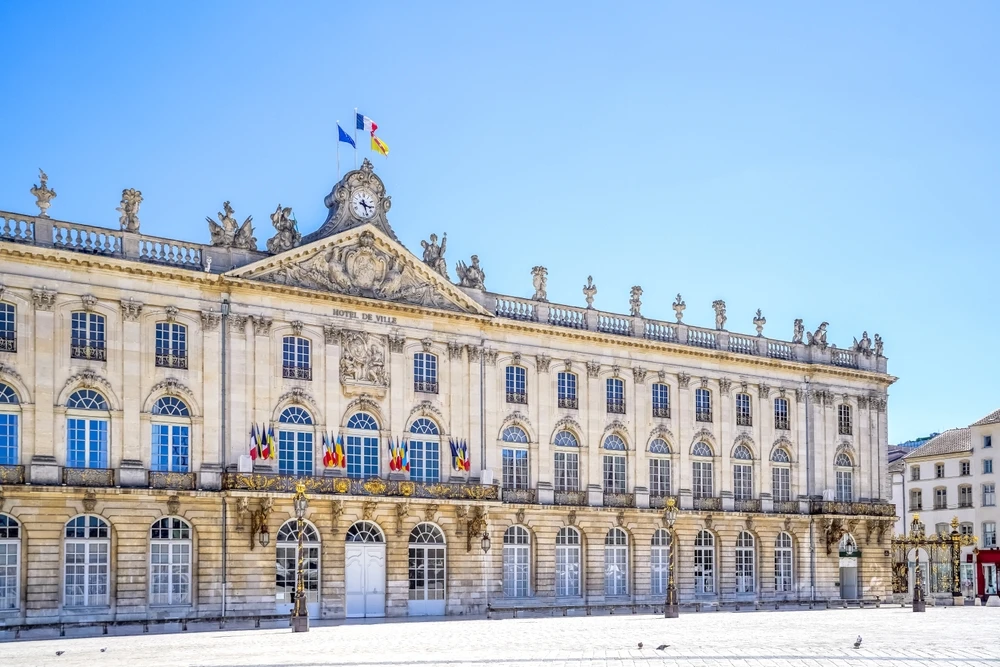
The façade of the Hôtel de Nancy, decorated with flags on major national holidays (July 14, May 8, etc.) but also to mark events (support for a cause, etc.)Sina Ettmer Photography/Shutterstock.com
From the outside and from top to bottom, we first see a clock surmounted by three flags: France, Lorraine, and Europe. The clock is flanked by Justice on the left and Prudence on the right. On the pediment, below the clock, we see the coat of arms of Stanislas, to whom we owe the building and the square (he donated the square and the town hall to the municipality at the time of the inauguration). Further down, a woman (perhaps Nancy) holds the city's coat of arms (with the arms of the Dukes of Lorraine and Bar at the top) and the thistle, the emblem of Nancy, whose motto is: "Qui s'y frotte s'y pique" ("He who rubs against it gets pricked"), in memory of the Battle of Nancy (1477) and the defeat and death of Charles the Bold. Finally, Stanislas' coat of arms can be found, this time gilded, on the central balcony.
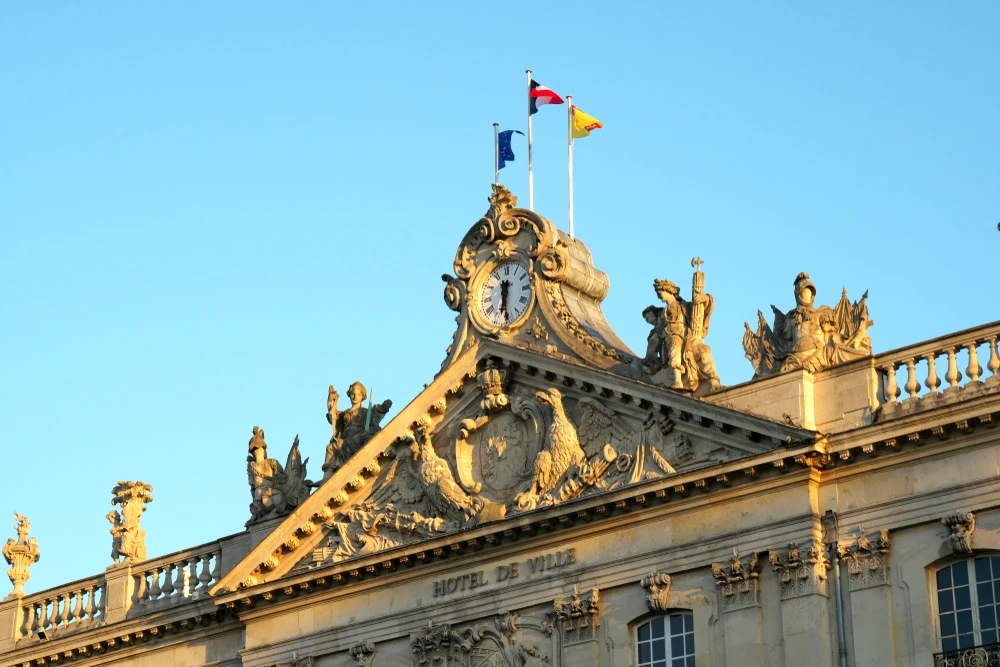
The pediment of City Hall with Justice on the left and Prudence on the right. Photo by Khun Ta/Shutterstock
Interior: peristyle, staircase by Jean Lamour, and paintings by Jean Girardet
Inside, visitors can admire the peristyle and its columns, the grand staircase with its banister designed by the ironworker Jean Lamour, and the paintings (trompe-l'œil and ceilings) by Jean Girardet (1707-1778). On the first floor, the Salon Carré (Salon de l'Académie), the only room that Stanislas ever knew, shows Stanislas driving Apollo's chariot. Beyond the Salon Carré are the "grands salons" (1866), created for the centenary of the union between France and Lorraine, depicted on the ceiling by Aimé Morot. It is said that the painter gave Lorraine (seen naked and from behind) the features of his mistress... You can also see the city's coat of arms and the balconies where orchestras played during gala evenings. Magnificent paintings by Emile Friant depicting the different stages of life adorned the walls for many years before being moved to the Museum of Fine Arts and replaced by mirrors).
Pavillon Jacquet: owners since 1755, Grand Café Foy and Café du Commerce
Located to the right of City Hall. It has been a private building since its inception, belonging to Mr. Jacquet, one of the first landowners in 1755. It was long used as a fashion store. Two cafés occupy the ground floor, the Café du Commerce on the right and the Grand Café Foy on the left. It takes its name from Maximilien-Sébastien Foy (1775-1825), a general of the Empire, whose bust is inside.
Nancy Museum of Fine Arts: Caravaggio, artists from Lorraine, and the Daum collection
This is where, when the position was created, surgery and medical students studied at the College of Medicine. The pavilion then became the municipal theater (there are many comedy masks in the entrance). A fire destroyed the theater in 1906 and the Museum of Fine Arts, originally located in the town hall, was moved there in 1936 after renovation work. It was expanded in 1999.

The Annunciation by Caravaggio (between 1608 and 1610). Nancy Museum of Fine Arts
It has several unique features. First, many works by the Dukes of Lorraine are included in the collections, such as Caravaggio's Annunciation, purchased by Henry II of Lorraine and Bar in the early 17th century. Secondly, there is a fine selection of works by artists from Lorraine, including some extremely rare paintings by Claude Gelée, known as "Le Lorrain" (born in Chamagne, Vosges, in 1600), a beautiful collection of engravings by Jacques Callot (1592-1635), born in Nancy, and works by Emile Friant (e.g. All Saints' Day) and Victor Prouvé.
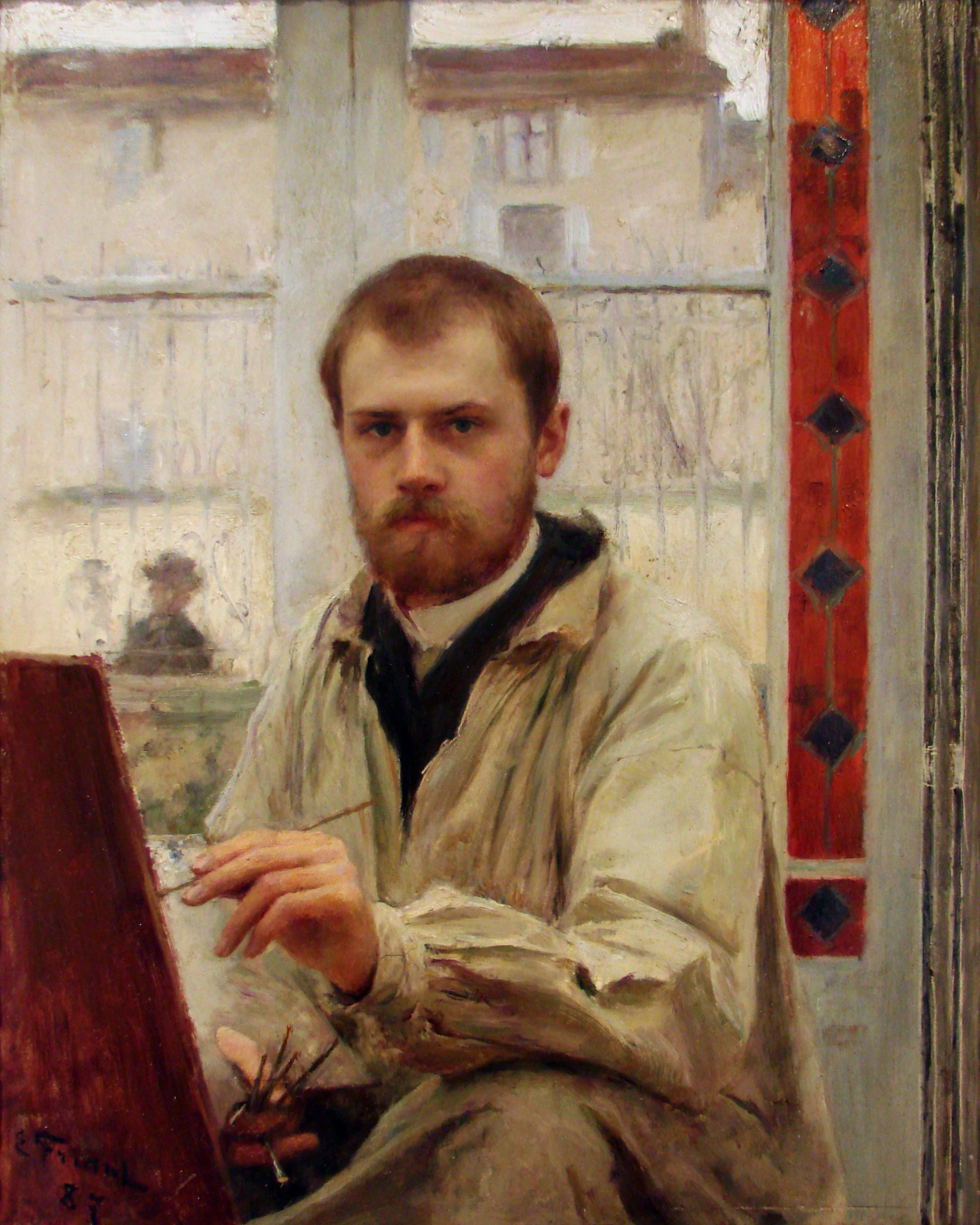
Emile Friant / Self-portrait 1888. Museum of Fine Arts, Nancy
Finally, don't miss the world's largest Daum collection: pieces made of crystal or pâte de verre over more than 150 years by the Daum factory in Nancy. You can take some magnificent photos there.
Grand Hôtel de la Reine (Alliot Pavilion): royal salons and sunset views
It is located to the left of City Hall. It is a very pleasant hotel, with royal salons that allow you to host receptions while admiring the most beautiful square in the world. It is the ideal spot on sunny days to have a drink on the terrace since it is the place that gets the most sun on the square. It is called the "Grand Hôtel de la Reine" because Marie Antoinette stayed there for a few hours in 1769 to listen to poetry on her way to her wedding with the future Louis XVI. Marie Antoinette was Lorraine on her father's side, François I (François III of Lorraine), born at Lunéville Castle, a descendant of the Dukes of Lorraine who are buried in the Cordeliers Church. Long used as the Intendance hotel, it was also a private building.
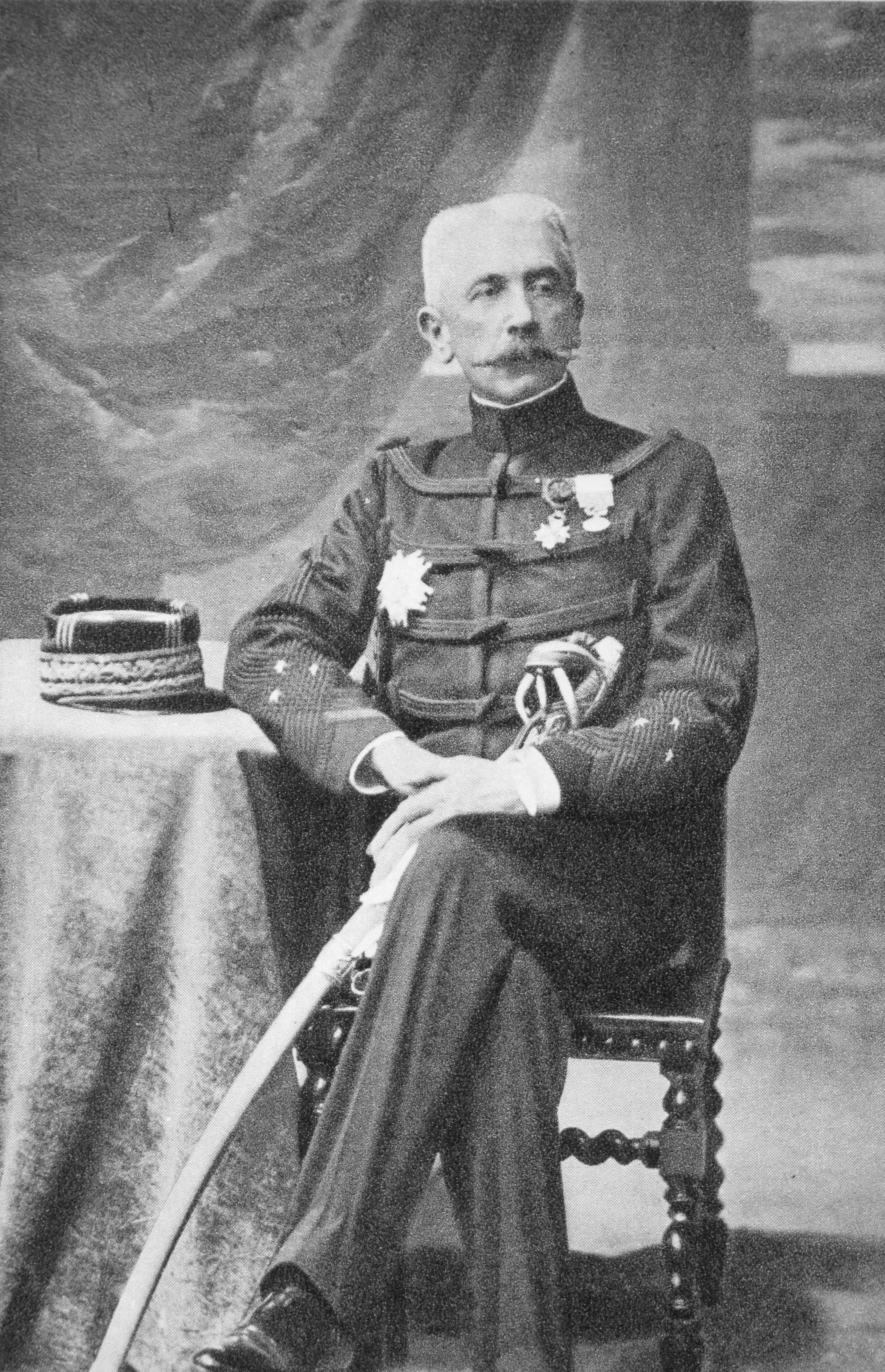
Hubert Lyautey by Eugène Pirou (1841-1909) in Histoire de la Marine française illustrée (Illustrated History of the French Navy), Larousse, 1934.
It was on the balcony of the Grand Hotel that Hubert Lyautey's life changed. In May 1856, when he was 18 months old, he fell from his nanny's arms while waving to a parade. The child remained bedridden for two years and wore an iron corset for more than 10 years. This disability forged his passion for the army, fueled by his reading. He would become a great marshal (state funeral in Nancy, attended by the President of the Republic). Lacking sports as a child, Lyautey became involved in founding the Scouting movement in France. Passionate about Morocco, where he was governor, he had Moroccan pieces installed in his castle in Thorey-Lyautey near Sion. He is buried at Les Invalides in Paris.
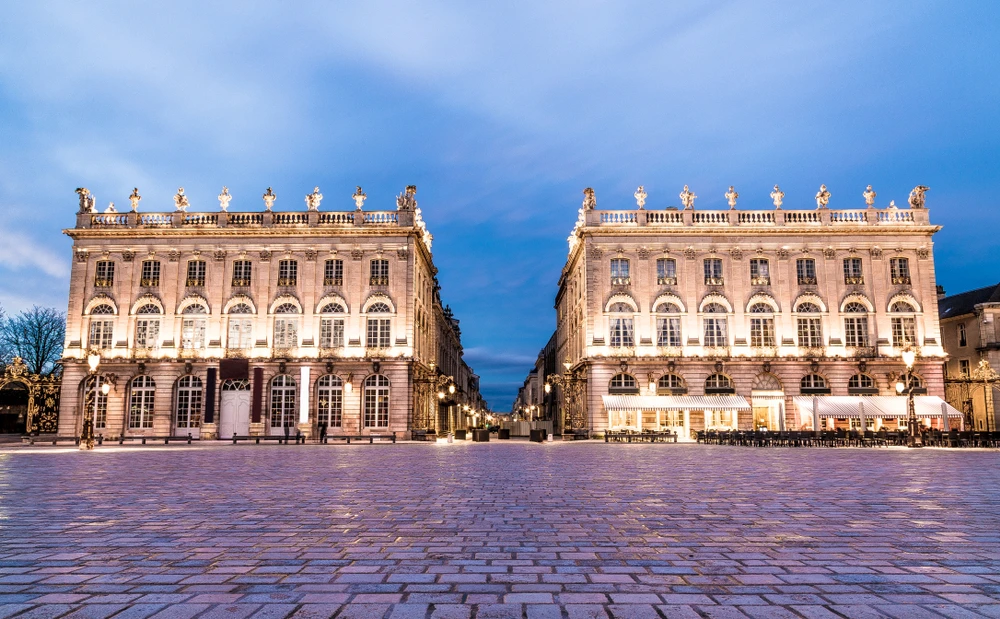
On the left, the Opéra National de Lorraine; on the right, the Grand Hôtel de la Reine / wsf-s/shutterstock.com
Opéra National de Lorraine: 18th-century façade, Italian-style auditorium (1919, 1,050 seats)
It is located in what was the Hôtel des Fermes at the time of the construction of Place Stanislas (1755). It became the seat of the bishopric in 1802, and was completely destroyed in 1909 except for the façade, which is still the one designed by Stanislas. During 10 years of construction, an Italian-style opera house was built with red, white, and gold décor in harmony with the square, with a few Art Nouveau and Art Deco touches. Inaugurated on October 14, 1919, with 1,050 seats, it is one of the most renowned in France.
Discover the program of the Opéra National de Lorraine here.
Les Basses-Faces: ramparts, original cafés, and the legendary "Chez Walter"
This is the name given to the single-story buildings located between the fountains and Rue Héré. Initially, they were not supposed to exist: Marshal de Belle-Isle wanted to preserve the line of fire from the ramparts. Stanislas insisted, and a compromise was reached: a single story with mansard roofs along the ramparts. This is where Nancy's first "cafés" opened (they served... coffee).
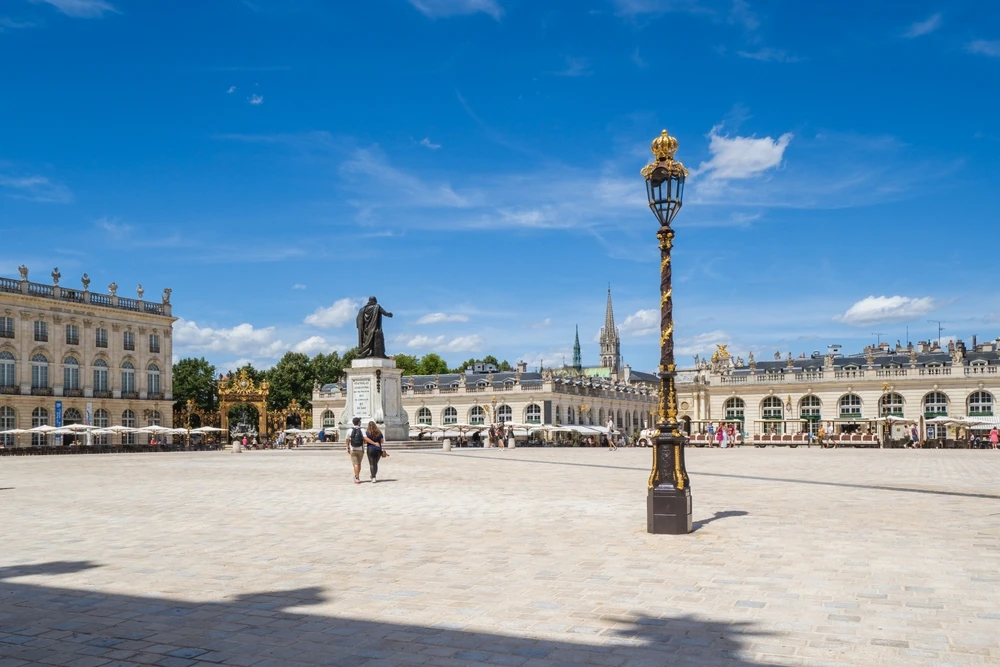
The low-rise buildings are the buildings seen in the background of the photo of Place Stanislas in Nancy. Photo Pete Stuart/Shutterstock
It was at a table in one of these cafés that Mozart sat down to write to his father during a trip to Paris, evoking "the beauty of the streets and squares of Nancy". Bartholdi, creator of the Statue of Liberty, met his wife Emilie Baheux de Puysieux there – it is said that he modeled her features on hers. Finally, at the "Jean Lamour," to the left of the Héré Arch, was the legendary brasserie "Chez Walter," occupying the entire left side of the Basses-Faces, famous in the East: the king of Cambodia, presidents, and stars of the Belle Époque were served there.

Nancy loves to party on the most beautiful square in the world / photo by Roman Samborskyi/shutterstock
This part of the square is very festive: brasseries, huge terraces, night bars, nightclubs for partying ("la chouille"). Lots of young people: for every 1,000 inhabitants, there are 200 students in the metropolitan area.
UNESCO site in Nancy: must-see attractions (since 1983)
The Neptune Fountain, one of two majestic fountains in Place Stanislas in Nancy / Photo selected by Monsieur de France: depositphotos
It would be a shame to limit yourself to Place Stanislas alone. What has been classified as a "World Heritage Site" since 1983 in Nancy is the entire 18th century. Each of the three squares has its own charm and is worth a visit. In addition to Place Stanislas, you should also see:
Place de la Carrière: hemicycle, façades of Héré and Palais du gouvernement
It is older than Place Stanislas. Created by Duchess Christiane of Denmark during the expansion of the ramparts of the Old Town, it was first called Rue Neuve, then Place de la Carrière for the tournaments (jousts, ring games) where champions made their careers. Emmanuel Héré, architect of Place Stanislas, gave it its current appearance, inspired by the Hôtel de Beauvau (now the Court of Appeal), by Germain Boffrand (architect of the Château de Lunéville and the Château d'Haroué), Héré's master. New facades plastered over old facades.
At the end, two mansions close off the Charles-de-Gaulle Hemicycle, pierced by two gates (city/park of the Pépinière) surmounted by trophies of defeated and chained enemies (amusing when Stanislas never won a battle).
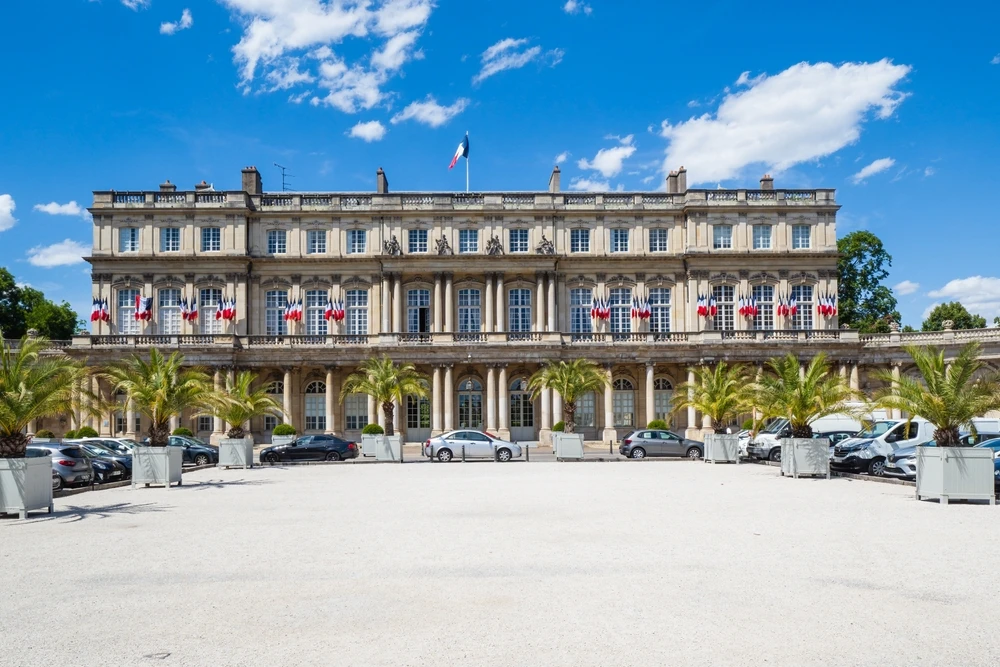
The Government Palace on Place de la Carrière in Nancy / Photo Pete Stuart/shutterstock.com
The square is closed off by the Government Palace (formerly the military government of Nancy), the military capital of the East after the Annexation of 1871. Foch and Castelnau spent time there during the First World War; Marshal MacMahon (future President of the Republic) lived there; it was also the prefecture of Meurthe (which disappeared in 1871), whose coats of arms can be seen in the Grand Salon. Magnificent grand staircase by Jean Lamour and hidden altar in the White Room. Art Nouveau treasure: Foch's desk by Louis Majorelle. This is where "Le Livre sur la Place" takes place, the first book fair of the literary season, one of the most important in France: more than 100,000 people for 400 authors around September 10. The people of Nancy call it "Place Carrière" and "Palais du Gouverneur".
Place d’Alliance: Cyfflé, the 1756 alliance and melancholic charm
It is the smallest of Nancy's three UNESCO squares (80 m × 60 m). Built on the former ducal kitchen garden, it was called Place Saint-Stanislas before becoming Place d'Alliance (central monument by Paul-Louis Cyfflé celebrating the 1756 alliance between France and Austria). Three old men represent the Scheldt, Meuse, and Rhine rivers, topped by a putto announcing the good news.
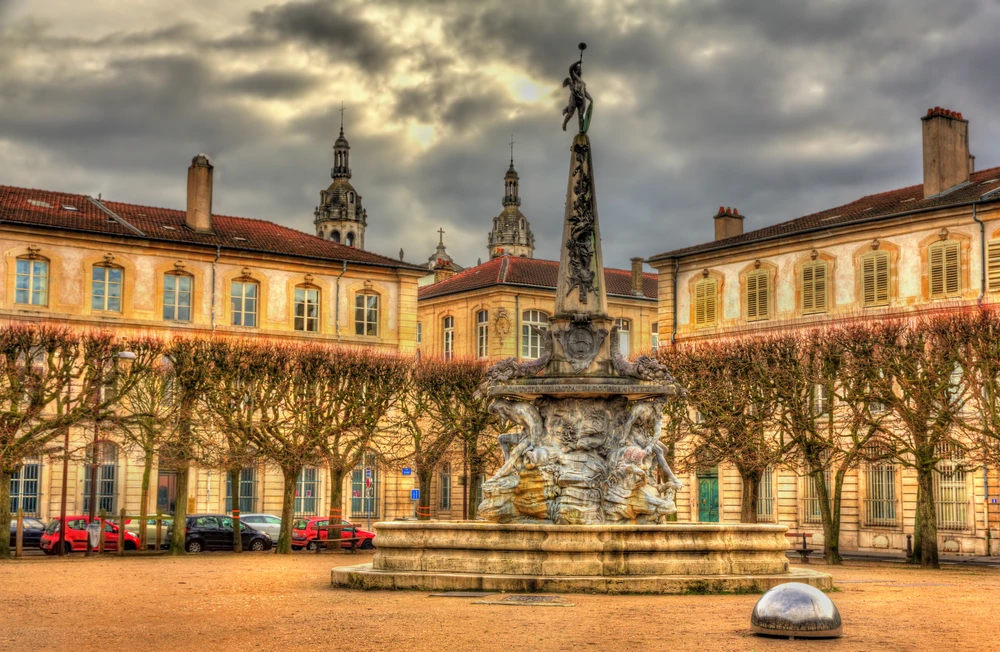
The monument at Place d'Alliance in Nancy / Photo Shutterstock.com
It is austere but delicate. Maurice Barrès describes it accurately in Colette Baudoche, evoking "the small Alliance square, solitary and taciturn" and "the melancholy" of its fountain.
Also worth seeing near Place Stanislas: Pépinière, Thiry barracks, and monumental gates
Behind Place Stanislas lies Nancy's green lung: the Parc de la Pépinière (21.7 hectares). Commissioned by Stanislas in 1765 (as a tree nursery for the roads), it features remarkable trees, a rose garden, an animal park, sports facilities, and a sculpture by Rodin representing Claude Gelée, known as "Le Lorrain." "La pep'" is ideal for relaxing, strolling, or having a drink; joggers and students gather there.
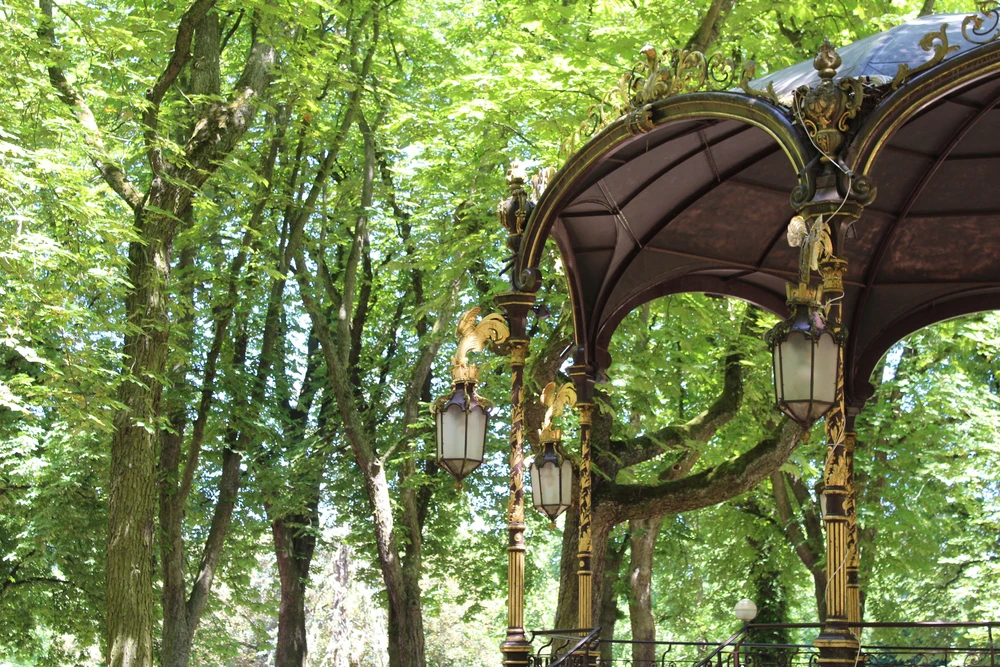
There are only two music kiosks like the one at La Pépinière in Nancy. One is in Germany, the other is here in Nancy. Photo by Gerald Mayer/shutterstock.
Not far away is the Thiry Barracks (1765-1769), designed by Richard Mique (architect of the Queen's Hamlet at Versailles). Stanislas appears on the pediment, in armor. The Sainte-Catherine Gate (at the end of Rue Sainte-Catherine), dedicated to Catherine Opalinska, depicts Apollo and the Nine Muses. the Saint-Stanislas gate, near the Nancy train station, also displays the god of the arts and the Muses.
Now is the time to treat yourself to a tour of Nancy with our guide.
History of the construction of Place Stanislas: a link between two cities
Stanislas Leszczyński: a king who became Duke of Lorraine
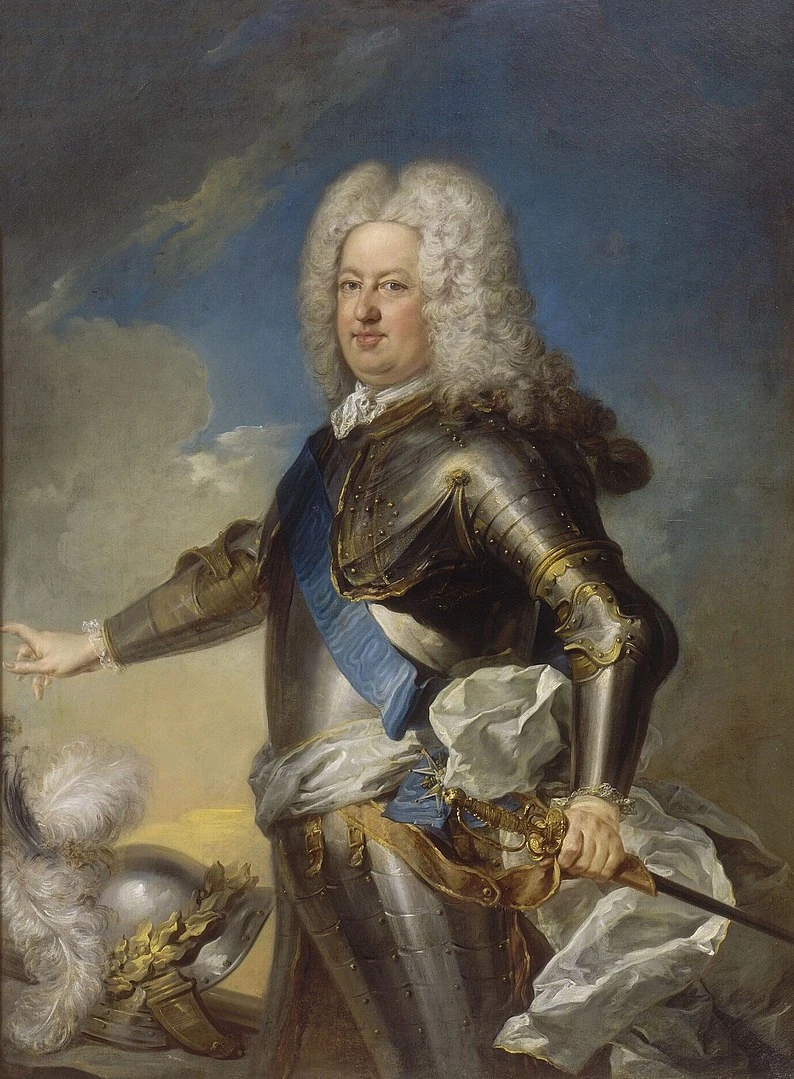
Portrait of Stanislas by Van Loo (Palace of Versailles).
Stanislas Leszczyński (1677-1766) was born in Lviv, in present-day Ukraine, which was then part of the Kingdom of Poland. The Polish monarchy was then elective: nearly 40,000 nobles elected the king. Supported by Charles XII of Sweden, Stanislas ascended to the throne, but was driven out by the Russians and forced into exile. Welcomed by France in Alsace, he regained his royal destiny when his daughter, Marie Leszczyńska, was chosen to marry Louis XV. The young king of France, aged 15, was then the only direct descendant of Louis XIV in the French line, and his marriage was intended to ensure the continuity of the dynasty. The couple had 10 children, thus anchoring Stanislas in the history of France.
👉 Stanislas is a truly remarkable man who lived a life worth discovering. Let me tell you the incredible story of a dethroned Polish king who found success in Nancy.
Lorraine became French thanks to Stanislas
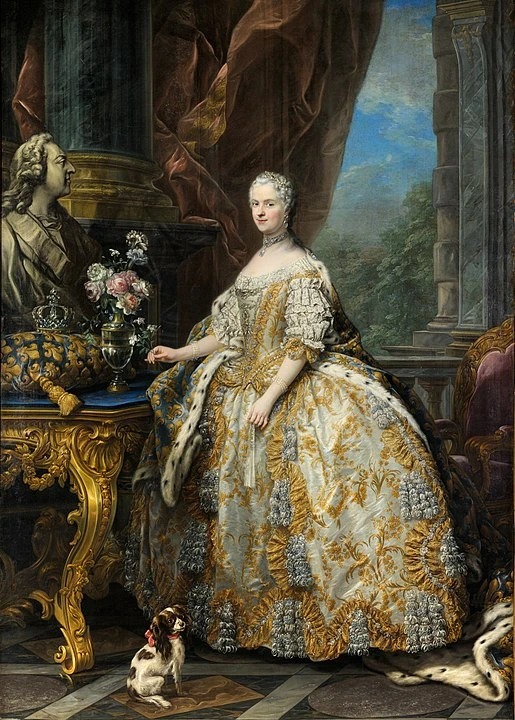
Marie Leszczynska, Queen of France, wife of Louis XV and daughter of Stanislas, by Van Loo (Versailles).
At the time, Duke Francis III of Lorraine wanted to marry Maria Theresa of Austria, heiress to the Empire. But France feared that Lorraine, close to Paris, would become Austrian territory. A diplomatic compromise was reached: François could marry Marie-Thérèse if he renounced his rights to Lorraine. The solution was simple: Lorraine was given to Stanislas Leszczyński for life. Upon his death, the duchy would revert to France. Stanislas arrived in Lorraine in 1737 and reigned until February 1766. Upon his death, the duchies of Lorraine and Bar were definitively united with the French crown.
Stanislas the builder and the fashion for royal squares
Stanislas had a real passion for construction. During his exile in Zweibrücken, he had a complex of buildings constructed called the Tschiflick. After becoming Duke of Lorraine, he embellished the Château de Lunéville with numerous "folies" and had several châteaux built. The 18th century was also the era of royal squares. Rennes adorned itself with two squares dedicated to the king (Place de la Mairie and Place du Parlement), while Paris developed the Place de la Concorde. Stanislas decided to follow the trend: he built a royal square in Nancy dedicated to his son-in-law Louis XV, a symbol of France in the heart of his Lorraine capital.
Where to build Place Stanislas: between the Old Town and the New Town

Map of Nancy at the beginning of the 17th century by Laruelle. The two towns that made up Nancy at the time are clearly visible. Stanislas built the square right in the middle, against the ramparts of Nancy's old town and at the edge of the new town. Photo Limedia.fr
Nancy had a unique feature: it was made up of two distinct cities. On one side was the medieval Old Town, surrounded by ramparts. On the other was the New Town, created in the early 17th century by Duke Charles III to expand the capital. The New Town, five times larger than the old city, had streets laid out in a grid pattern, intersecting at right angles: a modern feature for the time. At the junction of the two was a vast esplanade in front of the ramparts. It was here that Stanislas chose to build his royal square. Other sites had been considered, but the military esplanade posed a problem because the fortifications could be hidden from view. and the bourgeoisie also rejected the idea of building the square on the current Place du Marché, where the Town Hall and the courthouse were already located. Stanislas finally decided that the square would be built on the esplanade, connecting the Old Town and the New Town. This choice made it possible to create a link between the two parts of Nancy and provide the city with a powerful symbol. To conceal the moats and ramparts, two monumental semi-circular fountains were added, which could be dismantled if necessary.
A colossal four-year project
On March 18, 1752, Grand Duke Ossoliński (a close friend of Stanislas) laid the first stone of the construction site. Nearly 400 workers were mobilized. Jean Lamour, a master ironworker, forged his famous gilded gates a few steps away, in Nancy Cathedral. The work progressed rapidly, taking barely three and a half years to complete. As was often the case with this type of project, only the facades were built, leaving it up to the owners to fit out the interior according to their needs.
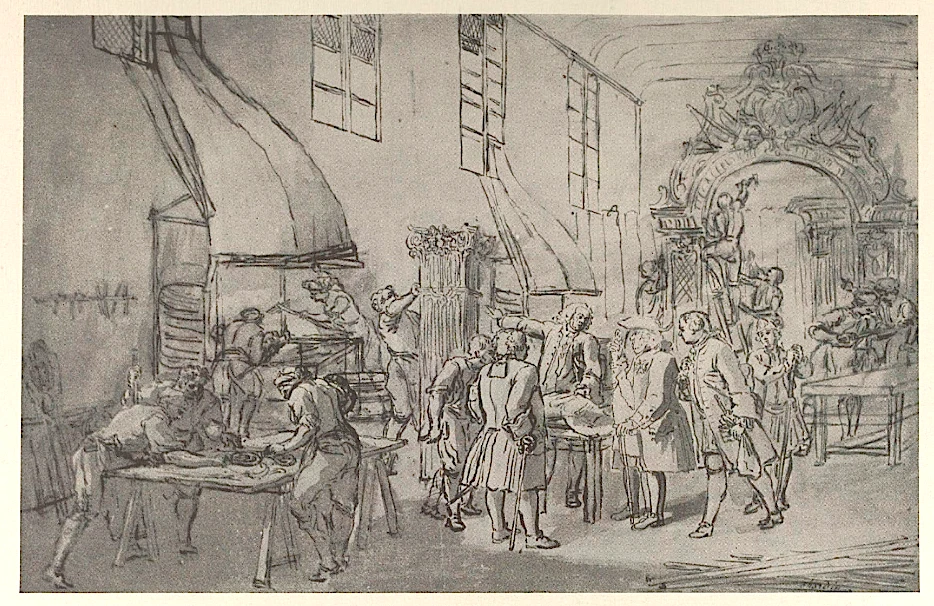
Stanislas Leszczynski, King of Poland, visiting Jean Lamour's workshops in Nancy, drawing by Jean Baptiste Bénard in 1755.
Compromises had to be made with the military. The buildings along the ramparts were constructed with only one floor and mansard roofs so as not to hinder any potential defense. As for the two monumental fountains, they were installed to conceal the moats and walls. They can still be seen today.
A lavish inauguration... and an incident
Place Royale (the former name of Place Stanislas) was inaugurated on November 26, 1755. Stanislas made his solemn entrance through the Porte Saint-Nicolas, escorted by seven carriages. The crowd was immense. That evening, to celebrate the event, the fountains flowed not with water, but with wine, causing the people of Nancy to rejoice. Stanislas then climbed the majestic staircase designed by Jean Lamour and appeared on the balcony to greet the crowd. It was then that a piece of plaster from the ceiling collapsed, having dried too quickly. The noise and proximity of the incident caused general panic: the guards drew their weapons, some courtiers fled, and one even jumped from the balcony, injuring himself and covering himself in shame. Only Stanislas remained impassive. The king, standing on the balcony, contemplates his work, happy to see the crowd admiring this urban masterpiece.
From the 20th century to the renovation in 2005
Over time, customs change. In 1906, a fire ravaged the Comédie, which became the current Opéra national de Lorraine. The Musée des Beaux-Arts took its place in the former theater. In 1958, the square underwent a major transformation: it was flattened to become a parking lot, which distorted the harmony intended by Stanislas. This situation lasted until 2005, when a major renovation restored the square to its former glory. It then became entirely pedestrianized, allowing visitors and residents to enjoy it as a true urban living room.

Terraces on Place Stanislas: a delight in summer. Photo selected by Monsieurdefrance.fr: olrat/shutterstock.
Place Stanislas today: terraces and light shows
Since becoming pedestrianized, Place Stanislas has once again become the beating heart of Nancy. Café and brasserie terraces stretch out, allowing visitors to enjoy the unique atmosphere. It is the ideal place to sit and contemplate one of the most beautiful squares in the world. In summer, the square comes alive with the "Rendez-vous Place Stanislas" show: every evening at 10:45 p.m. until August 15 (and 10 p.m. until mid-September), monumental projections illuminate the facades for fifteen minutes. A magical moment that's free of charge, which you can enjoy sitting on the ground, which is carefully cleaned every morning, or from a terrace. The magic returns in winter too, with illuminations for Saint-Nicolas, an iconic festival in Lorraine.

When is the best time to visit Place Stanislas?
The square is beautiful all year round, but:
-
In spring and summer, the terraces and lively evenings make it particularly vibrant.
-
In autumn, the colors of the trees surrounding the nursery add to its charm.
-
In winter, the magic of the Saint Nicholas celebrations and the illuminations transform the square into a fairy-tale setting.
How do I get to Place Stanislas?
Place Stanislas is located in the heart of downtown Nancy.
-
On foot: from Nancy train station (10-minute walk).
-
By tram: line 1, Division de Fer stop.
-
By car: several underground parking lots nearby (Parking Stanislas, Parking Charles III).
Where to stay in Nancy?
If you are planning to visit Nancy and discover its main highlights, staying in the city centre is often the most convenient option. From there you can easily reach the famous Place Stanislas, explore the charming old town, visit museums and enjoy the elegant atmosphere of one of the most beautiful cities in Lorraine.
To prepare your stay and compare accommodation depending on your dates and budget, you can check:
• available hotels in Nancy ↗
• hotels in Nancy city centre ↗
• well-located hotels near Place Stanislas ↗
This allows you to quickly see availability, guest reviews and prices depending on the time of your visit.
This article may contain affiliate links. This does not change the price for you but helps support the Monsieur de France website.

FAQ: everything you need to know about Place Stanislas in Nancy
Why is Place Stanislas so famous?
A UNESCO World Heritage site since 1983, it is often considered one of the most beautiful squares in the world due to its perfect proportions, classic elegance, and sparkling golden gates.
Who built this majestic square?
Stanislas Leszczyński, the former King of Poland who became Duke of Lorraine, ordered its construction in the 18th century to honor his son-in-law, King Louis XV of France.
What do the famous golden gates symbolize?
Created by the master ironworker Jean Lamour, these gold-leafed gates feature the intertwined initials of Louis XV and Stanislas, symbolizing the union between Lorraine and France.
Which buildings surround the square?
Designed by architect Emmanuel Héré, it is bordered by the City Hall, the National Opera, the Museum of Fine Arts, the Grand Hôtel de la Reine, and the Jacquet Pavilion.
When is the best time to visit?
Sunrise or sunset. The low light illuminates the white facades and makes the gold on the gates and balconies sparkle, offering an unforgettable visual spectacle.
Do you have to pay to enter Place Stanislas?
Not at all. It is a large, fully pedestrianized public square, open day and night, where locals love to meet for a coffee on the terraces.
Why was the Arc Héré built?
Inspired by ancient Roman triumphal arches, it was erected to celebrate the glory of Louis XV. It serves as a monumental gateway and transition to the Place de la Carrière.
What do the monumental fountains represent?
Sculpted by Barthélémy Guibal, they represent Neptune and Amphitrite, deities of the sea. They were cleverly placed to hide the city's old defensive walls.
Are there evening shows on the square?
Yes, during the summer, the city offers a magnificent free sound and light show projected via video-mapping onto the facades, recounting the history of the Dukes of Lorraine.
What else is there to see nearby?
Extend your walk by passing under the Arc Héré to discover the Place de la Carrière, stroll through the Pépinière park, or admire the peaceful Place d'Alliance.
Find out more about Nancy:
- The complete guide to visiting Nancy
- my audio guide in immersive sound to visit Nancy
- Place Stanislas: history and secrets of Nancy's most beautiful square
- Art Nouveau and the École de Nancy: an architectural treasure
- What to do in Nancy over a weekend?
- Culinary specialties of Nancy you absolutely must try
- And why not discover Lorraine?