Nancy Audio Guide at a Glance
Looking for a self-guided audio tour of Nancy? This walking tour takes you through Nancy's historic centre, from Place Stanislas to the Old Town, directly on your smartphone.
- Duration: about 1.5 to 2 hours
- 17 stops across Nancy
- 3 free audio stops to try before you buy
- Self-guided walking tour
- GPS guidance included
- No app to download
- Listen directly on your smartphone
- Start whenever you want and explore at your own pace
Along the way, discover Place Stanislas, Nancy's Old Town, the Dukes of Lorraine, René II and the Battle of Nancy, Joan of Arc, local legends and Lorraine specialities including bergamot sweets and Nancy macarons.

Listen for free first, with no obligation, and only if you like it, treat yourself to the full tour.
Why does this audio guide transform your visit to Nancy?
It’s so much more enjoyable to look around freely while listening to a story. And you can do it whenever you want! Forget about time constraints. With your hands free—and without spending your time reading a screen or a document—enjoy a fully immersive audio experience designed by an enthusiast, so you can discover Nancy at your own pace.
- Listen for free first, with no obligation—and only if you like it, treat yourself to the full tour.
- Total freedom: Visit whenever you want—even late at night—without having to install any apps; stop whenever you like to relax on a terrace or go shopping.
- No app required: You follow the tour directly on your phone, and there’s no app to download.
- Precise guidance: You’ll never get lost thanks to the built-in GPS.
- Audio immersion: Thanks to my selection of music and sound effects, you’ll experience the city’s history while exploring it today.
- Insider secrets: Unravel the mysteries of Place Stanislas and discover historical facts that many locals don’t even know.
- Gourmet delights: Let me guide you to the must-try culinary specialties.
- Save time: A rigorous historical overview that gets straight to the point, without unnecessary detours.
Try my free steps
Dive straight into the experience and discover the quality of the audio narrative before unlocking the full journey for 6 euros.
FREE Stop: Foodie Alert: The True Taste of Nancy
rue Gambetta

Nancy is a city of culinary delights, and this stop immerses you in its most famous specialities. Bergamotes, macarons, rum baba, quiche lorraine, Lorraine pâté, mirabelle plums… you’ll discover what the city has to say through its flavours. It’s a delicious stop, full of surprising stories, which immediately makes you want to look up and then pop into a shop.
FREE Stop: The “Rough-and-Tumble” Side of Nancy and the Invention of the Fire Ladder
Rue du Maure qui trompe

Henri de Toulouse-Lautrec, Salon on Rue des Moulins, 1894, Toulouse-Lautrec Museum. Photo selected by Monsieur de France: Didier Descouens — Own work, Public domain, https://commons.wikimedia.org/w/index.php?curid=109394957*
Nancy has also had a darker, more working-class and more scandalous side, and this section lays it bare. In the narrow streets around Saint-Epvre, in Nancy’s old town, you enter the former red-light district, with its brothels, tavern signs and a nightlife that was once vibrant. It is also the place where the inventor of the fire brigade’s tall ladder was seen waving a flag...
FREE Stop: Masco, the Palace Bear Who Adopts a Child
Grand-rue
Outside the Ducal Palace, the story takes on a different tone and becomes almost like a fairy tale. You’ll discover the Dukes of Lorraine in their own home, the changes the palace has undergone over the centuries, and, above all, the story of Masco, an endearing bear who saved a child during the terrible winter of 1709. It is a stop that is at once historical, heart-warming and truly memorable.

The full programme: 17 stops in Nancy
The tour begins at Place Stanislas, the beating heart of Nancy, so you can see straight away why the city boasts one of the richest heritage scenes in France. You’ll discover a UNESCO World Heritage Site, the historic capital of the Duchy of Lorraine – a city renowned for its cuisine, youthful spirit, vibrancy and rich contrasts. It’s the perfect introduction to capturing the soul of Nancy before setting off to explore its iconic landmarks and hidden gems.
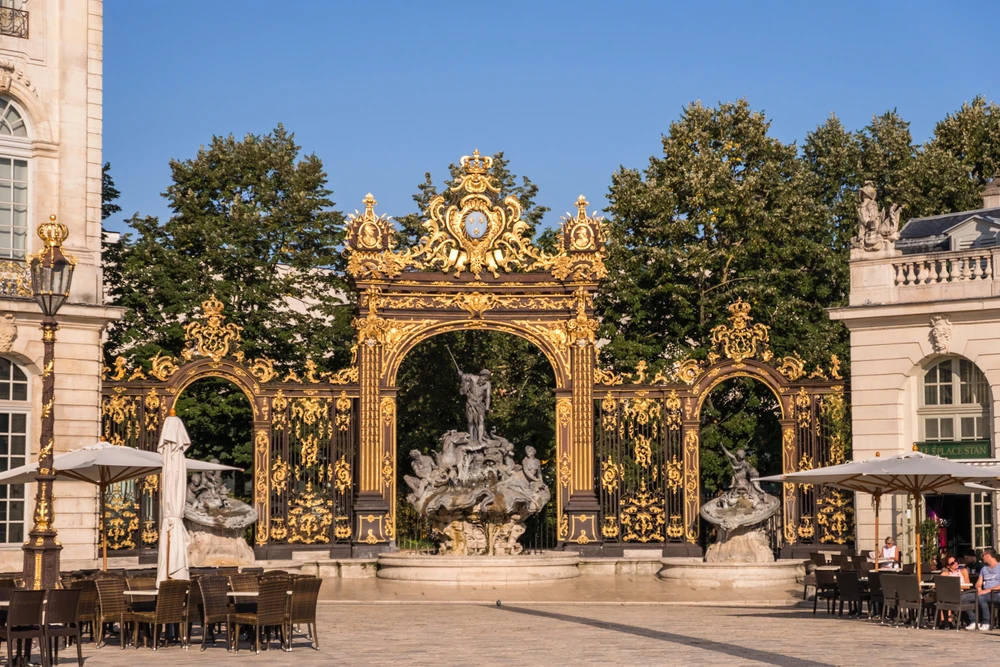
Photo: Depositphotos
2. Nancy for food lovers
We explore the culinary specialities of Nancy. Not just from Nancy, but from the whole of Lorraine. You’ll also discover the fascinating history of the rum baba.
On this stopover, you’ll discover:
-
The birthplace of the Quiche Lorraine: the story of the world’s most famous French dish, which originated right here, in the heart of the Lorraine region.
-
The secret of Pâté Lorrain: the authentic recipe made with meat marinated in white wine and puff pastry – a often overlooked gem of the bakery world.
-
La Bergamote de Nancy : why this iconic yellow sweet gets its unique fragrance straight from Calabria, Italy.
-
The authentic Nancy macaron : forget its colourful Parisian cousin; discover a secret recipe passed down since the French Revolution by the famous “Sœurs Macarons”.
-
The invention of the Baba au Rhum : how King Stanislas, having no teeth, created this world-famous dessert by drizzling wine over his brioche.
-
The Mirabelle of Lorraine: the passionate culinary use of this little golden plum, queen of orchards and festive tables.
-
An exclusive spot: where to sample the ‘real’ historic baba in Nancy, faithful to the sovereign’s original creation. You’ll get to try it on the full tour.
3. Joan of Arc: the dual story of an astonishing statue
Standing before Joan of Arc on horseback, you are transported back to the very origins of Nancy and to one of the most romantic episodes in its history. You’ll discover the first ducal castle, Joan’s passage through the city, the tragic fate of Alison du May, and the astonishing story of the young girl from Lorraine who inspired the statue. A powerful stop, where political history intersects with human drama.

Joan of Arc in Nancy / Photo: Jérôme Prod'homme
On this stopover, you’ll discover:
-
The birthplace of Nancy: the exact spot where Gérard I, the first Duke of Lorraine, had his castle built around 1060 in the middle of the marshes.
-
The meeting between Joan of Arc and the Duke: the account of her visit to Nancy in 1429, when she was just a 17-year-old girl on her way to Chinon.
-
The Maid’s Demand: how Joan dared to ask Duke Charles II to leave his mistress, the famous Alison du May, in exchange for her advice.
-
The Tragic Fate of Alison du May: the grim story of the Duke’s favourite, the daughter of a priest, whose end was one of utter brutality on the streets of Nancy.
-
The secret of the Frémiet statue: why the sculptor preferred the model of the horse in Nancy to that of the gilded statue in Paris.
-
Jeanne’s Face: the story of Aimée Girod, the young woman from Lorraine with an iron will who sat as a model for the artist, and her tragic death in a fire in 1937.
-
Towards “Nancy Canaille”: an introduction to the city’s darker and more mysterious historic neighbourhoods, from legends of witches to secrets hidden in the alleyways.
4. The ‘Nancy canaille’ and a firefighter from Nancy who invented the turntable ladder
Nancy has also had a darker, more working-class and more scandalous side, and this stop reveals it in all its starkness. In the narrow streets around Saint-Epvre, in Nancy’s old town, you enter the former red-light district, with its brothels, tavern signs and a nightlife that was once vibrant. It is a different side to the city, often overlooked by visitors, which lends the old town an unexpected depth.
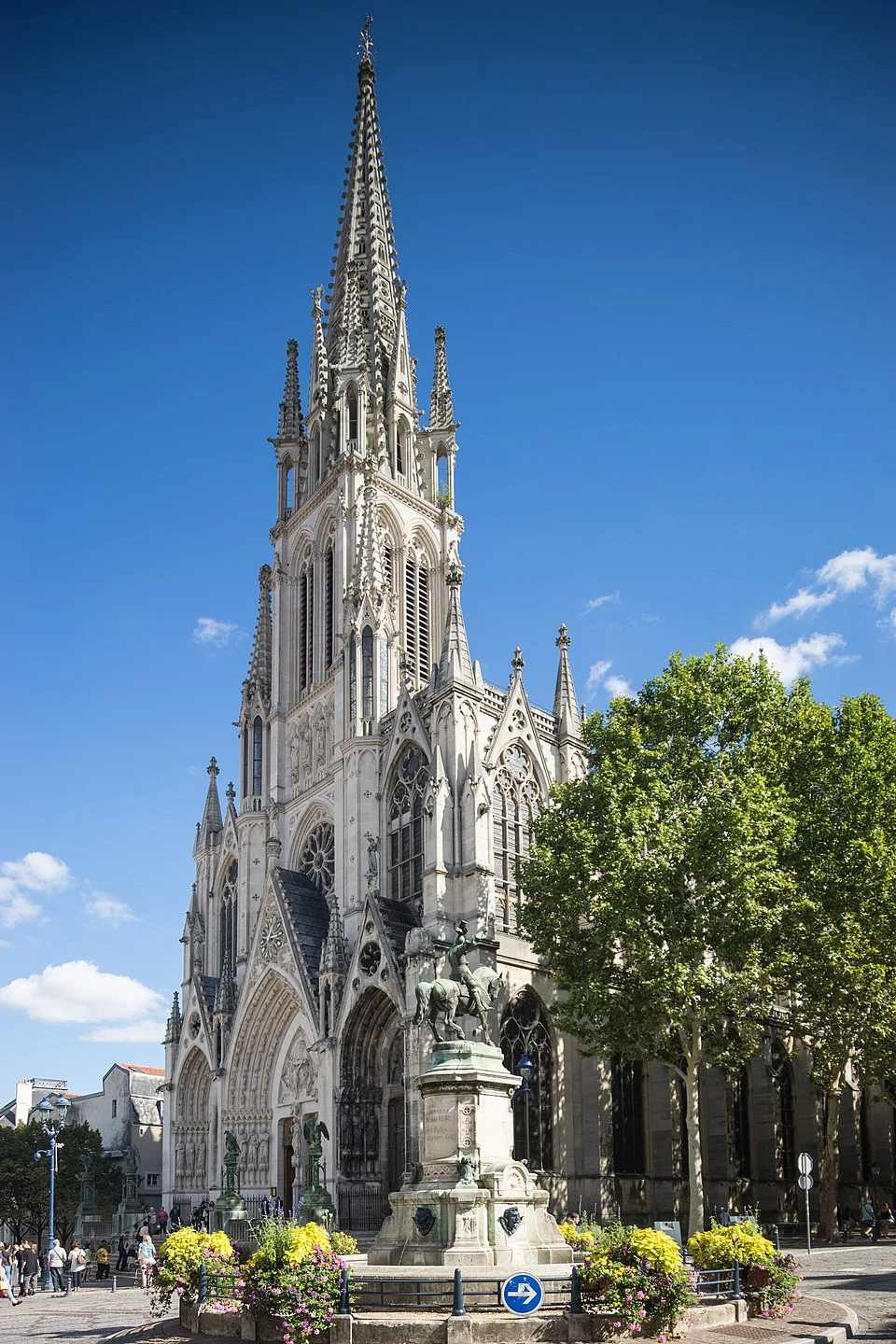
The Basilica of Saint Epvre is the heart of Nancy’s old town / Photo selected by monsieurdefrance.com: By Pedro J Pacheco — Own work, CC BY-SA 4.0, https://commons.wikimedia.org/w/index.php?curid=73191583
On this stopover, you’ll discover:
-
The secret of ‘Rue du Maure qui trompe’: the unusual medieval origin of this street’s name and what was actually depicted on its sign.
-
The remains of the “Grand 8”: how to spot what was once the city’s most famous amusement park, thanks to a heart-shaped architectural detail.
-
Nancy, the capital of brothels: why Lorraine was once the region of France with the highest number of brothels.
-
Marthe Richard, the “Widow who shut them down”: the pivotal role played by a former prostitute from Nancy in the permanent closure of France’s 1,400 brothels in 1947.
-
The Basilica of Saint-Epvre: the secrets of this monument, whose bell tower rises to a height of 87 metres, and the patron saint to whom people used to pray to avoid falls.
-
The invention of the Grande Échelle: the story of Louis Gugumus, an Alsatian patriot who took refuge in Nancy, whose ingenious invention continues to save lives all over the world.
-
The symbols of the four evangelists: a visual treasure hunt to identify the angel, the bull, the eagle and the lion at the church entrance.
5. René II the Victorious invented the Cross of Lorraine before his subjects named… America.
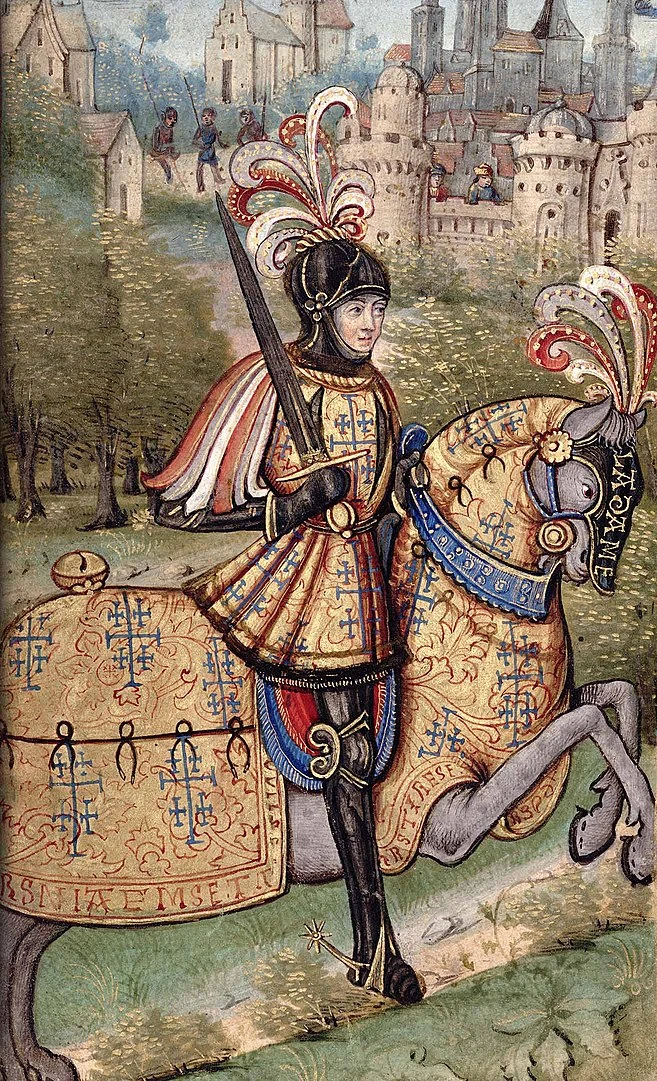
The dynasty of the Dukes of Lorraine reigned from the year 1000 to 1737. Among the most famous dukes was Duke René II, who won the Battle of Nancy on 5 January 1477. Illustration selected by Monsieurdefrance.Fr: illumination from the *Nancéide* by Pierre de Blarru, 15th century).
On Place Saint-Epvre, you’ll discover one of the most astonishing stories of the entire tour. It tells of René II, the Battle of Nancy, the Cross of Lorraine, but also of an intellectual journey that leads right to the name ‘America’. This stage demonstrates just how significant Nancy and Lorraine have been in European history, far beyond what one might imagine.
On this stopover, you’ll discover:
-
The heart of the Old Town: immerse yourself in Place Saint-Epvre, the historic and lively “hotspot” for the people of Nancy.
-
René II, the Saviour of Lorraine: the incredible story of the young duke who defeated Charles the Bold just when all seemed lost.
-
The origins of the Cross of Lorraine : how this world-famous symbol arose from a tactical decision during the Battle of Nancy in 1477.
-
The Tragic Siege of Nancy: an account of the extreme conditions endured by the inhabitants during the bitterly cold winter when the city nearly ceased to exist.
-
Why America is called America : the little-known and fascinating role played by Duke René II and scholars from Lorraine in the naming of the ‘New World’ in 1507.
-
The jewels of the ducal court: an overview of the prestigious mansions (Haussonville, Hôtel des Loups) that bear witness to the splendour of an independent state.
-
Towards the city’s mysteries: a journey towards the fortified gate to explore the dark history of the witches of Lorraine...
6. Witches and April Fools’ Day at the Porte de la Craffe
Outside the Craffe gate, the tour takes on a darker and more gripping tone. You’ll learn about the site’s former role as a prison, the great witch hunts in Lorraine, the judicial abuses of the past, but also an incredible story of escape and an April Fool’s prank that changed the destiny of the duchy. A powerful, impressive stop that leaves a lasting impression.
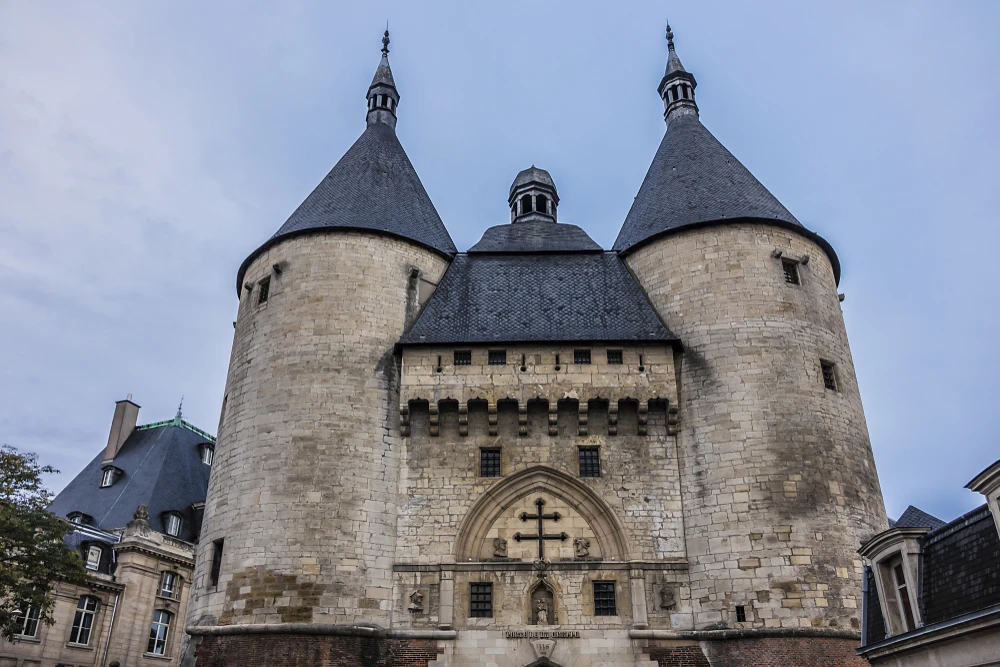
photo: Depositphotos
On this stopover, you’ll discover:
-
La Porte de la Craffe: the secrets of the oldest monument in the historic centre, a 14th-century fortress with impressive walls.
-
A ‘fashion victim’ of architecture: how successive trends, from 17th-century classicism to 19th-century pastiche, have reshaped the façade of the gate.
-
The dark witch-hunt in Lorraine: the harrowing account of Nicolas Rémy and the thousands of victims who were imprisoned and tortured in this former prison.
-
The “mark of the devil”: the interrogation methods and execution rituals that led the condemned women from the Porte de la Craffe to the stake.
-
The craziest April Fool’s Day prank in history: how, on 1 April 1634, a princely couple managed a spectacular escape thanks to an incredible blunder by the French guards.
-
The Citadel Passage: an invitation to continue your stroll towards this other remarkable 17th-century gate.
-
A stroll down the Grande Rue: a journey into Nancy’s gourmet quarter, amongst sculpted façades and the Old Town’s finest restaurants.
7. The Saint Denis of the Dukes of Lorraine and its symbols
The Cordeliers Chapel is one of the most moving and noble sites in Nancy. Here you will encounter the Dukes of Lorraine, the deeply moving recumbent effigy of Philip of Guelders, the legacy of a ruling dynasty and a whole world of symbols. It is a place of silence, beauty and historical depth, in the heart of the former ducal capital.
On this stopover, you’ll discover:
-
The Church of the Cordeliers: the private sanctuary of the Dukes of Lorraine, donated by René II to an order of mendicant monks.
-
The recumbent statue of Philip of Guelders: a masterpiece of melancholy sculpted by Ligier Richier, the “Michelangelo of Lorraine”, and its incredible rescue during the Revolution.
-
The Round Chapel: the royal mausoleum modelled on the Medici mausoleum, housing the remains of the ducal dynasty.
-
The Mystery of the Alérions: the legend of Godfrey of Bouillon and the origin of these strange birds, with neither beaks nor claws, which symbolise Lorraine.
-
The coat of arms of the Duchy of Bar: why there are two fish depicted alongside the eagles on the monument’s façade.
-
The closed crown: a powerful political symbol reminding people that the Duke of Lorraine was answerable only to God.
-
The Ducal Palace and its gargoyles: an exploration of the façade, combining Renaissance architecture with unusual sculptures, such as the astonishing ‘monk-monkey’.
8. The Dukes’ Palace and Masco the Bear, who adopted a child
Outside the Ducal Palace, the story takes on a different tone and becomes almost like a fairy tale. You’ll discover the Dukes of Lorraine in their own home, the changes the palace has undergone over the centuries, and, above all, the story of Masco, a endearing bear who saved a child during the terrible winter of 1709. It is a stop that is at once historical, heart-warming and truly memorable.
On this stopover, you’ll discover:
-
Life at the Ducal Palace: the secrets of the residence of the Dukes of Lorraine, set amongst marshes and involving unusual chores to keep the frogs quiet.
-
The Mystery of La Porterie: why this monumental gateway is the only one of its kind in France, combining Flamboyant Gothic and Renaissance styles.
-
The Palace’s eventful history: from René II’s wolf hunts to Duke Leopold’s plans to demolish it, discover what remains of this thousand-year-old monument.
-
A royal library: how, under Stanislas’s leadership, the palace became Nancy’s foremost sanctuary of learning.
-
The carved bestiary: a treasure hunt along the façade to track down the mischievous figures, including the famous monkey dressed as a monk.
-
Masco, the bear with a big heart: the moving story of the bear from Nancy who, during the terrible winter of 1709, saved a child from the cold at the risk of his own life.
-
The Great Winter of 1709: a look back at the year when wine was sold by the axe and glasses burst in the freezing cold.
9. It has been possible to build a career in Nancy for five centuries
The Place de la Carrière is not only beautiful: it also tells the story of a brilliant urban innovation. You’ll discover how a duchess decided to transform the space to host jousting tournaments and equestrian displays, giving the square its name and its current elegance. It’s an ideal stop to understand how Nancy managed to transform power into a refined setting.
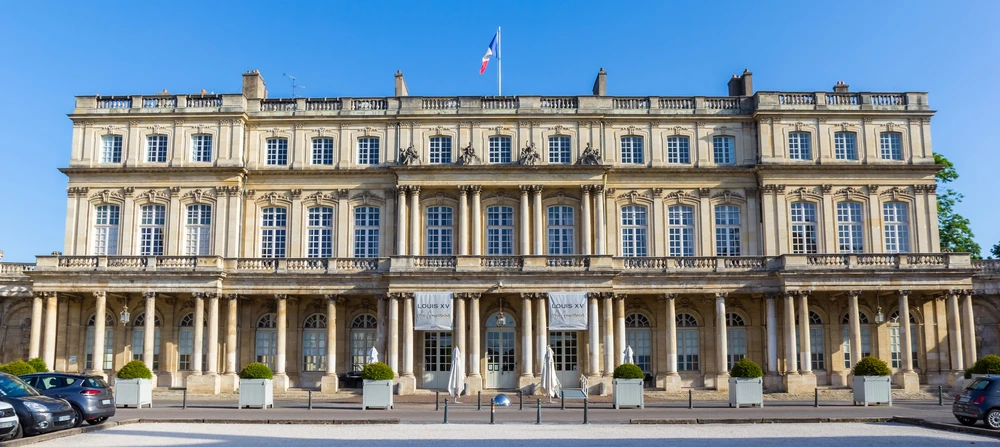
The "Palais du Gouvernement" marks the end of Place de la Carrière / Photo selected by Monsieur de France: depositphotos
10. A place brimming with ideas and a slightly mad marshal
In this second exploration of the square, you’ll discover Emmanuel Héré’s ingenuity and the art of creating beauty without having to rebuild everything from scratch. Reimagined façades, fountains, the Government Palace, mansions, busts, arcades and political memorabilia lend this stop a very French, very 18th-century charm, with a few delightful anecdotes thrown in along the way.
On this stopover, you’ll discover:
-
The origin of the name ‘Carrière’: why this square has nothing to do with a mine, but everything to do with 16th-century jousting and chivalric tournaments.
-
Christian of Denmark : the portrait of an iron-willed duchess who refused to marry King Henry VIII of England with a legendary retort.
-
Emmanuel Héré’s tip: how the king’s architect transformed a Renaissance square into an 18th-century masterpiece on a shoestring budget.
-
The Government Palace: the history of the seat of military power and a President of the Republic whose quotes are, to say the least… surprising.
-
The Hémicycle de Gaulle and its pavilions: the home of the architect Héré and the man to whom Nancy owes its status as a major university city.
-
Putti and fountains: a charming artistic detail for your photos, symbolising advances in hygiene during the Age of Enlightenment.
-
Chained enemies: the irony of the victory sculptures of a king, Stanislas, who never actually won a battle.
11. The Nursery Park: Nancy’s ‘Central Park’
After the buildings and façades, the tour moves outdoors to the Parc de la Pépinière. You’ll discover how this space evolved from a functional site into a large public garden, which has become one of the locals’ favourite spots. With its bandstand, music, remarkable trees and popular memories, this stop offers a welcome breather during the tour.
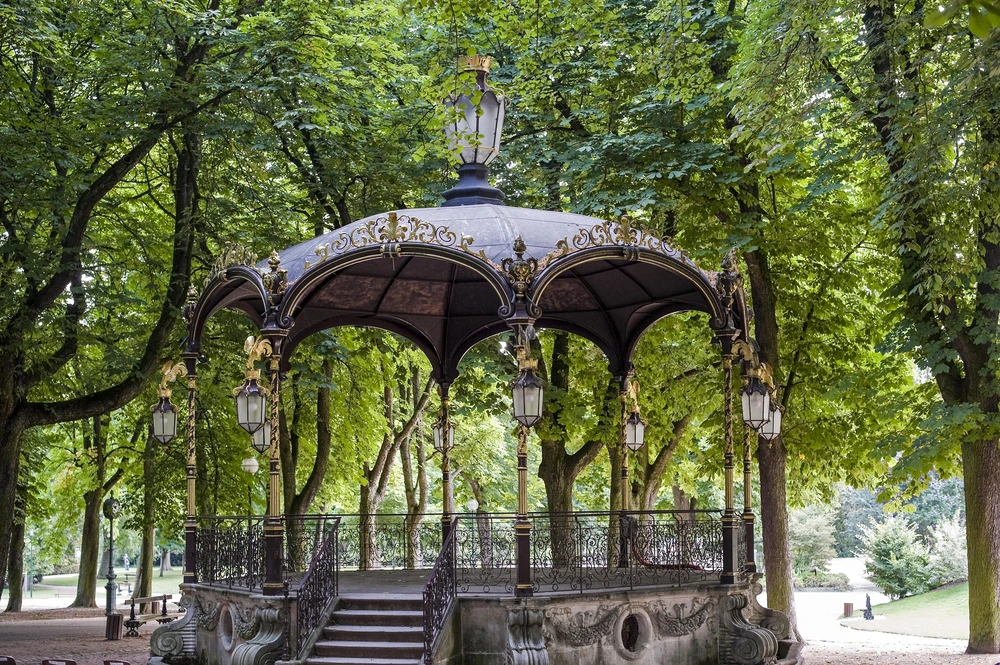
The famous “Mozart” bandstand. Not far away stands one of the few outdoor statues by Rodin (Statue of Claude Le Lorrain) Photo selected by monsieurdefrance.com: depositphotos
12. The only Rodin statue in a public park to honour a master painter
This stage brings together nature, sculpture and painting in one of the most pleasant corners of Nancy. Here you will encounter Claude Gelée, known as Le Lorrain, a great painter born in Lorraine, as well as Rodin, the sculptor behind the statue. Together, they illustrate the city’s artistic ambition, its appreciation of beauty and its deep connection with the arts.
On this stopover, you’ll discover:
-
Nancy’s “Central Park” : the history of the Pépinière, which was transformed from an unhealthy marshland into a 20-hectare garden commissioned by King Stanislas.
-
The Bandstand: the secret behind its exceptional acoustics and why it is the ultimate meeting place for lovers.
-
Claude Gellée, known as ‘Le Lorrain’: the fascinating story of an orphan who went on to become one of the greatest painters in history, admired from the Louvre to the Prado.
-
The inventor of puff pastry: how this genius from Lorraine revolutionised the world of gastronomy before turning his hand to painting.
-
An outdoor Rodin sculpture: the eventful history of the only Rodin statue on display in a public garden, funded by a lottery that caused a scandal.
-
The park’s secrets: anecdotes ranging from the ‘naughty’ past of the Pépinière’s thickets to the music festivals that bring Nancy to life today.
-
A detour to the Governor’s Garden: an expert tip for discovering an English-style haven of peace tucked away behind the palace.
13. The Héré Arch: the triumph of Louis XV, Mozart and the face of the Statue of Liberty
In front of the Héré Arch, you enter a ceremonial setting that is at once triumphal, political and spectacular. You will discover the gods, allegories and inscriptions dedicated to Louis XV, as well as very practical details, such as the appearance of pavements in Nancy. This is a pivotal stage, one that solemnly prepares you for your entry onto Place Stanislas.
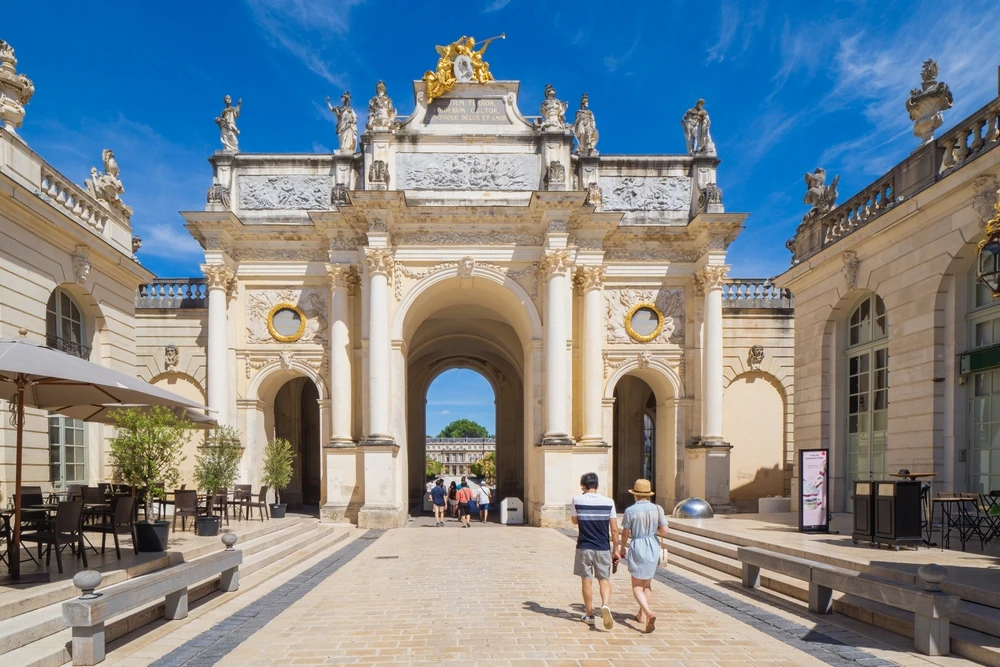
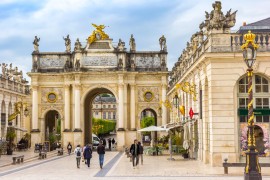
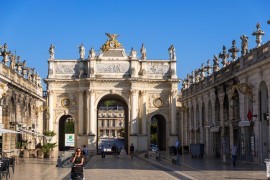
The Arc Héré closes off Place Stanislas and leads to the magnificent Place de la Carrière / Photo selected by Monsieur de France, Shutterstock
Dans cette escale, vous découvrirez :
-
The Arc Héré: the secrets of Nancy’s most majestic triumphal arch, directly inspired by a monument from ancient Rome.
-
A tribute to the “Beloved”: an analysis of the Latin inscriptions and gilded deities that celebrate the glory of King Louis XV.
-
The goddess Fama: why does Fame blow her trumpet at the top of this arch in the medieval ramparts?
-
A revolution beneath your feet: the appearance of Nancy’s very first pavements in 1755 – a radical invention that allowed people to remain elegant despite the mud.
-
In the footsteps of Mozart and Churchill: the world-famous figures who have walked these cobbled streets and the glowing tribute left by the young Mozart.
-
The Face of Liberty: the incredible love story between the sculptor Bartholdi and a milliner from Nancy who is said to have served as the model for the Statue of Liberty in New York.
14. Place Stanislas: Versailles for everyone
Place Stanislas reveals itself here as a theatre of stone and gold, open to all. More than just a square, it is Nancy’s grand salon – a place for gatherings, celebrations, shared memories and wonder. This stop provides the key to understanding why it resonates so deeply with visitors and locals alike.
On this stopover, you’ll discover:
-
Place Stanislas: why this UNESCO-listed “royal salon” is regarded as the people’s Versailles and the Acropolis of the people of Nancy.
-
Stanislas’s finger: the secret behind this historic gesture and why the sculptor had to alter the statue’s proportions.
-
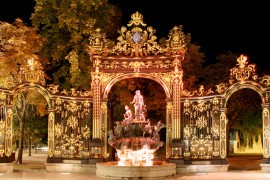
Jean Lamour’s grilles: the story behind these masterpieces of metalwork that have earned Nancy the title of the “City of Golden Gates”.
-
Marshal Lyautey’s miracle: how a dramatic fall from a balcony on the square changed a child’s destiny and gave rise to French Scouting.
-
Amphitrite and the Marquise: the hint of scandal lurking behind the monumental fountain and the cast mould of the King’s mistress.
-
The Museum of Fine Arts and the Cristal: a journey into the splendour of the Daum and Baccarat collections, symbols of Lorraine’s luxury heritage.
-
Festivities with a wine theme: a reminder of the 1755 inauguration, when wine literally flowed from the fountains in the square.
15. Place Stanislas: gold, fountains and secrets
In this stage, you’ll explore the details of the setting to better appreciate this 18th-century masterpiece. Jean Lamour, Emmanuel Héré, Barthélémy Guibal, the putti, the fountains, the pavilions, the opera house, the Museum of Fine Arts and the statue of Stanislas all come into their own. It is a subtle, vivid and fascinating exploration of Nancy’s most famous square.
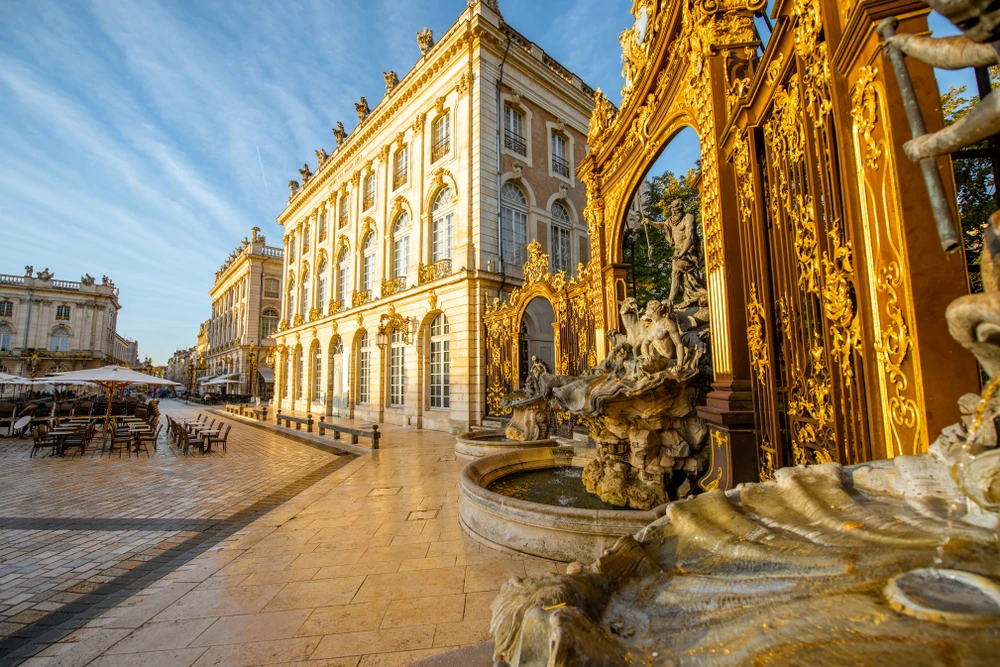
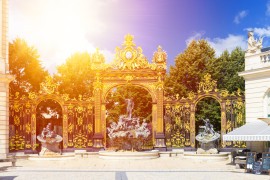
Place Stanislas in Nancy, with its golden railings bathed in the rising sun / Photo chosen by Monsieur de France: Shutterstock
16. The Town Hall and the Painter’s Revenge.
Set opposite the town hall, the tour blends official grandeur with very human anecdotes. You’ll discover the façade, the symbols of Lorraine and Stanislas, the grand salons and the allegorical paintings, as well as a surprising tale of romantic revenge hidden within a painted ceiling. A brilliant, entertaining stop that truly captures the spirit of Nancy.
On this stopover, you’ll discover:
-
The Town Hall: the secrets of the square’s largest monument, inaugurated by Stanislas amidst an incident that nearly ended in tragedy.
-
The thistle coat of arms: why Nancy chose this prickly plant as its emblem, along with a motto that leaves no one indifferent.
-
Justice and Prudence: an analysis of the monumental sculptures that watch over the clock and the city’s destiny.
-
The Grand Staircase: a masterpiece by Jean Lamour that leads to the splendour of ducal power.
-
The Revenge of the Painter Morot: the incredible and daring story hidden on the ceiling of the grand salons, where an artist chose to expose his mistress’s private life for all the people of Nancy to see.
-
Lorraine’s Polish destiny: an introduction to the twists and turns in the life of Stanislas Leszczynski, the exiled king who became the tireless builder of Nancy.
-
Expert tips: a final invitation to savour the city like a true Nancy local, on the steps of the statue or on the terrace of a café.
17. Why a King of Poland became Duke of Lorraine
The tour concludes with the extraordinary story of Stanislas Leszczynski, without whom Nancy would not be Nancy. King of Poland, father-in-law of Louis XV, philosopher, gourmet, builder and a man of destiny, he single-handedly linked Poland, France and Lorraine. This final stage gives the tour its full meaning and sheds new light on everything you have just discovered.
On this stopover, you’ll discover:
-
Louis XV’s ‘miracle’ marriage: how a royal bout of indigestion and a list of 99 princesses propelled Stanislas’s daughter onto the French throne.
-
The Incredible Life of Marie Leszczynska: from poverty in Alsace to the splendour of Versailles, the story of a queen who “darned her socks” before her coronation.
-
Stanislas, the king with a thousand lives: his incredible escapes whilst disguised as a peasant, his two reigns in Poland and his life of luxury in exile at Chambord.
-
The Secret Pact for Lorraine: how France ‘bought’ Lorraine to prevent it from becoming part of Austria, making Stanislas a transitional duke.
-
The Birth of the Madeleine: the story of the young maid from Commercy who saved the king’s dessert and gave her name to France’s most famous cake.
-
A tragic and unusual death: the story of Stanislas’s final days at the age of 89, when he fell victim to his pipe and dressing gown at Lunéville Castle.
-
The “Benevolent King”: how this foreign ruler, initially detested, became the idol of the people of Lorraine by welcoming the greatest philosophers of the Enlightenment.

The statue of Stanislas by Georges JACQUOT, which has stood in Place Stanislas in Nancy since 1831. Photo selected by monsieurdefrance.fr: inavanhateren/shutterstock
18. Nancy – there’s so much to see!
Before I go, let me remind you of what you can see in Nancy once you’ve left the historic city centre and Place Stanislas – the UNESCO World Heritage Site. You’ll see that it’s a city with plenty to offer!
Ready to explore Nancy at your own pace?
Don’t settle for a mere stroll on the surface. By downloading this audio guide, you’re choosing an immersive experience that transforms every street, every monument and every flavour into an unforgettable discovery. You’re not just buying a file, but exclusive access to a self-guided exploration, rich in secrets and emotions, designed to fit in perfectly with your schedule.
Jérôme Prod'homme Specialist in French heritage, gastronomy and tourism. Find out about all my discoveries at monsieur-de-france.com.
FAQ: Nancy Audio Guide
Can I visit Nancy with an audio guide on my phone?
Yes. This self-guided audio tour lets you explore Nancy's historic centre directly from your smartphone. There is no app to download. The tour includes 17 stops and GPS guidance to help you find your way.
What can I see in Nancy in 2 hours?
In about 2 hours, you can discover many of Nancy's essential sights, including Place Stanislas, the Old Town, Place Saint-Epvre, Porte de la Craffe, the Ducal Palace, Parc de la Pépinière, Place de la Carrière and the Arc Héré.
What is the best walking route to explore Nancy?
This audio guide provides a self-guided walking route with 17 stops through the historic centre of Nancy. GPS guidance helps you find each stop while leaving you free to pause, explore and continue the tour whenever you wish.
What will I learn on the Nancy audio tour?
The tour brings Nancy and Lorraine's history to life through its monuments, famous figures and surprising stories. You'll hear about the Dukes of Lorraine, René II and the Battle of Nancy, Joan of Arc, Stanislas, the Cross of Lorraine, local legends and Nancy's food specialities.
Can I try the Nancy audio guide for free?
Yes. You can listen to 3 stops for free before purchasing the full tour. This lets you experience the storytelling and see how the audio guide works before deciding whether to continue.
Do I need to download an app?
No. The audio guide works directly on your smartphone, with no app to install.
Can I start the Nancy audio tour whenever I want?
Yes. There is no fixed departure time. You can start whenever you like, pause the tour and explore Nancy entirely at your own pace.
Do I need to download an app to listen to the audio guide?
No, everything works directly on your phone. All you need to do is sign up and access the tour.
How much does the full tour cost?
The full tour is available for €5, with no subscription or hidden charges.
Can you listen to the tour several times?
Yes, you can listen to the audio guide as many times as you like, with no time limit.
Can we take breaks during the tour?
Yes, you can stop whenever you like, have a drink, and then carry on later or even the next day.
How long does the tour last?
The tour lasts between 1½ and 2 hours, depending on your pace.
Can two people listen together?
Yes, it’s perfectly possible for two people to listen on the same phone.
Is this a good place to visit on a first visit to Nancy?
Yes, the audio guide is ideal for exploring Nancy and getting to know its key attractions.
Discover Nancy and make the most of your stay
-
Place Stanislas: the history and secrets of Nancy’s most beautiful square
-
Art Nouveau and the École de Nancy: an architectural treasure
-